
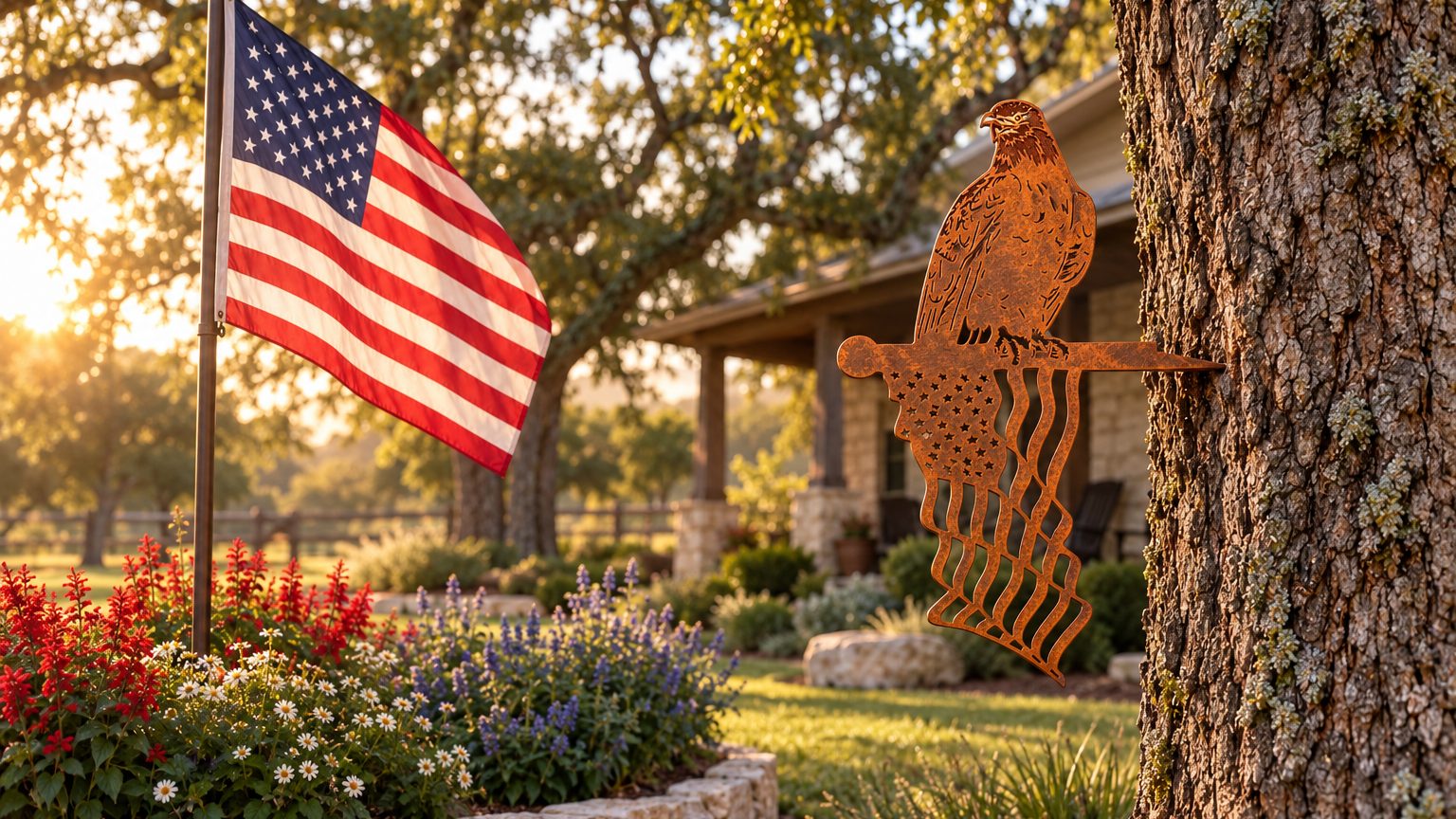
The patriotic garden decor that honors a veteran well is usually quiet. Pick one strong focal piece, fly the flag the way the Flag Code describes, plant red, white and blue flowers that can take a Texas summer, and leave a place to sit. For a veteran who has died, add a plaque and a small memorial corner.
That’s the short answer. The rest of this guide starts with the difference between Memorial Day, Veterans Day and Flag Day, because it changes what you do on each one. Then it covers flying the flag outdoors (lighting, weather and half-staff on Memorial Day), nine ideas for patriotic garden decor that stays dignified, plants that grow here, a memorial corner, the poppy, honoring a specific branch, and gifts for a veteran, living or remembered.
Memorial Day, Veterans Day and Flag Day: who each one honors
The Department of Veterans Affairs puts the difference plainly. Memorial Day is a day for remembering and honoring military personnel who died in the service of their country, while Veterans Day is the day set aside to thank and honor all those who served honorably in the military. The same VA page notes that Veterans Day is largely meant to thank living veterans for their service, and that it’s spelled without an apostrophe.
The dates are set in federal law: Memorial Day falls on the last Monday in May and Veterans Day on November 11. Veterans Day began as Armistice Day, and the VA’s history page explains that in 1954 Congress struck out the word “Armistice” and inserted the word “Veterans”.
Flag Day isn’t about people at all. June 14 is Flag Day, the anniversary of the day in 1777 when the Continental Congress adopted the Stars and Stripes.
What that means for patriotic garden decor:
- On Memorial Day, the garden is for remembrance: the half-staff flag, a poppy on the bench, a quiet minute.
- On Veterans Day, the garden is for thanks. If the veteran is still with you, invite them out to sit in it.
- On Flag Day, the garden is for the flag. Check whether yours is faded or frayed, and swap it.
A common, kindly meant mistake is thanking a living veteran for their service on Memorial Day. Some veterans will gently remind you that Memorial Day belongs to the ones who didn’t come home.
How to fly the flag in a front yard garden
If there’s a flag in your patriotic garden decor, it’s the piece people judge the rest by. The rules come from the US Flag Code, which the American Legion describes as advisory rules for display and care of the United States flag. Nobody will fine you, but following them is what makes a yard read as respectful.
At night. The Flag Code says the flag may be displayed 24 hours a day if properly illuminated during the hours of darkness. Otherwise the custom is sunrise to sunset. In a garden, that means one solar spotlight in the flagpole bed, aimed up at the flag.
In bad weather. The same section says the flag should not be displayed on days when the weather is inclement, except when an all weather flag is displayed. Either way, check it after a big spring wind.
Raising and lowering. The code asks that the flag be hoisted briskly and lowered ceremoniously. Up quickly, down slowly.
Keep it off the ground. The flag should never touch anything beneath it, such as the ground, the floor, water, or merchandise. In a planted bed, that means a pole tall enough that the flag clears the plants even when it hangs limp.
When it wears out. The code says a flag that is no longer a fitting emblem for display should be destroyed in a dignified way, preferably by burning. You don’t have to do that yourself. The American Legion’s guide to an unserviceable flags ceremony describes posts retiring faded and worn flags as a service to people who have them. Call your local post.
Half-staff on Memorial Day until noon
The Flag Code says that on Memorial Day the flag should be displayed at half-staff until noon only, then raised to the top of the staff. The morning is for the dead. The afternoon is for the living.
There’s a small ceremony to it. When you put the flag at half-staff, it should be first hoisted to the peak for an instant and then lowered to the half-staff position. And at the end of the day, the flag should be again raised to the peak before it is lowered for the day.
Memorial Day has one more marker worth knowing. Federal law sets the minute beginning at 3:00 p.m. local time on Memorial Day as the National Moment of Remembrance. If your family does one thing in the garden that afternoon, make it that: everyone outside, one minute, no speeches.
A simple Memorial Day routine for a home with a flagpole:
- At sunrise, run the flag to the top, then down to half-staff.
- At noon, raise it to the top of the pole.
- At 3:00 p.m., stop for a minute.
- At sunset, bring it down slowly, or leave it up if it’s lit.
Patriotic garden decor that stays dignified: 9 ideas
There’s a version of patriotic garden decor that tips over into a used-car lot: pinwheels, three sizes of flag, bunting on every rail. It’s well meant, but it puts the decorator ahead of the veteran. The ideas below lean the other way. Pick two or three, not all nine.
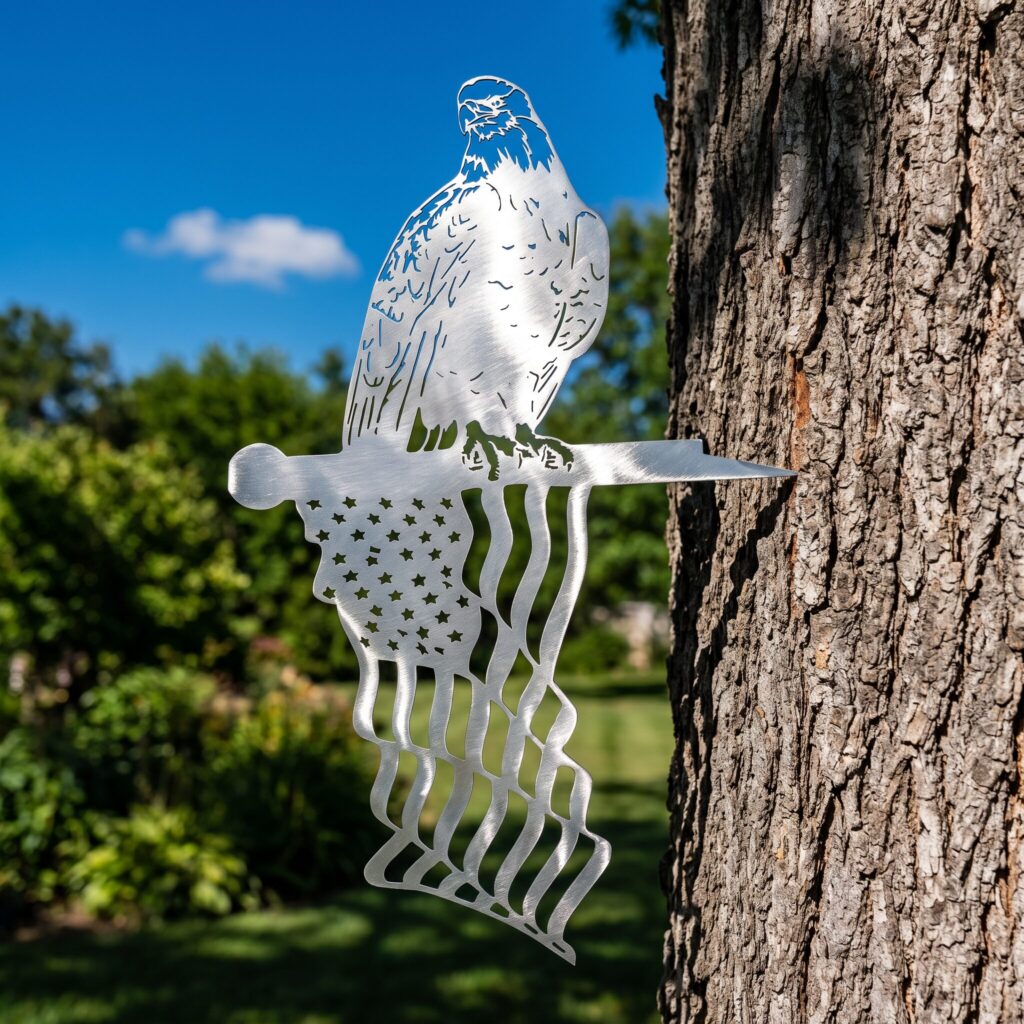
- One strong focal piece. Choose a single thing the eye goes to first. For front-yard patriotic yard art, that might be the Eagle and Flag Stake, a bald eagle and the flag in solid steel, set on the tree you see from the street. One piece, set once, reads as intention.
- A flagpole bed. Ring the base of the pole with a low bed, a few feet across, edged in stone. It frames the flag, keeps the mower away from the pole and gives you a place for the solar light.
- Red, white and blue plantings. Plant in loose drifts of one color, not a striped flag pattern. The plant list below sticks to things that grow here.
- A bench. Face it toward the flag, or toward whatever the veteran liked to look at. On Veterans Day, a bench is the whole point: a place for him or her to sit.
- A plaque or an engraved stone. Name, branch and years of service. Nothing more is needed. Set it at the edge of the bed where it can be read without stepping in the dirt.
- Light. One light on the flag, maybe one low light on the plaque. Skip the string lights.
- A poppy. A single red poppy pin tied to the bench arm on Memorial Day says what a whole display can’t. More on the poppy below.
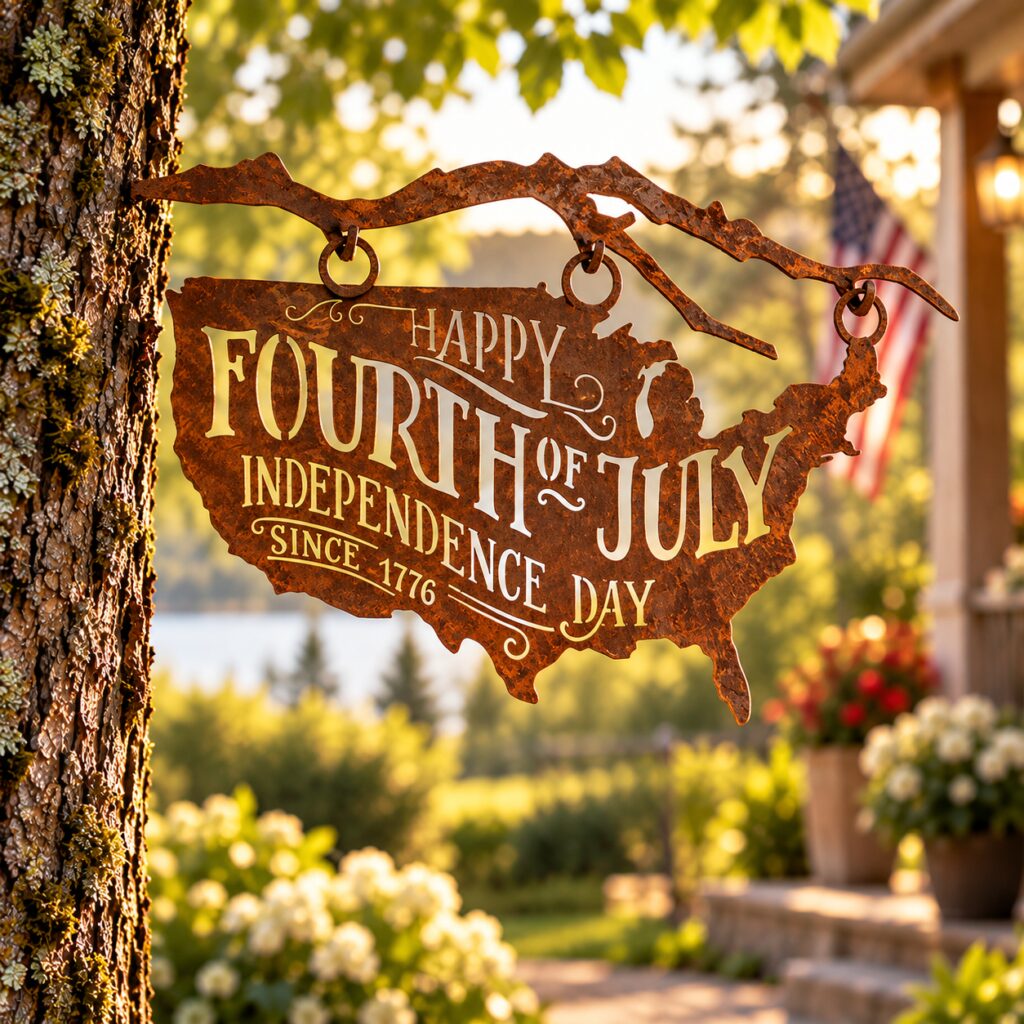
- Seasonal patriotic yard art for the Fourth. The 4th of July Stake is a USA map lettered Happy Fourth of July, hung from a cut branch. Our guide to outdoor tree decorations for every holiday covers hanging it low on the trunk, below the summer canopy.
- Room around it. Leave open ground and open bark around whatever you choose, so each piece has space to be seen.
Red, white and blue plants for patriotic garden decor in Texas
The flowers should still be blooming in August, which rules out a lot of what the big-box stores sell in May. These natives hold their color in Texas heat.
Red:
- Turk’s cap. The Lady Bird Johnson Wildflower Center lists it as native to Central Texas east to Florida, blooming May through November and preferring partially shady sites. It’s the answer for the shady side of the house.
- Autumn sage. For full sun. The Native Plant Society of Texas describes red, two-lipped, tubular flowers that bloom March through November on a low-water shrub whose natural range is west Texas. It also comes in white, so one plant gives you two colors.
- Coral honeysuckle. A vine for the fence behind the bed, not for the flagpole. The Wildflower Center calls it frequently visited by hummingbirds, with red blooms in spring.
White:
- Blackfoot daisy. A low mound of white daisies with yellow centers, blooming March through November. It wants dry, rocky, calcareous soils, and good drainage is essential, so it suits the stone edge of a flagpole bed.
Blue:
- Mealy blue sage. Full sun, low water, and blue flowers from April through October.
- Texas bluebonnet. Blue with a white tip. The Wildflower Center says to propagate by sowing seed or planting seedlings in fall, for blooms in March through May.
A planting plan that works in a small bed: autumn sage in red at the back, mealy blue sage in the middle, blackfoot daisy along the front edge, and bluebonnet seed scattered in between each fall. None of it is a flag made of petunias.
Patriotic yard art without the clichés
Patriotic yard art usually goes wrong on amount, not taste. One eagle reads as respect. Five eagles read as a sale. A few things that help patriotic yard art look settled:
- Choose steel. Our pieces are cut from 1/8-inch American Corten® steel. They’re made in the USA.
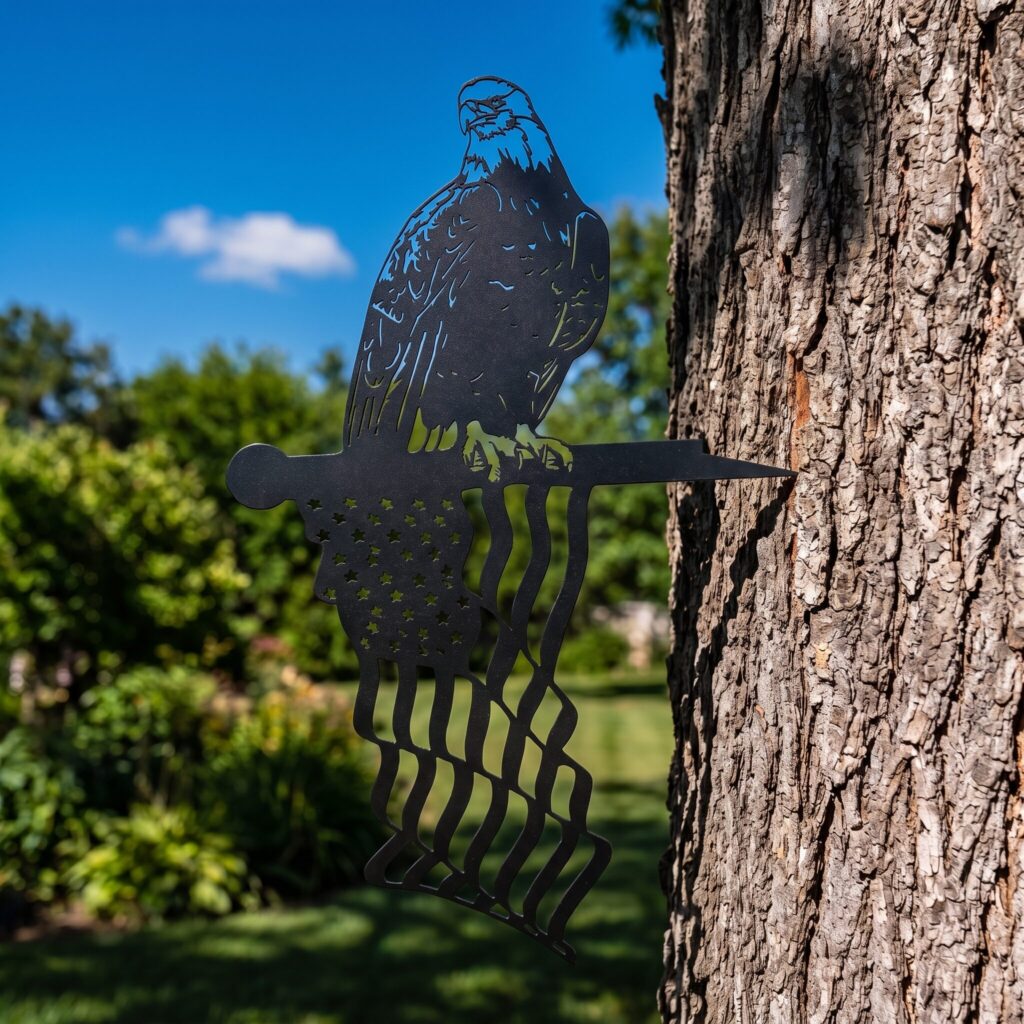
- Pick a finish that suits the yard. Raw Steel weathers outdoors, with most of the change in the first several months before it holds steady, and Black keeps a clean, consistent look. Raw Steel sits well against bark and stone. Black reads as a crisp silhouette against a white house or a pale fence.
- Set patriotic yard art where you’d fly a flag. The tree by the drive, the porch post, the post at the end of the walk. Each piece taps in with a hammer, into a tree, a wooden fence post, a porch post or a wall.
- Mind the bunting rule if you use any. The Flag Code says bunting should be arranged with the blue above, the white in the middle, and the red below. Draped any other way, a veteran will notice.
A memorial corner for a veteran who has died
A memorial corner is patriotic garden decor turned inward, made for the family, not the street. Start where you’ll see it: the corner you can see from the kitchen, the tree they planted, the spot by the shed where the tools lived. Our pillar guide to memorial garden ideas walks through choosing the spot, a focal point, plants and a seat in more detail. For a veteran, a few touches are worth adding:
- The plaque. Name, branch, years of service, and maybe one line they would have chosen. Some families add the unit or the ship.
- The flag, indoors. Eligible families can receive from the VA a United States flag to drape over a casket or coffin or place with an urn. That folded flag belongs in a case on the mantel, out of the weather. If you want a flag outside, fly an everyday one.
- A certificate. The VA also offers the Presidential Memorial Certificate, an engraved certificate signed by the current president. It belongs indoors, but its wording can shape the plaque. Eligibility rules apply.
- A bird. Some families put a cardinal near a memorial. It’s a folk belief, not a fact, that a cardinal is a visitor from someone who has died, but people hold it closely. The Cardinal Stake gives you a red bird on the trunk in every season, including the gray ones.
- A seat. Even a single chair. A memorial corner without a place to sit tends to be walked past.
On Memorial Day, put the poppy on the seat. On their birthday, or the day they enlisted, sit there for a while.
The poppy as a remembrance symbol
The red poppy is a plain, quiet remembrance symbol, and it has a specific history.
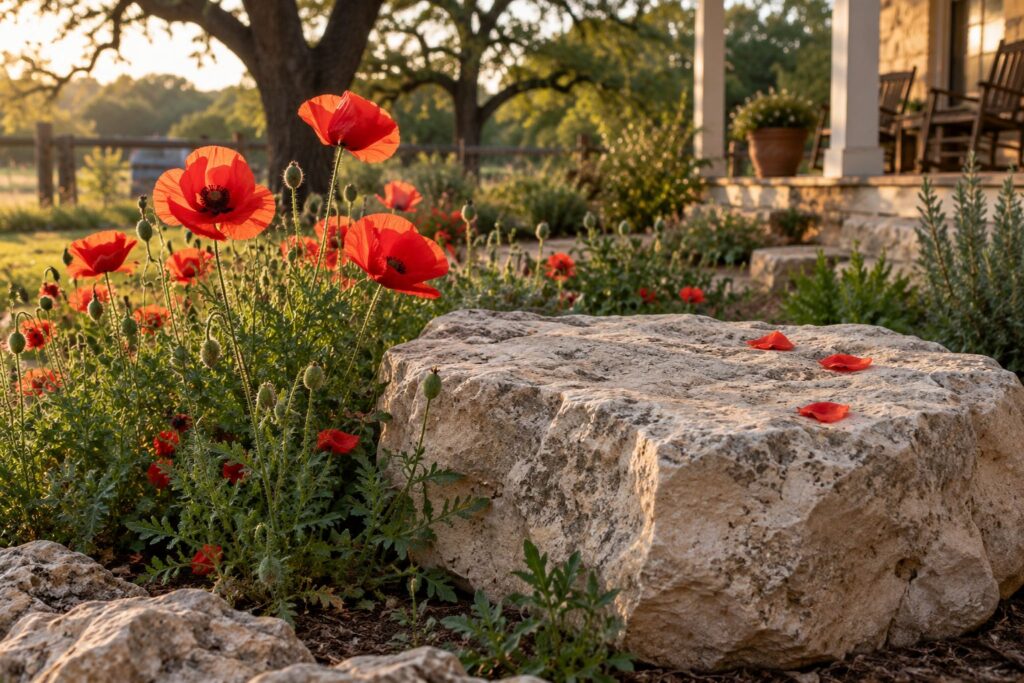
It comes from the World War I poem “In Flanders Fields,” written by Lt. Col. John Alexander McCrae while serving as a physician in the Canadian army. An American woman, Moina Michael, spent years promoting the single red poppy as a symbol of the sacrifice of United States’ veterans, and according to the American Legion Auxiliary, in 1920 the national American Legion adopted the poppy as its official symbol of remembrance.
The Auxiliary’s poppy program explains that the red poppy came to symbolize the blood shed during battle, and that wearing one on National Poppy Day, the Friday before Memorial Day, is meant to honor the fallen. So the poppy is a Memorial Day symbol, for the dead.
Ways to bring the poppy into the garden:
- A poppy pin on the bench or plaque the Friday before Memorial Day, left through the weekend.
- A painted river rock with a single red poppy at the base of the plaque.
- A line from the poem as the inscription on a memorial stone.
Honoring a specific branch
Veterans tend to be specific about the branch. A Marine was not in the Army, and will tell you so.
Know the birthday. Each service keeps its own. The Naval Postgraduate School library lists them: Army 14 June 1775, Navy 13 October 1775, Marine Corps 10 November 1775, Coast Guard 4 August 1790, Air Force 18 September 1947 and Space Force 20 December 2019. The Army’s birthday falls on Flag Day, and the Marine Corps birthday is the day before Veterans Day. A branch birthday is a good day to tend the corner.
Fly the branch flag correctly. If you add a service flag to the pole, the US flag goes on top. The Flag Code says no other flag or pennant should be placed above or, if on the same level, to the right of the flag of the United States. The same goes for a Texas flag.
Put the branch on the plaque. Branch, rank if it mattered to them, and the unit or ship. That’s the detail old friends look for.
Use the branch colors in the planting. Ask what they are, then pick from the plants above, or add a yellow native where the colors call for gold. It’s quiet patriotic garden decor that doesn’t need a second flag.
Gifts for a veteran, living or remembered
The gift that works for a veteran is usually about the place they live, not the service itself. Ask before you plan anything big; plenty of veterans would rather not have their yard turned into a monument.
For a living veteran:
- A new flag on Flag Day, with an offer to retire the old one through the local Legion post.
- A solar spotlight for the flagpole, so the flag can stay up at night.
- An afternoon of yard work. Build the flagpole bed together. Sow the bluebonnets in fall and come back in spring to see them.
- A bench, set where they like to sit.
- One piece of patriotic yard art for the tree they can see from their chair, like the Eagle and Flag Stake.
For the family of a veteran who has died:
- A piece for the memorial corner, like the Cardinal Stake or the Eagle and Flag Stake.
- Help with the plaque. Find out the branch, the unit, the years, so the family doesn’t have to.
- A poppy for Memorial Day weekend, tied to the bench or set by the plaque.
If the veteran was a father, our guide to a memorial gift for the loss of a father goes further, including the hard dates on the calendar. If it’s a gift and it isn’t right, there’s a 30-day return window from delivery; just email us first.
Patriotic yard art for a veteran’s garden
If you’re looking for a piece to anchor a bed or a memorial corner, these are the ones we’d point you to:
- Eagle and Flag Stake: a bald eagle and the flag, for the tree out front. Check the product page for its size.
- 4th of July Stake: the USA map, lettered Happy Fourth of July, for the summer.
- Cardinal Stake: a red bird for a memorial corner, in every season.
- The Birds collection: for the veteran who kept the feeders full.
- The Seasonal & Holiday collection: pieces that change with the calendar.
Most pieces run 7 to 17 inches, with exact dimensions on each product page. All of them are solid steel.

Questions customers ask
How do I install it?
Find your spot, then tap the stake in with a hammer. If the wood is hard, drill a small pilot hole first. It works in a tree, a wooden fence post, a porch post or a wall.
Will the Raw Steel finish rust?
It weathers outdoors on purpose. Most of the change happens in the first several months, then it holds steady. If you’d rather have a clean, consistent look, choose Black.
Will it arrive in time for Memorial Day or Veterans Day?
Orders are processed in 1 to 2 business days, and delivery takes 5 to 7 business days after that, US only. Order a couple of weeks ahead of the date.
What’s your shipping policy?
Free shipping on orders of $99.99 and up.
Sources
- Veterans Day Facts and Information, US Department of Veterans Affairs
- History of Veterans Day, U.S. Department of Veterans Affairs
- VA Memorial Items, U.S. Department of Veterans Affairs
- 5 U.S. Code § 6103, Holidays, Cornell LII
- 36 U.S. Code § 110, Flag Day, Cornell LII
- 36 U.S. Code § 116, Memorial Day, Cornell LII
- 4 U.S. Code § 6, Flag Code, Cornell LII
- 4 U.S. Code § 7, Flag Code, Cornell LII
- 4 U.S. Code § 8, Flag Code, Cornell LII
- Flag, The American Legion
- Unserviceable Flags Ceremony, The American Legion
- Moina Michael: The Poppy Lady, American Legion Auxiliary, 21 May 2021
- ALA Poppy Program, American Legion Auxiliary
- Military History & Leadership guide, Naval Postgraduate School library
- Malvaviscus arboreus var. drummondii (Turk’s cap), Lady Bird Johnson Wildflower Center
- Lonicera sempervirens (Coral honeysuckle), Lady Bird Johnson Wildflower Center
- Melampodium leucanthum (Blackfoot daisy), Lady Bird Johnson Wildflower Center
- Salvia farinacea (Mealy blue sage), Lady Bird Johnson Wildflower Center
- Lupinus texensis (Texas bluebonnet), Lady Bird Johnson Wildflower Center
- Salvia greggii (Autumn sage), Native Plant Society of Texas