
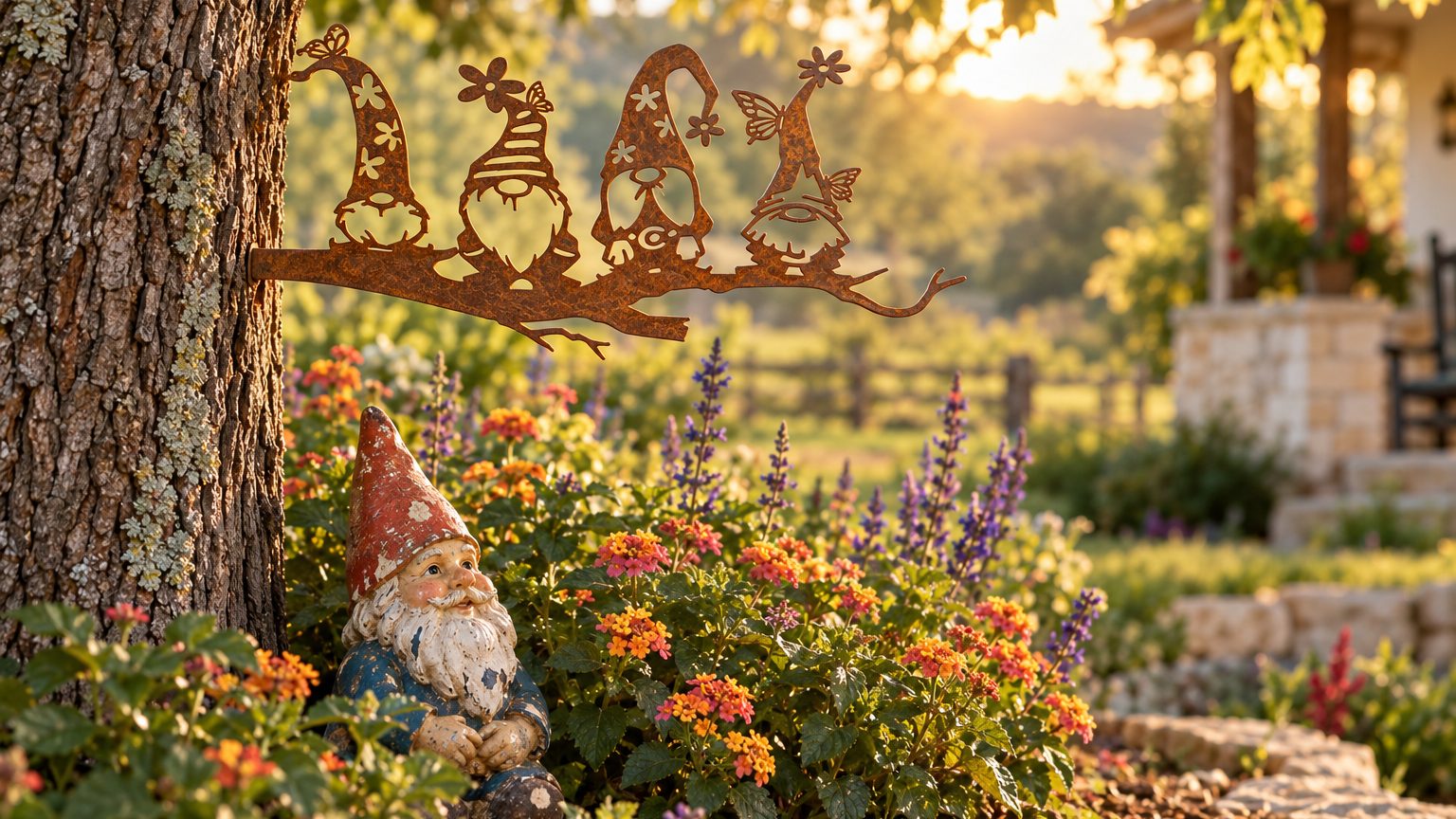
The garden gnome meaning starts in folklore about small earth spirits who guarded treasure hidden underground. In the garden, that spirit became a watchman, believed to ward off evil and help plants grow at night. Today most people put a garden gnome out for luck, for a laugh, or for the memory of a grandparent’s yard.
That’s the short answer. The longer one runs through ten questions that come up about garden gnomes: where the idea came from, the potter in a German village who made them for gardens, the English baronet who brought them home, the flower show that kept them out for a century, and the prank that sends them traveling. Then the practical part: where a garden gnome looks right in a yard, and why some of ours hang in a tree instead of standing in the flower bed.
Where does the garden gnome meaning come from?
Long before anyone set one beside the birdbath, the gnome was an idea about the ground itself. Britannica describes the gnome of folklore as a dwarfish, subterranean goblin or earth spirit who guards mines of precious treasures hidden in the earth.
The word came later. The Swiss alchemist Paracelsus popularized the term in the 16th century. He used the Latin gnomus for elemental beings of the earth, which he also called pigmaei, and his gnomes were described as capable of moving through solid earth as fish move through water.
Where Paracelsus got the word is less settled. The Online Etymology Dictionary mentions a possible Greek root meaning “earth-dweller,” while marking that form as unattested, which is a scholar’s way of saying nobody has found it written down.
So the first garden gnome meaning had very little to do with gardens. A gnome was a creature of stone, mines and buried wealth: small, old, a bit secretive, and happiest left alone. The pointed red hat came along later. By the early 1800s, English children’s books were using the word for the red-capped dwarfs of German and Swiss folklore, and that’s the figure most of us picture now.
What were gnomes believed to do in the garden?
Once the gnome came up out of the ground, he picked up a job. The Garden Museum in London puts it plainly: gnomes were believed to ward off evil and to help plants grow during the night. That’s why so many garden gnomes carry a spade, a fork, a wheelbarrow or a trug, the working tools of rural life.
The Farmers’ Almanac describes gnome folklore in the same spirit, with gnomes holding protective powers to aid nature and make gardens or farms more productive. In some of the old stories the statues come to life at night to do their garden chores, their good deeds, or now and then a naughty trick.
Put together, the old beliefs give a garden gnome three jobs:
- Guarding the garden. Keeping out whatever might spoil it, the way the Garden Museum’s gnomes were believed to ward off evil.
- Helping plants grow. Working the beds after dark, since gnomes were thought to help plants grow during the night.
- Watching over the home. In the farm versions of the story, the gnome lives in the barn or under the house and protects the farm, so long as he’s treated with respect.
Nobody has to believe any of it to enjoy a garden gnome. But it explains the posture. A good gnome looks like he’s on duty: standing at the edge of the bed, leaning on a shovel, keeping one eye on the gate.
Who made the first garden gnomes?
The garden gnome as most of us know it, a small fired-clay figure with a beard and a pointed hat, comes out of central Germany in the 19th century. National Geographic reports that a gnome-making trade had grown up around Dresden by the 1840s, and later around Gräfenroda in Thuringia.
The name most tied to it is Philipp Griebel. Mental Floss tells how Griebel, a sculptor and potter, began with ceramic animal figures, then turned to small, pointy-hatted gnomes for gardens, inspired by the gnome myths of his home in Gräfenroda. The Farmers’ Almanac credits Griebel with making sculpted gnomes popular in the mid-1800s.
There’s a reason the idea took hold in that part of the world. National Geographic links the classic garden gnome to the folkloric dwarves said to have worked in the mines. Bring that old miner up into the vegetable patch and he’s still a worker. He’s just traded the pick for a spade.
It’s worth pausing on how ordinary those first garden gnomes were. They weren’t fine art or museum pieces. They were village-made clay figures, sold to people who wanted a little life in the garden, and that’s still more or less the whole idea.
How did garden gnomes get to England?
By way of one Victorian gentleman and his rockery. National Geographic reports that Sir Charles Isham, 10th Baronet, imported 21 gnomes in 1847 and used them in an alpine rockery at Lamport Hall in Northamptonshire.
The rockery was the real project. Lamport Hall’s own history says Sir Charles began work on it in 1847 and built it right up against the Hall, so he could see it from his bedroom window. It stands about 24 feet high and 90 feet long, made to look like a miniature world, with crevices, caves and dwarf trees. Gnomes were the obvious residents.
The dates don’t all agree, which is worth knowing before you tell the story at a cookout. Lamport Hall’s page says he populated the rockery with gnomes around 1874, the Online Etymology Dictionary dates the first garden figurines in England to the late 1860s, and National Geographic and Atlas Obscura both give 1847. Lamport itself calls Isham’s figures the world’s first garden gnomes, and it signs off that line with an exclamation point.
Not everyone at Lamport loved them. After Sir Charles died, most of the gnomes were lost, and the legend Lamport tells has his daughters shooting at them with air rifles. One survived because, as National Geographic tells it, he was hidden in the shrubbery.
That one is Lampy. Atlas Obscura calls him the oldest garden gnome in the world, and he was insured for a million pounds in 1997. You can still see him inside the Hall today: a small clay man who outlived a family that didn’t care for him and a good many changes in taste.

Are tomte and nisse the same as garden gnomes?
They’re cousins of the garden gnome, more or less. In Sweden the tomte, and in Norway and Denmark the nisse, is a small, wrinkled, bearded farm spirit, often pictured in a red cap, who keeps watch over the farm.
He also expects to be paid. The Farmers’ Almanac notes that families would leave a bowl of porridge with butter at the barn door on Christmas Eve, and that skipping it, or being rude to him, was said to bring bad luck such as cattle illness, accidents or lost milk.
So the Scandinavian gnome is less a gardener and more a household guardian, the one who looks after the home through the long dark months. That’s where the Christmas gnome on so many mantels comes from, and it’s a long enough story to deserve its own article come December.
Why did the Chelsea Flower Show ban garden gnomes?
For most of its history, the Royal Horticultural Society’s Chelsea Flower Show kept garden gnomes off the grounds. ITV News reported that the Chelsea rules forbid the use of coloured sculptures, and a painted garden gnome is about as coloured as a sculpture gets.
Gnome lovers took it personally. The Christian Science Monitor reported that for decades protesters in fancy dress stood outside the gates on opening day. In 2009 the herb grower Jekka McVicar slipped a gnome named Borage into her display, and when officials ordered him out, she said she would cover him with foliage instead.
In 2013 the show turned 100, and the RHS relented. The ban was lifted for the first time in the show’s 100-year history, for that year only. Celebrities and artists decorated gnomes that were auctioned to raise money for the RHS Campaign for School Gardening. Then, as National Geographic put it, the show went back to being a gnome-free zone.
There’s something in that story for the rest of us. A garden gnome was never made for the judges. It was made for the person out with the hose in the evening, and for whoever comes up the walk after.
What is the traveling gnome prank?
It’s the one where a garden gnome disappears from a front yard and starts sending home snapshots. Someone borrows the gnome, takes him on vacation, photographs him in front of famous places, and eventually brings him back with the evidence.
Mental Floss dates the first documented case to the mid-1980s, with an Australian family’s gnome, and credits the 2001 film Amélie and the Travelocity Roaming Gnome with spreading the prank.
One well-reported trip belonged to Murphy, a gnome from Gloucester, England. The Scotsman reported that he turned up on his owner’s doorstep seven months after he disappeared, with an album of 48 photographs taken at 12 far-flung locations. The note blamed his absence on “itchy feet”. His owner said his feet were missing, which was no surprise given that he’d been sent abseiling down a mountain.
If you’re tempted to send a garden gnome traveling, a few ground rules: ask the owner’s family first, bring him back in one piece, and don’t take a gnome that belonged to someone who’s passed. A prank that ends with a missing gnome is just a theft with a theme.
So why do people have garden gnomes today?
Very few people put a garden gnome out because they think it will weed the beds at night. The garden gnome meaning has drifted from magic to something more human, and the reasons tend to overlap.
- Humor. A gnome is a garden that doesn’t take itself too seriously. After a season of weeding and watering, a small bearded man with a wheelbarrow is a way of saying this is supposed to be fun.
- Luck. Plenty of people keep one for luck, the way some folks hang a horseshoe over the barn door. It’s a folk belief, not a promise, and that’s part of the charm.
- Nostalgia. For a lot of us, the first garden gnome we ever saw stood in a grandparent’s flower bed. Putting one out is a way of bringing that yard along.
- Company. A gnome by the back step is someone to nod at on the way to the mailbox. Small things like that add up.
- A little stage. A garden is a bit of theater, and gnomes give it a cast.
That last one has a long history. In 18th-century England, some estates hired a live ornamental hermit to sit in the garden for effect, a fashion that peaked roughly between 1727 and 1830. One history of the practice that Smithsonian Magazine cites is titled The Hermit in the Garden: From Imperial Rome to Ornamental Gnome, which tells you where the job ended up. Sir Charles Isham’s rockery was a stage too, built to be a miniature world he could look at from his window. A garden gnome in your yard is the same idea at a friendlier size.
Where should you put a garden gnome in your yard?
The old jobs are a good guide. A guard goes where he can see who’s coming, a gardener goes where the work is, and a house spirit stays close to the door.
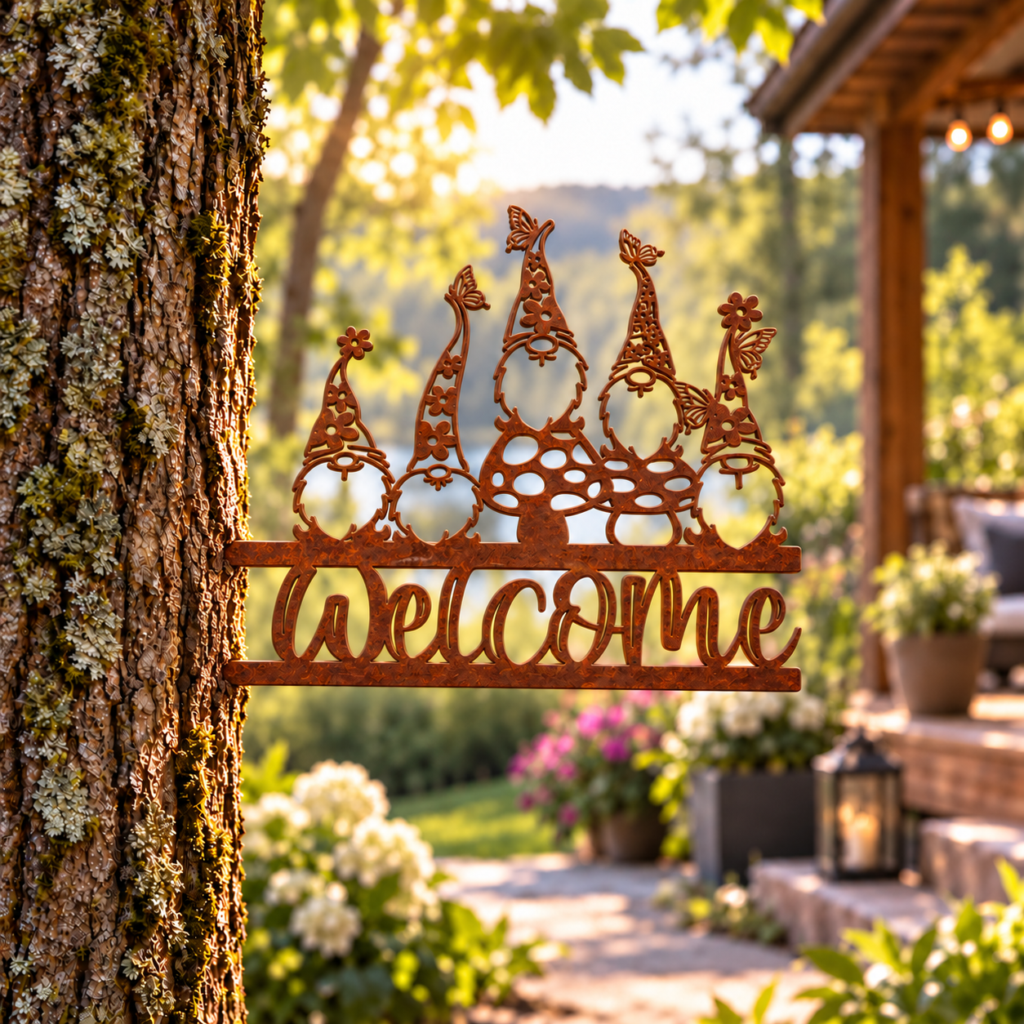
- By the gate or the front walk. This is the watchman’s post. A gnome with a welcome sign belongs here, where people read it on the way in.
- At the edge of a flower bed, half-hidden. A garden gnome reads well when you come across him. Let a fern or a salvia lean over him a little.
- Under a big tree. Gnomes were earth spirits first, and the base of an old oak or pecan suits them.
- Beside the vegetable patch. That’s the garden gnome’s original posting in the stories, the place where he was believed to help plants grow during the night.
- Near the back door or the porch step. Close to the house, for the watching-over-the-home part of the job.
A few things to keep in mind once you’ve picked the spot:
- Face him toward the house. You want to see his face from the kitchen window, not the back of his hat.
- Think about scale. A tiny gnome disappears in a big bed, and a big one can crowd a small porch. Hold it up before you commit.
- Mind the mower. A gnome in open lawn gets knocked over, hidden by the grass, or clipped by the string trimmer.
- Look again in July. A bed that’s open in March can be a wall of leaves by midsummer. Pick a spot that still shows in both seasons.
- Don’t overdo it. One good garden gnome, or a small group, reads clearly. A dozen scattered across the yard turns into clutter.
Can a garden gnome hang in a tree instead of sitting on the ground?
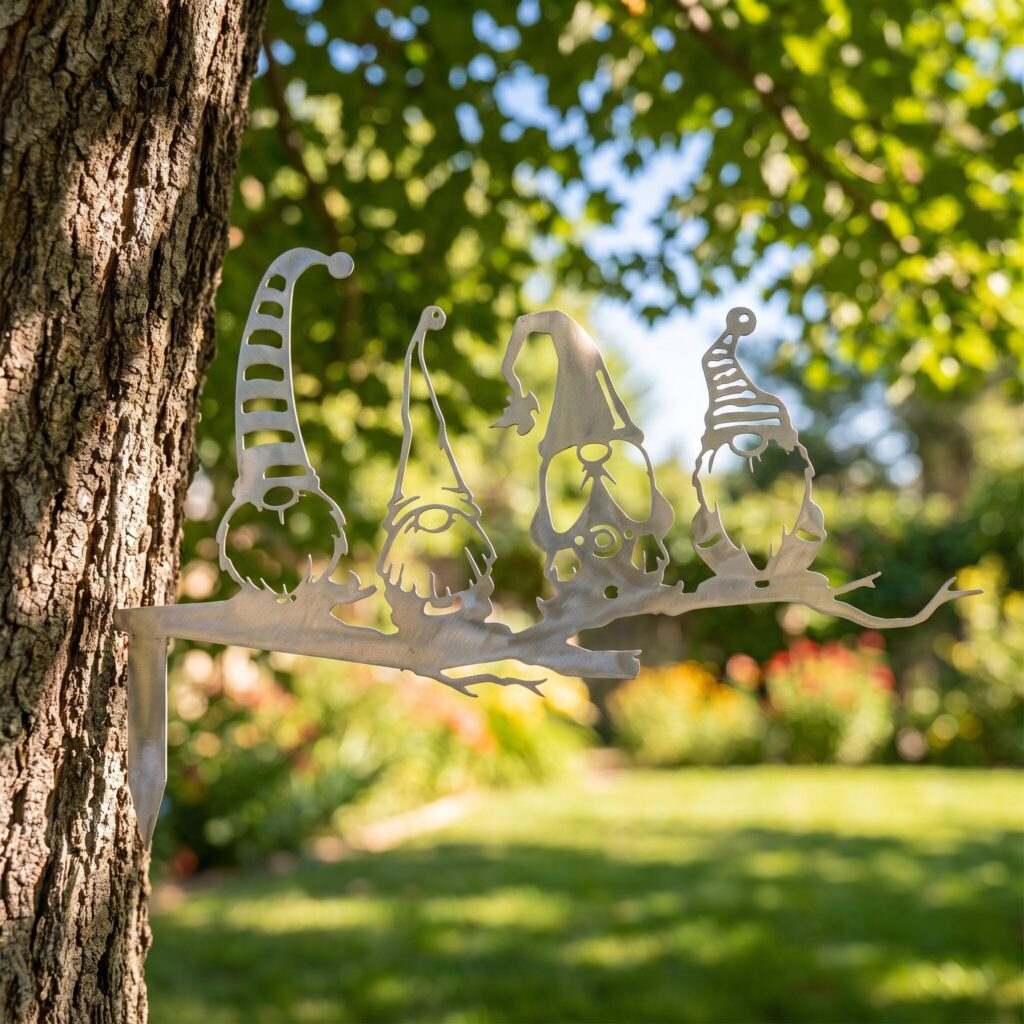
It can, and it solves most of the problems in that last list. A garden gnome on the ground gets mowed around, tipped by the dog and lost in the grass by June. One that hangs on a tree trunk or a fence post stays where you put it, up where you can see it from the window.
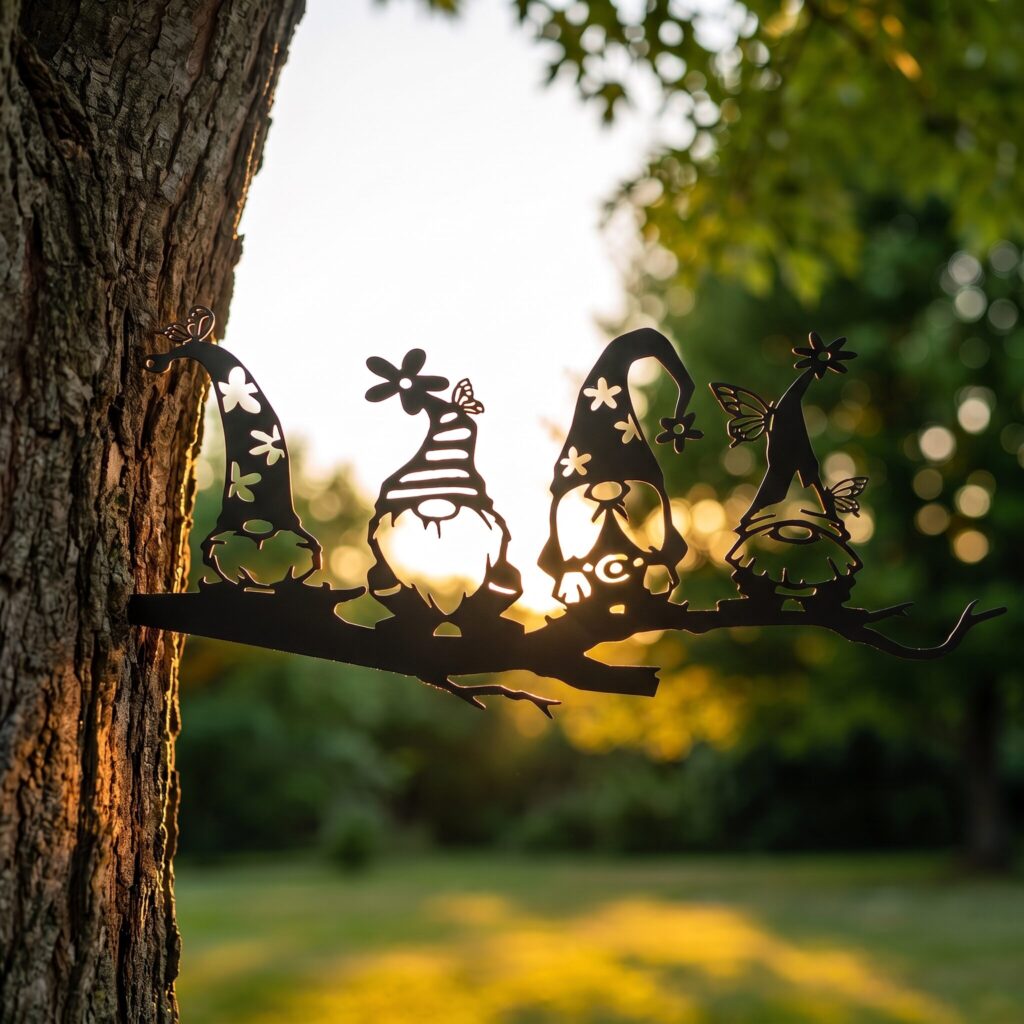
That’s how ours work. Each piece is a solid steel silhouette that taps into a tree, a wooden fence post, a porch post or a wall with a hammer, and if the wood is hard, you drill a small pilot hole first. None of them go into the ground. A silhouette reads clearly at eye level, especially with light behind it, so a trunk that catches the evening sun is a good home.
If you’re wondering what a stake does to the tree, our guide on whether a metal tree stake will hurt your tree goes through it: choose a sound, mature tree, set it once, and leave it.
On finish, the choice is about the look you want. Raw Steel weathers outdoors, with most of the change in the first several months before it holds steady, and Black keeps a clean, consistent look. A weathered gnome looks like he’s been on duty for years. A black one reads as a crisp shadow against the bark.
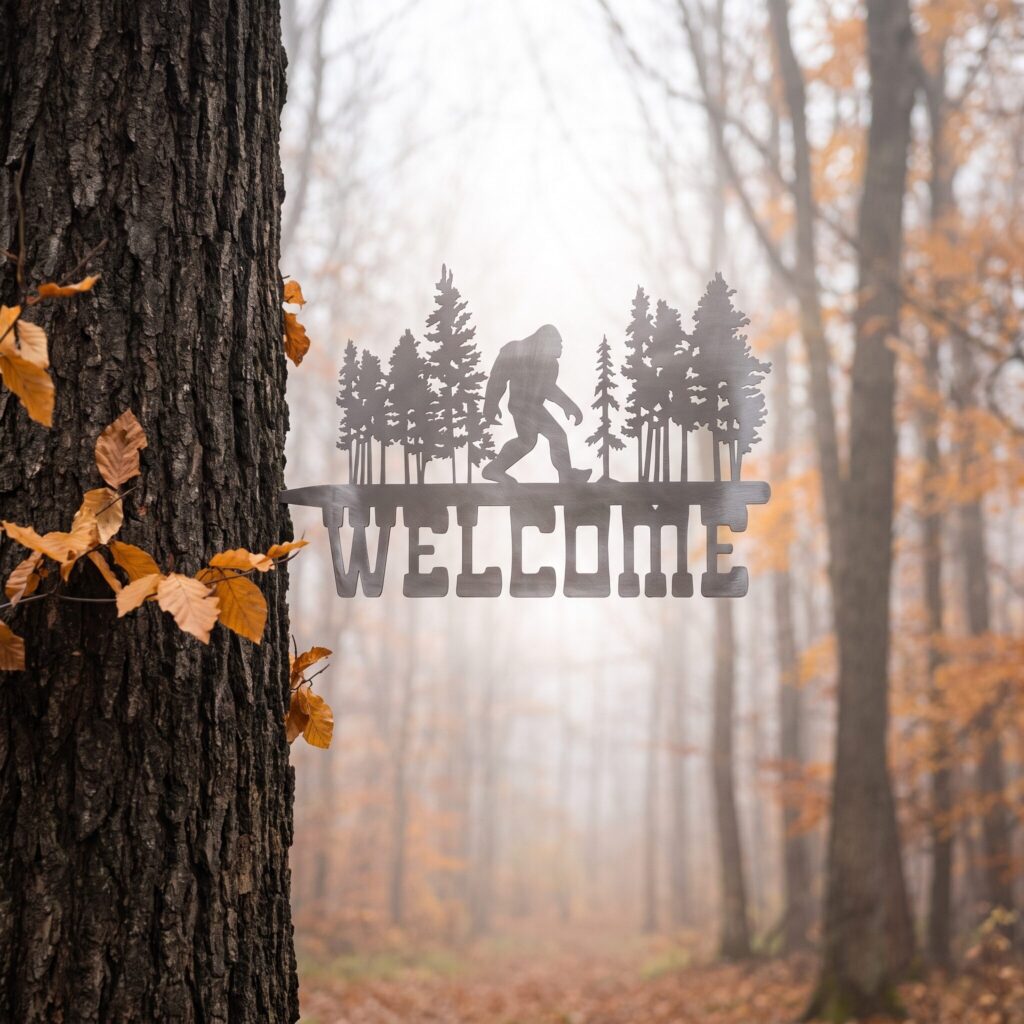
Garden gnomes in steel, for the tree, the post or the gate
If the history has you thinking about a gnome of your own, these are the pieces we make for it. Most run between 7 and 17 inches, and each product page lists the exact size, so you can hold a tape measure up to the trunk before you choose.
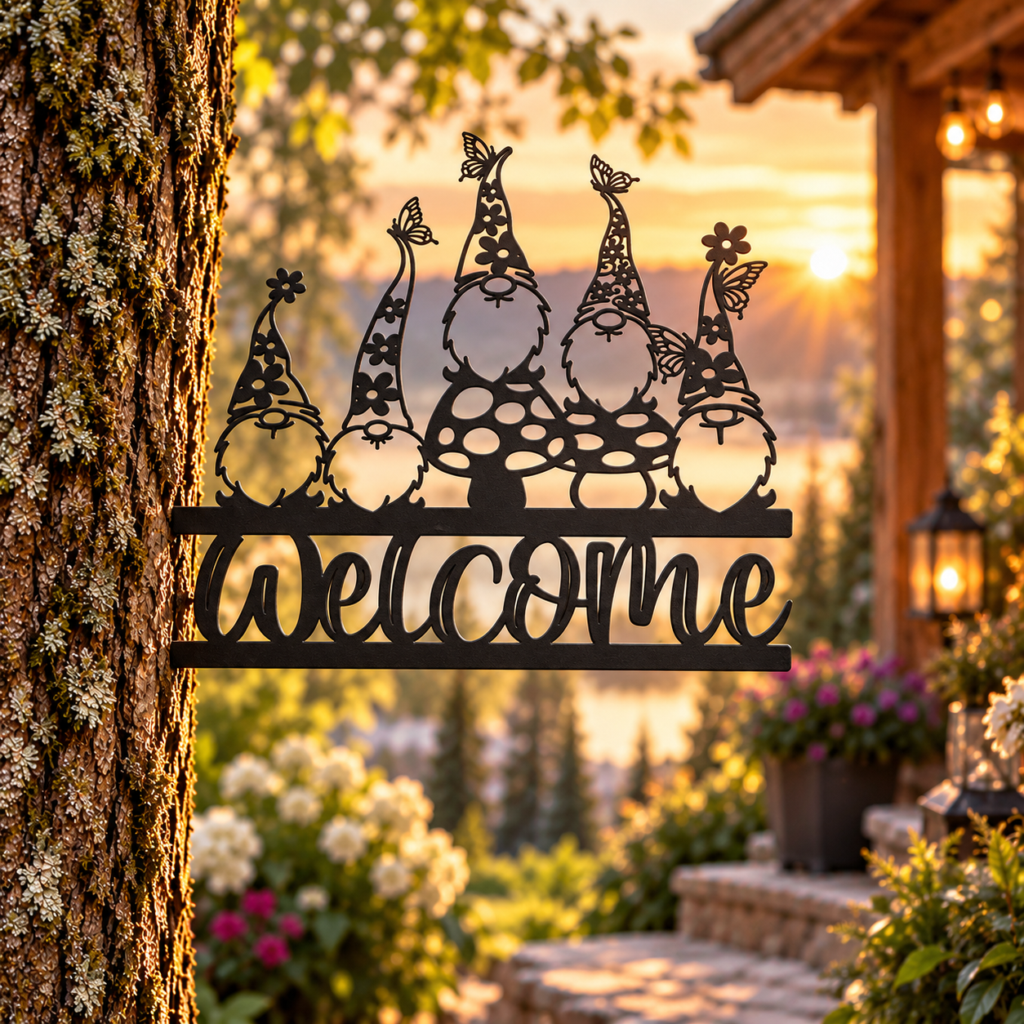
- For the gate or the front door: the Gnome Welcome Sign Stake has five gnomes, a toadstool and the word Welcome. It’s the watchman’s job, done in steel.
- For a trunk beside the flower bed: the 4 Gnomes Stake puts a small crew where you’ll see them from the patio.
- For a tree you look at every day: the 4 Whimsical Gnomes Tree Stake is made to sit up in a tree, out of reach of the mower.
- For a yard that’s all woods and no flower beds: Welcome Bigfoot is a cousin by temperament, if not by folklore.
The whole Garden Folk collection is the place to browse them side by side. If you’re shopping for someone who already has a garden gnome or two, our garden gift ideas cover gnome lovers along with the rest of the gardeners in your life. And if you’d like the tree to change with the calendar, outdoor tree decorations for every holiday picks up where the gnomes leave off.
Questions customers ask
How do I install it?
Find your spot, then tap the stake in with a hammer. If the wood is hard, drill a small pilot hole first.
Will the Raw Steel finish rust?
It weathers on purpose. Raw Steel changes color outdoors, mostly in the first several months, then holds steady. If you’d rather keep a clean, consistent look, choose Black.
Will it arrive in time for a holiday gift?
A lot of these are bought as gifts, so order early during Christmas, Valentine’s Day and other peak weeks. Orders are processed in 1 to 2 business days and arrive 5 to 7 business days after that, within the US.
What’s your shipping policy?
Shipping is free on orders of $99.99 and up.
Sources
- gnome, Encyclopedia Britannica
- gnome (n.1), Online Etymology Dictionary
- Gnome with Spade (c. 1960), Garden Museum, London
- Folklore and History of the Garden Gnome and Christmas Gnome (Tomte, Nisse, and More), Farmers’ Almanac (Melissa Mayntz, 15 December 2022, updated 20 July 2026)
- A Brief History of Garden Gnomes, Mental Floss (Linda Rodriguez McRobbie, 21 March 2011)
- There’s a Gnome at the Bottom of Your Garden, National Geographic (Roff Smith, 23 May 2013)
- The Gardens, Lamport Hall
- Lampy the Garden Gnome, Atlas Obscura
- Gnomes at Chelsea Flower Show, ITV News London (20 May 2013)
- Chelsea Flower Show includes gnomes this year, The Christian Science Monitor (Lynn Hunt, 21 May 2013)
- Home at last, Murphy the garden gnome who conquered the world, The Scotsman (11 August 2008)
- Ornamental Hermits Were 18th-Century England’s Must-Have Garden Accessory, Smithsonian Magazine (Shoshi Parks, 7 July 2023)