
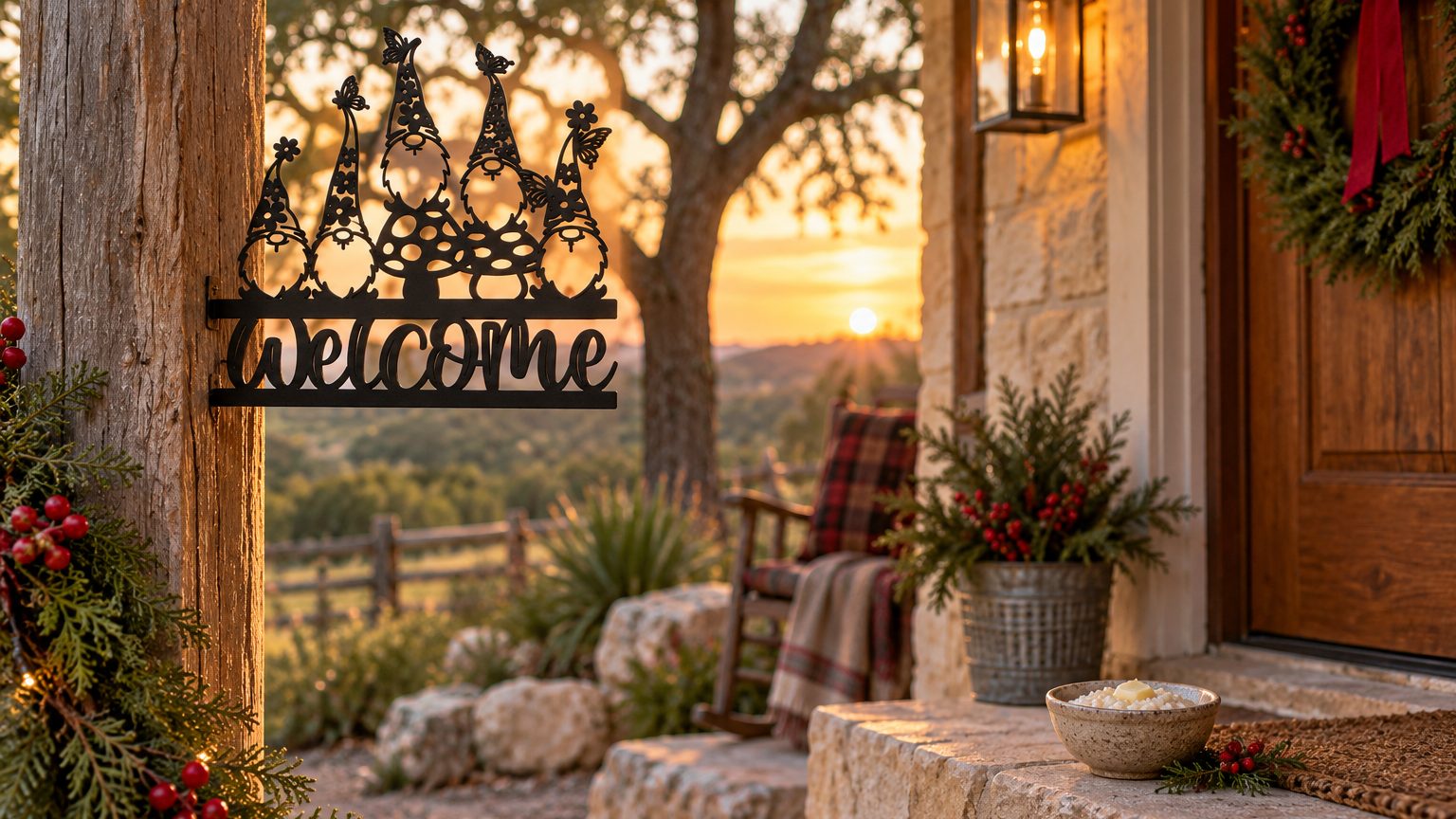
Christmas gnomes come from the Swedish tomte and the Norwegian and Danish nisse, small bearded spirits said to live in the barn or under the house and protect the farm. Families paid them in Christmas Eve porridge. Today a Christmas gnome stands for a well-kept home, a cozy winter and a little luck.
That’s the short answer. The longer one runs through twelve questions: who these farm spirits were, why the porridge mattered, how a cranky barn spirit ended up delivering presents, the poet and the illustrator who gave him his face, and how the tall-hat, all-beard gnome reached American porches. Then the practical part: where Christmas gnomes look right outside, and how to give one. For the older story of the clay garden gnome, see our piece on garden gnome meaning.
Where do Christmas gnomes come from?
They come from the farm, long before they came from the store. In Swedish folklore the tomte, and in Norway and Denmark the nisse, was pictured as a small wrinkled bearded farm spirit, often in a red cap.
The Swedish name says a good deal about the job. Europeana explains that tomte comes from tomt, a plot of land, so the word means something like “homestead man”. He belonged to the place.
In Norway, the nisse took over an older role. The Norwegian encyclopedia Store norske leksikon says that in Norwegian tradition the nisse replaced the gardvord, a house spirit who watched over the farm. The same entry notes that the name nisse is a short form of Nils, a Nordic form of Nikolaus, which turns out to matter later, when Christmas gets involved.
None of this began as a holiday story. The tomte and nisse were working spirits, tied to the barn, the animals and the long dark of a northern winter. Christmas was simply the night of the year when people made a point of thanking them.
Tomte and nisse: are they the same thing?
Close enough that people use the names interchangeably. The Farmers’ Almanac describes the nisse as having the same role as the tomte, with slightly different regional variations. A North Dakota State Museum post puts it the same way: Swedes and Norwegians had similar stories of a small creature with a long white beard and a brightly colored conical cap living in the storehouse on a farm.
A few of the names you’ll run into:
- Tomte, plural tomtar, in Sweden.
- Nisse, plural nisser, in Norway and Denmark.
- Fjøsnisse in Norway, the one who lives in the barn. Visit Norway explains that fjøs means barn.
- Jultomte and julenisse, the Christmas versions, which we’ll come to.
They also shared a temper. The Local describes the Swedish tomte as usually thought to be an angry, righteous old man of diminutive stature who watched over the house and barn at night. Life in Norway says Norwegian nisser had a reputation for being quick-tempered, capricious, and taking joy in others’ misfortune.
So he was a good neighbor if you were a good neighbor back. That part of the story never really went away.
What did the tomte and nisse actually do?
Mostly, he looked after the animals and the place. Visit Norway says the fjøsnisse calms the horses if they are scared and is warm and hardworking if you treat him right. Europeana sums up the Swedish tomte as one who works hard to care for animals, children and the home.
When things went well, people gave him some of the credit. The Local describes him as a sprite who brought both good fortune and mischief to residents and neighbours.
That double edge is the heart of the old belief. He wasn’t a lucky charm you could buy and set on a shelf. He was a relationship. You kept a tidy barn, treated the animals well and showed some respect, and the farm did well. It’s folklore, but it’s folklore with a moral in it: look after your place and the people and creatures in it.
Why did families leave porridge for the tomte on Christmas Eve?
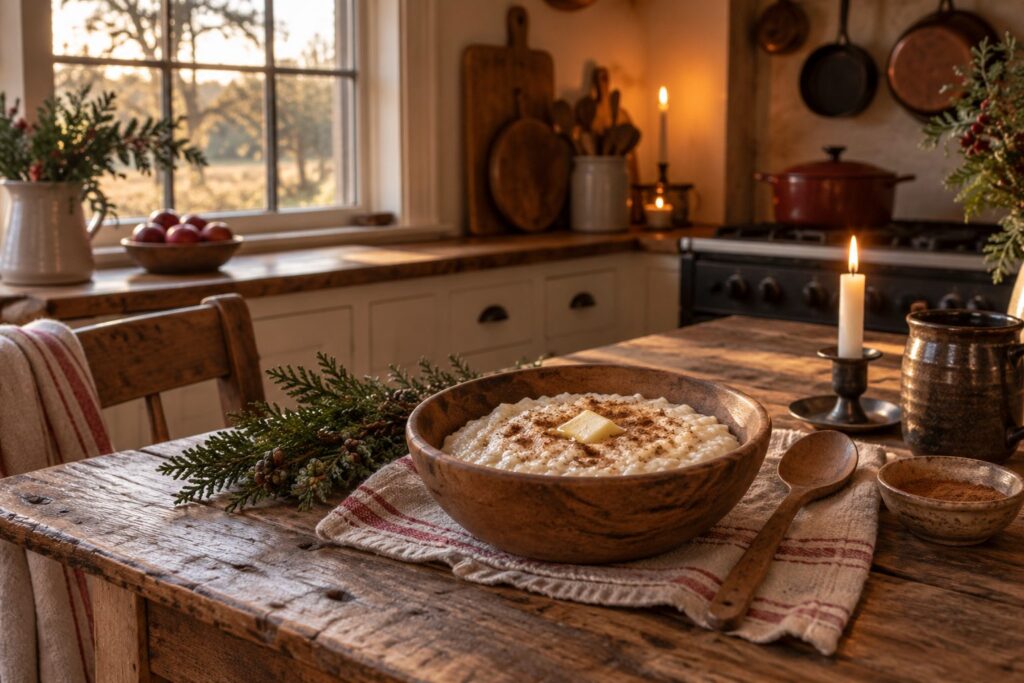
Because that was his pay. The Farmers’ Almanac says families would leave a bowl of porridge with butter on Christmas Eve at the barn door. Store norske leksikon says it was important in Norway to set out Christmas porridge with a pat of butter in the middle, in the barn, on Christmas Eve.
One version was risengrød, which Atlas Obscura describes as a luxurious, sweet porridge of rice boiled in milk and topped with butter. Visit Norway still calls it a Norwegian tradition to bring a bowl of porridge out to the barn on Christmas Eve.
Rice, milk and butter don’t sound like much now. On a farm in the middle of winter, they were a real gift, and that was the point. If you have children, a bowl of rice pudding with a pat of butter left on the porch step on Christmas Eve is a sweet custom to borrow. Just don’t forget the butter.
What happens if you forget the tomte’s porridge?
According to the old stories, nothing good. The Farmers’ Almanac says that if you skip the porridge or treat the gnome rudely, bad luck such as cattle illness, accidents or lost milk follows. Store norske leksikon puts it plainly: if he didn’t get the treatment he was owed, he could cause a great deal of trouble.
The butter mattered as much as the bowl. Atlas Obscura’s line on it is woe to the person who forgot the nisse’s butter, and it retells a folktale in which the unbuttered porridge so enrages him that he kills the family’s cow. When he finds the butter hidden at the bottom of the bowl, he feels terrible, and makes it right by stealing a neighbor’s cow.
The milder versions are closer to pranks. Visit Norway says a neglected fjøsnisse may get up to mischief, such as leaving the barn door wide open.
Nobody is asking you to believe any of this. But if you’ve had a run of bad luck in late December and wondered why, the Scandinavians had an answer ready: check whether anyone remembered the butter.
How did the tomte and nisse become Christmas gift-bringers?
Slowly, and with help from Saint Nicholas. In Sweden, the gift-bringer used to be a goat. The Local reports that from the late 19th century, the jultomte overtook the julbock, the Christmas goat, as the traditional gift bearer on Christmas Eve. Kalmar County Museum credits the illustrator Jenny Nyström with the idea of the gnome, rather than the Christmas goat, bringing children their parcels.
Norway went a similar way. Store norske leksikon says it became a tradition in many places that the farm nisse or barn nisse left gifts for the children in stockings. The first pictures linking him with Christmas were probably painted in the 1830s, and the first Norwegian julenisse Christmas card was drawn by Wilhelm Larsen in 1883.
Santa Claus left his mark too. The Local notes that over the years the Christmas Tomte has become more and more like the American version, and that Haddon Sundblom, who drew the Coca-Cola Santa, had Swedish parents. In Norway, Life in Norway says the julenisse can rely on the support of fjøsnisser, the barn gnomes, for his work, much as Santa relies on elves.
So the old barn spirit got a promotion. He kept the beard and the red cap, picked up a sack, and started coming to the door.
Who gave him his face? Viktor Rydberg’s “Tomten” and Jenny Nyström
A writer and an artist did a great deal to turn the tomte into a Christmas figure.
The writer was Viktor Rydberg, whom Britannica calls an author of the Romantic school who greatly influenced Swedish cultural life. The Local credits him with the change through his 1871 short story Little Vigg’s Adventures on Christmas Eve and his 1881 poem “Tomten.”
The poem is a quiet one. The Local describes its old gnome pondering the mysteries of life in mid-winter, awake on the farm while everyone sleeps. There are no presents in it and no reindeer, just an old watchman walking his rounds in the cold. If you can find it in English, it’s a good one to read aloud on a winter night.
The artist was Jenny Nyström. Europeana says she was born in Kalmar in 1854, and Kalmar County Museum says she was seventeen when she illustrated Rydberg’s Little Vigg, the start of a long collaboration. From there:
- Her tomte was on the cover of the first issue of the Christmas magazine Jultomten in 1891.
- In 1911 she won a contract to illustrate greeting cards, and her gnomes went on to appear on many Christmas cards.
- She painted between 6,000 and 7,000 gnomes in her lifetime, by the museum’s count.
The Local says her own father provided the model for the Christmas gnome’s appearance. Picture a kindly grandfather in a red cap, peering around a doorframe with a parcel, and you’re close to a Nyström.

How did the tall-hat gnome reach American Christmas decor?
The gnome on American mantels today doesn’t look much like Nyström’s grandfather. He’s rounder, his hat has slid down over his eyes, and his beard reaches the floor. In Britain he’s called a gonk. Homes & Gardens describes gonks as having pointy hats that cover their eyes and long white beards, and says the British named them after a troll doll popular in the 1970s.
Here, the style arrived on store shelves. PureWow, writing in 2022, said gnomes kept coming until they’d saturated the suburban landscape, and reported a 1,350 percent spike over five years in searches for “Christmas gnome decor”, according to Google. The same piece noted that these gnomes have been part of Swedish and Norwegian culture for centuries.
What changed on the way over was mostly the face, or the lack of one. A faceless gnome doesn’t look stern and doesn’t look silly, and he fits a farmhouse kitchen or a grandmother’s china cabinet equally well. PureWow put the appeal down to a cozy, friendly vibe.
What do Christmas gnomes mean today?
Plenty of people who put out Christmas gnomes now aren’t thinking about barn spirits, and that’s fine. The meaning has drifted, but not far. Three ideas tend to come with it:
- Protection of the home. The old job is still the main one. Homes & Gardens says gonks are said to protect homes throughout the winter solstice and festive season. A gnome by the door is a small watchman on duty.
- Coziness. Christmas gnomes go with candles, wool socks and a pot of something on the stove. They say the house is warm and you’re welcome in it.
- Luck. In the old stories, a well-treated tomte brought good fortune to the place. People keep a gnome for luck in that spirit, the way you might hang a horseshoe.
Those are folk beliefs, not promises, and nobody has to take them literally. A gnome at Christmas is a nod to an old idea: look after your home and the people in it, and things have a way of turning out all right.
How do you decorate with Christmas gnomes outside?
The old job is a good guide. A farm spirit keeps watch over the place, so put him where he can see who’s coming.
- On the front tree. It’s the tree everyone sees from the street. A gnome on the trunk at about chest height reads clearly from the sidewalk, and a bare winter tree gives him room.
- On a porch post. Close to the door, the way a house spirit should be, greeting everyone who comes up the steps.
- By the gate or the end of the drive. The first post people pass is a good place for a welcome.
- On the shed or the garage wall. It suits his original address in the barn.
A few things help once you’ve picked the spot:
- Choose it from the window. Pick the post or trunk you can see from where you sit with your coffee.
- Think about the light. A silhouette reads clearly with light behind it, and in December a trunk that catches the low afternoon sun is a good home.
- Keep it simple. One gnome reads as a watchman and a small group reads as a household. A dozen across the yard reads as clutter.
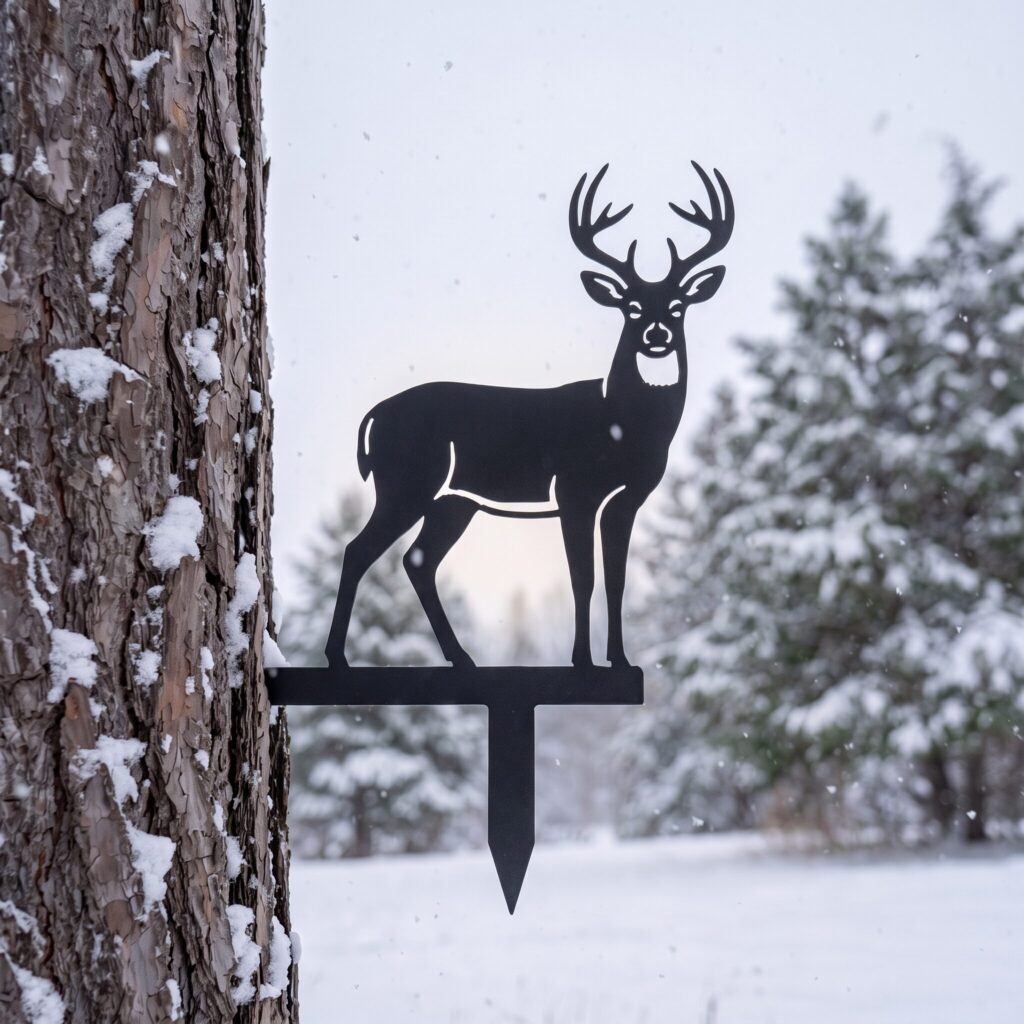
- Pair him with the holiday. A gnome on the porch post and a steel buck on the front tree make a small winter scene without much effort. Our guide to outdoor tree decorations for every holiday goes through the rest of the calendar.
Our pieces tap into a tree, a wooden fence post, a porch post or a wall with a hammer, and if the wood is hard, you drill a small pilot hole first. If you’re wondering what that does to the tree, our guide on whether a metal tree stake will hurt your tree covers it: choose a sound, mature tree, set it once and leave it.
Can a welcome gnome stay up after Christmas?
It can, and the old tomte would probably approve. In the stories he lived on the farm all year. Christmas Eve was simply the night people thanked him.
A gnome that stays up does a few things for you:
- It covers the gap. The weeks after New Year are the bare stretch, when the lights come down. A gnome by the door carries you through to spring.
- It saves the tree. Pulling a stake and resetting it every season is how one hole in a trunk becomes several.
- It changes with the light. A gnome against bare bark in January looks different from the same gnome framed in leaves in June.
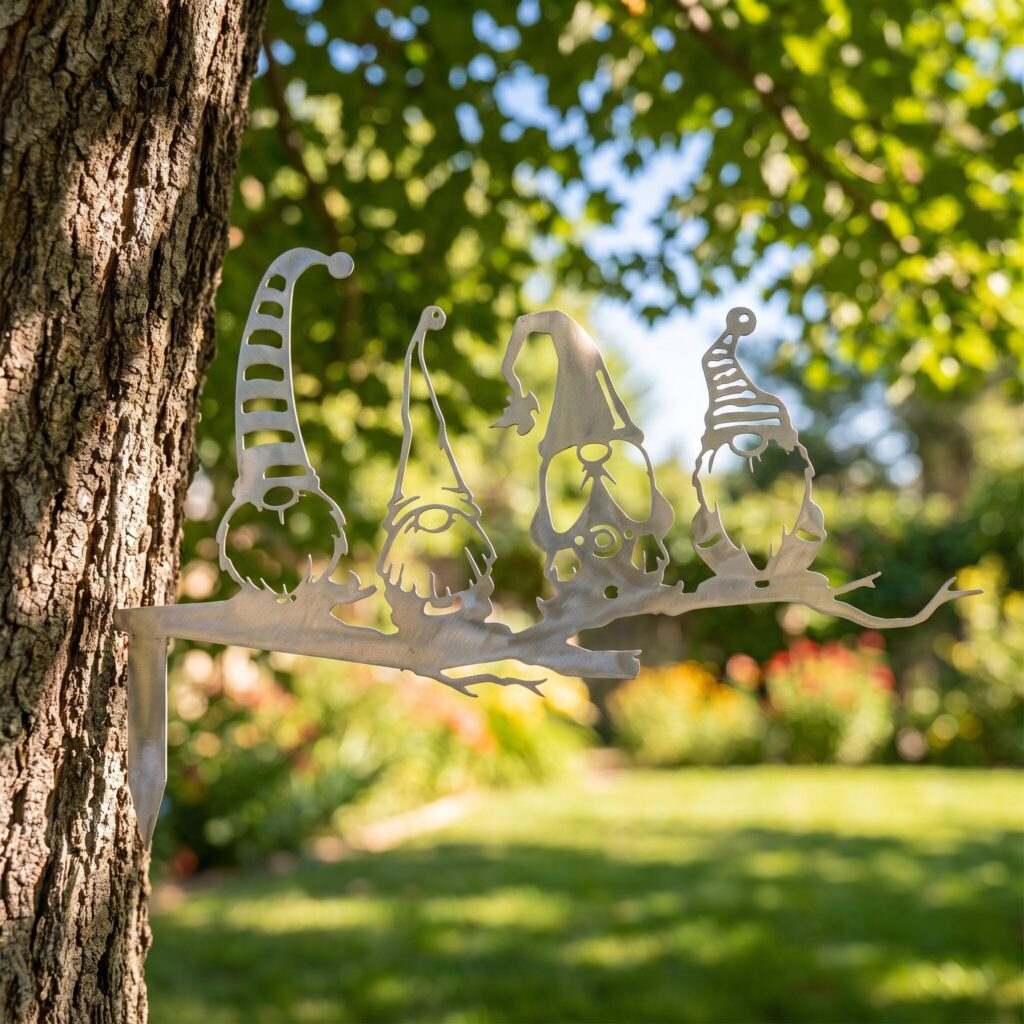
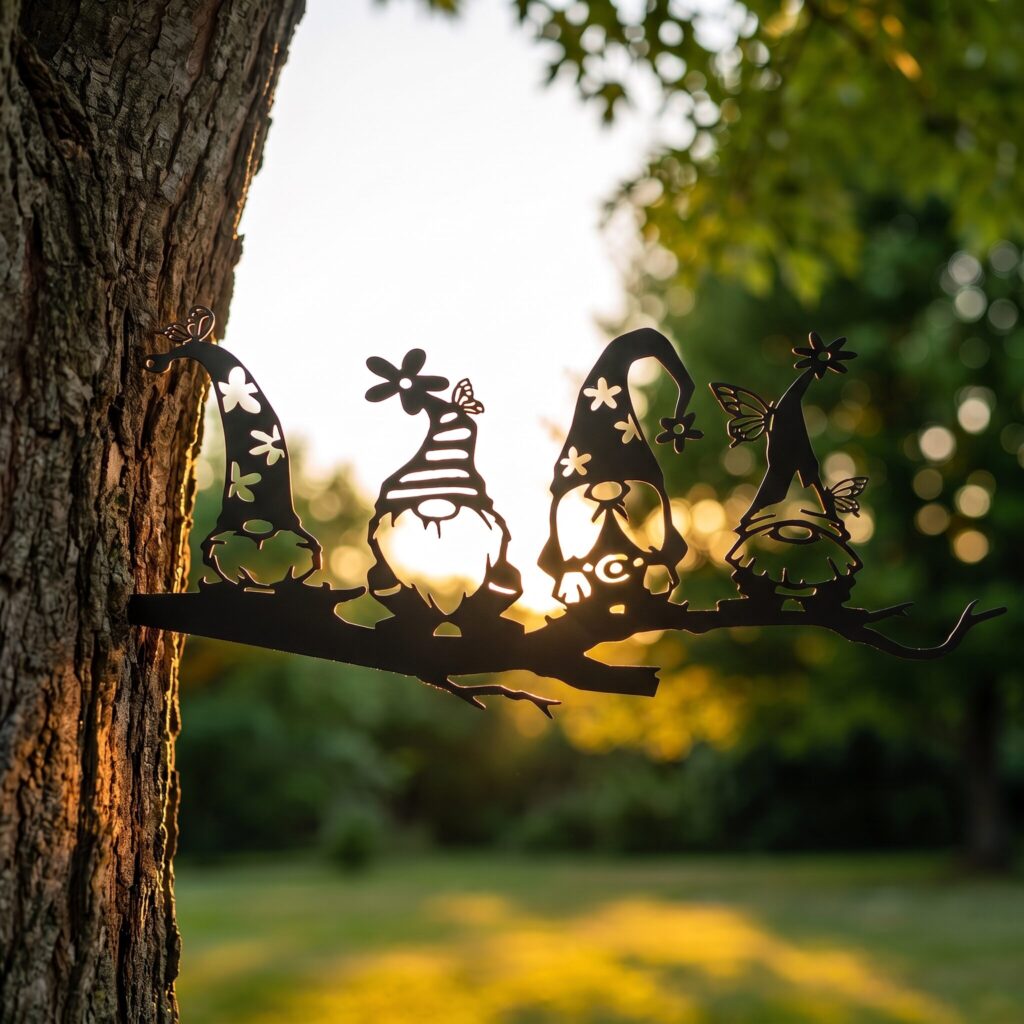
The trick is choosing one that isn’t dressed for a single day. A welcome gnome, or a small crew on a branch, works in every season. Save the holiday pieces for December.
Are Christmas gnomes a good gift?
They make a good one, especially for:
- Anyone with Scandinavian roots. A Christmas gnome is a small way of honoring a grandmother’s stories, and it often starts a conversation about where the family came from.
- The gnome collector. Many gnome lovers already have a shelf of them indoors. One for the porch or the tree is something new.
- A new homeowner. Given the old job, a gnome by the front door is a fitting housewarming gift, a small watchman for a new place.
- The friend who keeps decorations up until February. A welcome gnome lets them keep something out all year, no explaining required.
A short note helps. Tell them what the old farm spirit was, a guardian who kept an eye on the place in exchange for a bowl of porridge, and where you pictured it: “for the post by your front door,” say. That turns a piece of steel into a small, specific thought.
If it’s for Christmas, order early, since a lot of these are bought as gifts. Orders are processed in 1 to 2 business days and arrive 5 to 7 business days after that, within the US. For more ideas, our garden gift ideas cover gnome lovers along with the rest of the gardeners on your list.
Steel gnomes and Christmas pieces for the tree or the porch
If the story has you thinking about a gnome of your own, these are the pieces we make for it. Each one is a solid steel silhouette that hangs on a trunk or a post, up where you can see it. Most run between 7 and 17 inches, and each product page lists the exact size.
- For the porch post: the Gnome Welcome Sign Stake has five gnomes, a toadstool and the word Welcome. It’s the watchman’s job, done in steel, and it stays up year round.
- For a fence post by the walk: the 4 Gnomes Stake puts a small household of gnomes where guests pass.
- For the front tree: the 4 Whimsical Gnomes Tree Stake is made to sit up in a tree, out of reach of the mower.
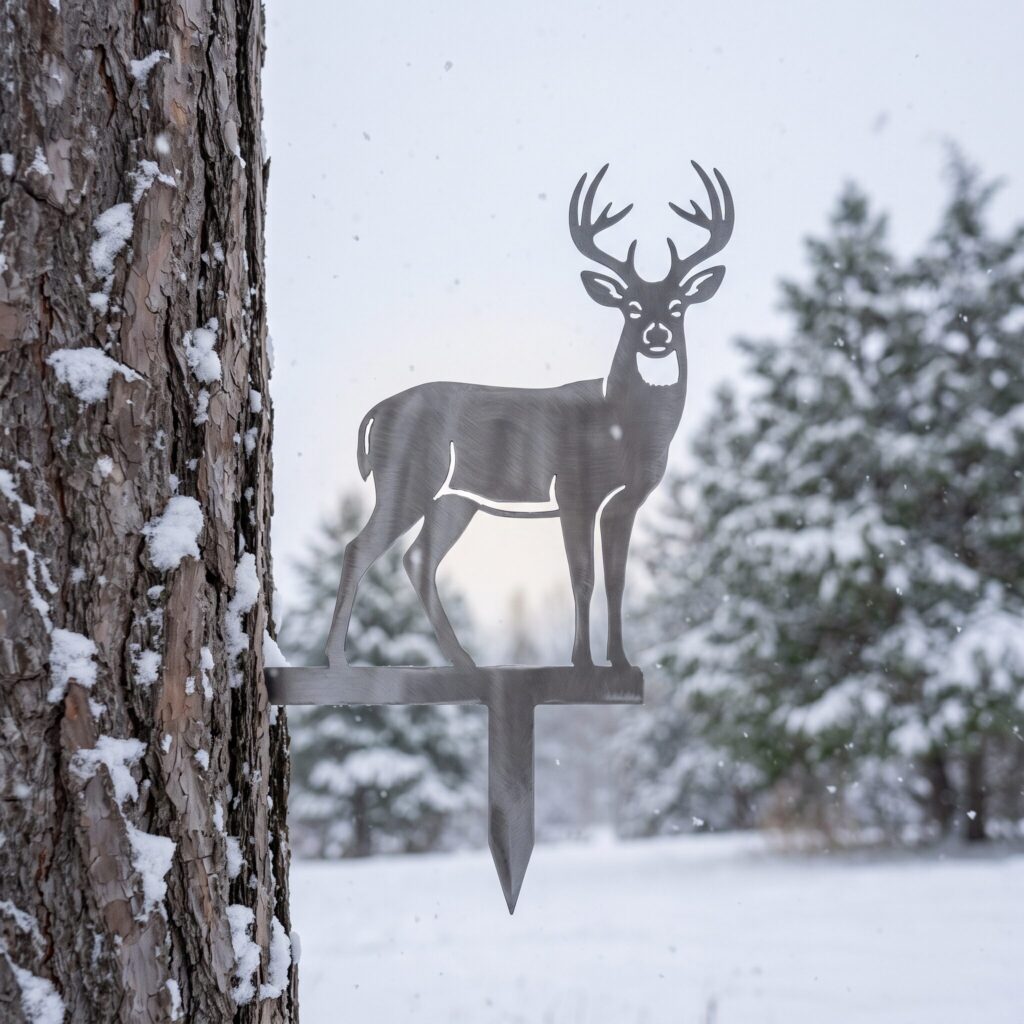
- For December: the Christmas Stake is a whitetail buck in full rack, cut from solid steel. Pair it with a gnome on the porch and the yard is ready for December.
Raw Steel weathers outdoors, with most of the change in the first several months before it holds steady, and Black keeps a clean, consistent look. A weathered gnome looks like he’s been on duty since your great-grandparents’ day. A black one reads as a crisp shadow against bare bark.
The Garden Folk collection shows the gnomes side by side, and the Seasonal & Holiday collection has the Christmas Stake along with pieces for the rest of the year.
Questions customers ask
How do I install it?
Find your spot, then tap the stake in with a hammer. If the wood is hard, drill a small pilot hole first.
Will the Raw Steel finish rust?
It weathers on purpose. Raw Steel changes color outdoors, mostly in the first several months, then holds steady. If you’d rather keep a clean, consistent look, choose Black.
Will it arrive in time for a holiday gift?
A lot of these are bought as gifts, so order early during Christmas, Valentine’s Day and other peak weeks. Orders are processed in 1 to 2 business days and arrive 5 to 7 business days after that, within the US.
What’s your shipping policy?
Shipping is free on orders of $99.99 and up.
Sources
- Folklore and History of the Garden Gnome and Christmas Gnome, Farmers’ Almanac (Melissa Mayntz, 15 December 2022, updated 20 July 2026)
- nisse, Store norske leksikon (Ina Louise Stovner, updated 25 November 2024)
- Fjøsnissen: The Norwegian Santa, Visit Norway
- The Story of a Cultural Icon, Life in Norway (Daniel Albert, updated 20 November 2023)
- What Is Risengrød?, Atlas Obscura (Sam O’Brien, 9 December 2020)
- Holiday Spiders, Goats, and Pigs: Learning about Different Christmas Traditions, State Historical Society of North Dakota museum blog (Jenny Yearous, 23 December 2019)
- How a folklore figure became Sweden’s Santa, The Local Sweden (Victoria Martínez, 6 December 2018)
- Who is he and why is he famous?, The Local Sweden (Paul O’Mahony, 18 December 2006)
- Viktor Rydberg, Encyclopedia Britannica
- Jenny Nyström: the woman who created the image for a Swedish Christmas, Europeana (Beth Daley, 12 March 2024)
- Jenny Nyström: the mother of the modern gnome, Kalmar läns museum
- Christmas gonks, Homes & Gardens (Ginevra Benedetti, 26 November 2020)
- Gnomecore Is Trending, PureWow (Candace Davison, 1 September 2022)