
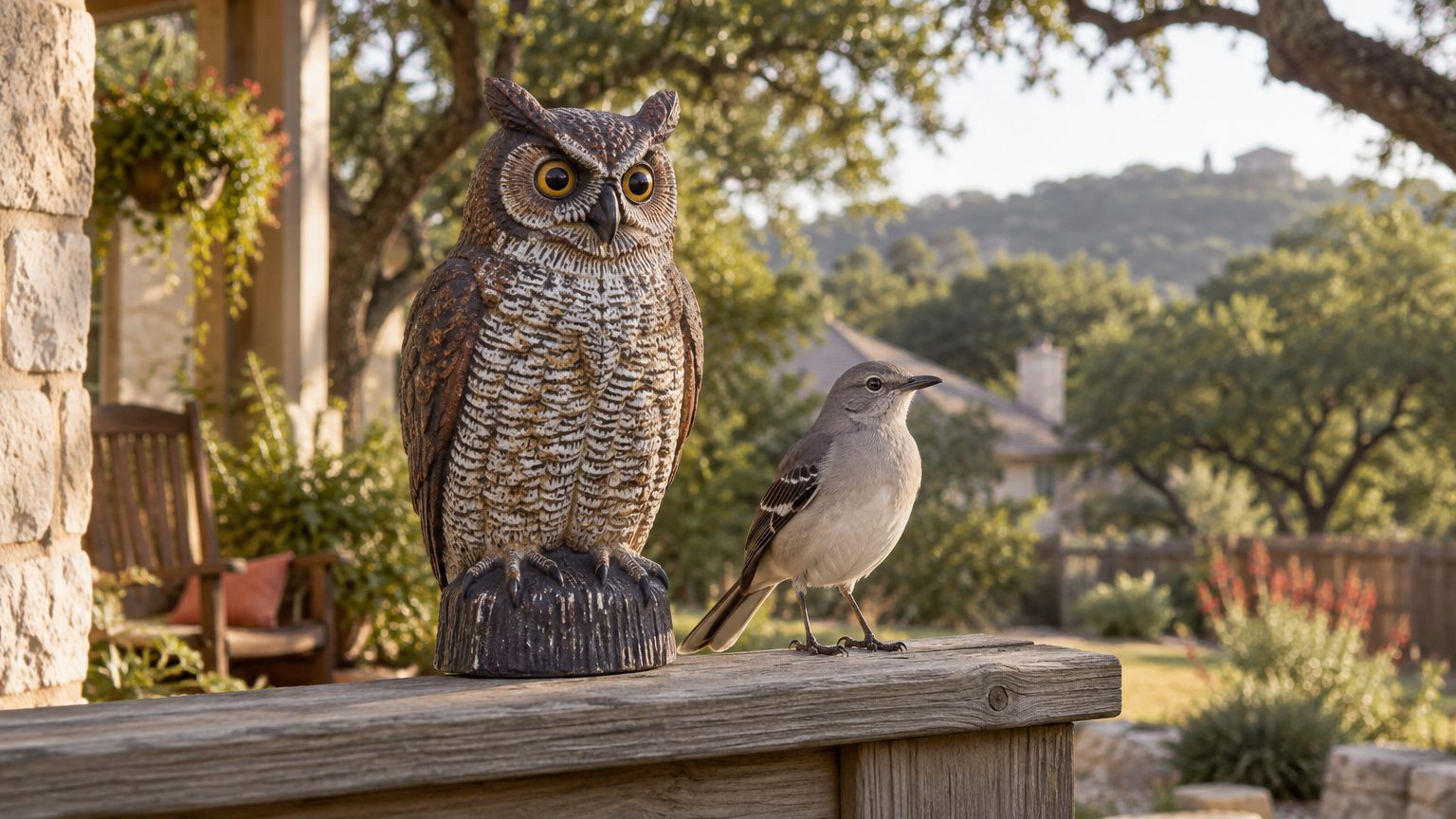
An owl decoy works for a little while, if at all. Birds learn fast that a plastic owl never moves, and the Cornell Lab notes that plastic owls may work at first, but woodpeckers get used to them. Moving it often and adding motion helps some. Netting, blocking access and taking away food do the lasting work.
It’s a fair question, and since we make a steel owl ourselves, we’d rather answer it straight. Below are nine honest answers, built on what university extension services and the Cornell Lab have actually found: why an owl decoy stops working, how to stretch it a little, what to do about woodpeckers, pigeons, sparrows and birds in the garden, what the law says, and a little about the real great horned owl and when you’ll hear one in Texas. At the end, we’ll be upfront about our own owl.
Why does an owl decoy stop working?
An owl decoy is a bluff, and birds call it quickly.
The idea behind one is simple enough. Griffin Dill, an integrated pest management specialist at the University of Maine, told the Bangor Daily News that the hope is that nuisance animals will recognize these decoys as a threat and avoid the areas. The trouble is what happens next. In the same interview, he said birds and other wildlife quickly learn that the decoys don’t pose a threat and resume their activities within a few days.
That learning has a name: habituation. A real owl moves, hunts, turns its head and turns up at different hours. An owl decoy sits in the same spot, at the same angle, every single day. The University of Nebraska–Lincoln’s guide to urban pest birds says frightening rarely provides long-term damage reduction because birds become accustomed to devices that do not change over time.
The research on woodpeckers lands in the same place. A study of six common long-term woodpecker deterrents tested plastic owls alongside reflective streamers and distress calls, and the Cornell Lab sums up the result: nothing deterred woodpeckers all the time, and only streamers worked with any consistency.
So, do owl decoys work? For a few days, sometimes. As a long-term fix, the evidence says no.
Can you make an owl decoy work longer?
A little. The same specialists who doubt decoys also explain how to get some use out of one.
- Move it often. Dill’s advice is to frequently change their position. A new spot, a new angle, a different perch.
- Add motion. He also suggests adding the element of movement by placing streamers nearby. Some store-bought decoys include moving parts and even speakers to produce sounds.
- Time it. Dill says the placement of decoys should be timed to ensure protection without giving birds time to get used to them. In practice: put it out when the trouble starts, and take it down after.
- Vary the scare. The Nebraska guide recommends varying the timing, placement and type of frightening devices and starting before birds settle into a site.
- Pair it with something physical. A decoy is one layer at most. Netting or a blocked opening is the layer that holds.
Even with all of that, Dill notes that wild animals typically become used to these options as well. Treat an owl decoy as a stopgap while you put a real fix in place, not as the fix itself.
What works for woodpeckers on the siding?
Start with why the bird is there, because the reason decides the fix. The Cornell Lab lists four reasons woodpeckers hammer on houses, including drumming because it makes a loud noise that proclaims the bird’s territory and attracts a mate and digging out a nest or roost hole. The other two are hunting insects in the wood and storing food.
A quick way to read the damage, drawn from an Ask Extension answer that leans on Cornell’s material:
- Loud drumming in spring, few holes. That’s a bird making noise, not looking for dinner, and it usually stops once breeding begins in spring.
- Large, round holes. That’s a nest or roost cavity, and Ask Extension’s advice is to evict birds before or after nesting season, not during.
- Small, irregular holes. The bird is after insects in the wood, and controlling the insects, such as carpenter bees, may be needed.
Then the deterrents, in the order the research supports them:
- Reflective streamers. In the Cornell summary, the streamers’ shiny coating and movement in the wind kept woodpeckers at bay.
- Netting. If you use it, Cornell says to make sure it is taut and set at least 3 inches from the siding so birds can’t peck through it. The Internet Center for Wildlife Damage Management suggests a ¾-inch mesh for wood siding under the eaves.
- Patch the holes. Fill them with wood putty, but only once you’re sure no bird is inside, as Cornell advises for roost holes.
- Skip the sticky stuff. Cornell warns that sticky repellents can fatally trap or injure birds and other animals.
And the owl decoy on the gutter? The wildlife damage center is blunt: stationary hawks, owls, snakes, and cat silhouettes usually are ineffective as frightening devices.
What works for pigeons on the porch and the roofline?
If it’s pigeons on the porch rail or the roofline, an owl decoy is a long shot. The Internet Center for Wildlife Damage Management lists revolving lights, waving colored flags, balloons, rubber snakes, owl models, and other devices among the things that have little or no effect. Noise-makers don’t fare much differently: the same page says they are usually disturbing to humans but have little permanent effect on roosting pigeons.
What does work is making the place less useful to them:
- Close the doors. The center says pigeons can be excluded from buildings (in some cases very easily) by blocking access to indoor roosts and nesting areas, including openings to lofts, vents and eaves.
- Change the ledge. Roosting on ledges can be discouraged by changing the angle to 45 degrees or more, with a sloped board or sheet metal.
- Net the trim. Ornamental architecture can be screened with 1-inch mesh polypropylene netting that’s UV-stabilized.
- Stop the buffet. The center calls the elimination of feeding, watering, roosting, and nesting sites important in long-term pigeon control.
What about house sparrows and starlings?
These two are a special case, and it’s worth knowing why. The Cornell Lab’s NestWatch program notes that House Sparrows and European Starlings were both introduced to North America in the 19th century.
An owl decoy won’t sort that out. Food and housing will:
- Pick the feeder. NestWatch says feeders with short perches and small ports are also less attractive to these two species.
- Pick the seed. House sparrows go for small seeds like millet, cracked corn, and milo, while safflower, nyjer and nectar tend to be left alone. Those are the foods that target cardinals, finches and hummingbirds anyway.
- Mind the hole. For nest boxes, NestWatch notes that starlings cannot squeeze through a hole smaller than 1 1/2 inches. Sparrows are harder: the same page says there currently is no scientifically-documented way to exclude House Sparrows that works permanently.
- Plug boxes until the natives return. NestWatch suggests plugging entrance holes until migratory natives return, so they get first pick.
One caution before you do anything more: be sure of the bird. The Nebraska guide advises confirming the species first, because house sparrows can be confused with protected native birds.
What about birds in the garden and the berry patch?
If your owl decoy is standing guard over the tomatoes, here’s the honest answer from the extension side: a decoy might buy you a few days, and netting buys you the crop.
Iowa State’s Yard and Garden team, writing about blueberries, says scare devices are sometimes helpful, but netting is the most effective way to protect the crop. Their advice on how to do it is practical:
- Net when the fruit begins to color. Iowa State says netting should be placed over the plants when the fruit begin to color, not weeks ahead.
- Hold it off the plants. Hang it over a support frame of some kind, so birds can’t sit on the net and pick through it.
- Anchor the edges. Bury or pin the bottom edge so birds can’t get in from below.
Owl decoys are also sold to keep rodents out of gardens. Dill describes them as aimed at birds or rodents that may be destroying crops, but his overall view is that they tend to be limited in their effectiveness at deterring birds and other wildlife. He’s fair about netting too: it can provide protection in certain situations, though covering a big area can be costly and unsightly. Net the plants that matter, and let the birds have a little of the rest.
What actually works, in short
Across woodpeckers, pigeons, sparrows and the garden, the extension advice comes down to five things:
- Block the way in. Close vents, eaves and lofts, and use the right entrance hole on birdhouses.
- Net what matters. Taut, held off the surface, anchored at the edges.
- Take away the food. Change feeders and seed, stop feeding pigeons, and keep trash covered, as the Nebraska guide recommends.
- Fix the cause. Insects in the siding, a ledge built for roosting, a box with the wrong hole.
- Use motion and shine, and keep changing them. Streamers and reflective tape, moved and swapped.
An owl decoy fits in as a sixth, short-term extra if you want one, moved often and paired with the first five.
Is it legal to scare birds away?
Here’s the part people tend to skip. In the United States, most native birds are protected by federal law: the U.S. Fish and Wildlife Service explains that the Migratory Bird Treaty Act of 1918 prohibits the take (including killing, capturing, selling, trading, and transport) of protected migratory bird species without prior authorization. The Service also notes that the Act applies only to migratory bird species that are native to the United States or U.S. territories.
What that means in your yard:
- Woodpeckers are covered. The Ask Extension answer on woodpecker damage notes that woodpeckers are protected under the federal Migratory Bird Treaty Act.
- Nests and eggs count too. NestWatch reminds readers that harming or harassing native species, including their nests and eggs, is prohibited.
- A few birds aren’t covered. The Nebraska guide says the Migratory Bird Treaty Act of 1918 and Nebraska regulations do not afford protection to these non-native species, meaning house sparrows, European starlings and pigeons. State rules can apply as well, so check with your state wildlife agency before you go past exclusion and netting.
The practical upshot: netting, closed openings, streamers and feeder changes are the tools the extension services keep pointing to. Anything past that, especially anything involving a nest, is a question for the Fish and Wildlife Service or your state wildlife agency first.
What is a great horned owl, really?
The bird every owl decoy is modeled on is worth meeting on its own terms. The Cornell Lab calls the great horned owl one of the most common owls in North America, and it is at home in deserts, wetlands, forests, grasslands, backyards, cities and nearly any semi-open country in between.
A few things that make the real great horned owl hard to fake:
- It eats nearly anything. All About Birds says great horned owls have the most diverse diet of all North American raptors, mostly rabbits, hares and mice, and down to tiny scorpions, mice, and frogs.
- It borrows a house. They usually adopt a nest that was built by another species, most often a hawk’s, crow’s, heron’s or squirrel’s.
- It turns its head, not its eyes. Its eyes don’t move in their sockets, so it swivels its head instead. An owl decoy mostly does neither.
- Crows know it. American crows will mob a great horned owl, and Cornell describes the owl as their most dangerous predator.
- It’s doing fine. Cornell rates the species Low Concern, common and widespread throughout much of the Americas.
That’s a lot of animal for an owl decoy to stand in for.
When do you hear great horned owls in Texas?
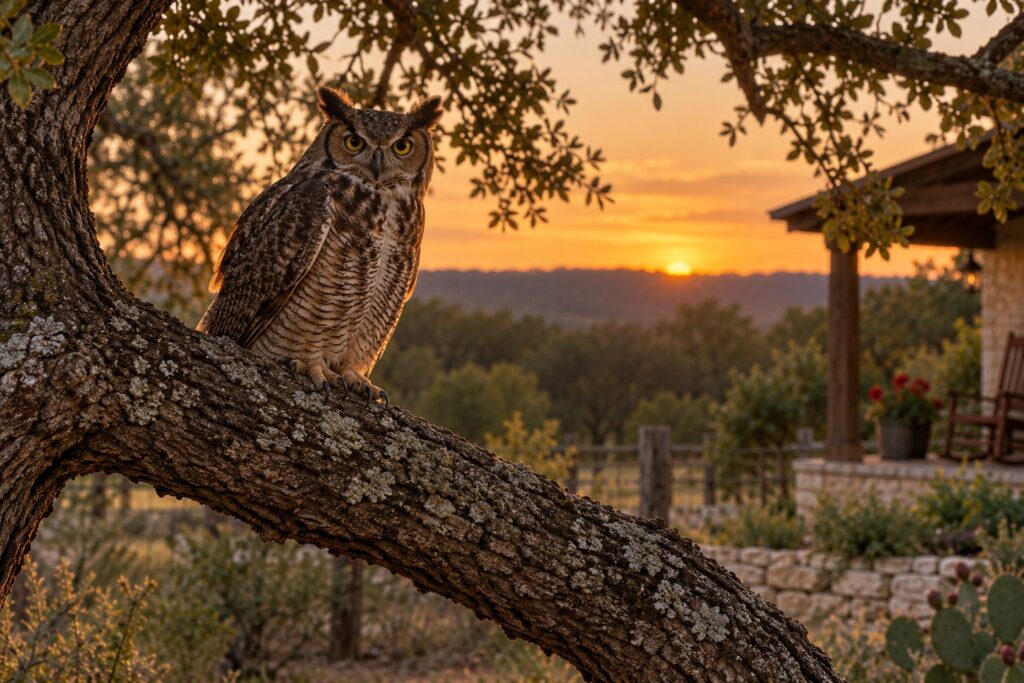
If you’re reading this in October, you’re at the start of the season. Travis Audubon’s Yvonne Karnath writes that great horned owl calling is at its peak from October through March in Central Texas, mostly at dusk and before dawn.
The calendar runs early. Karnath notes that great horned owls are pairing up in November and are incubating eggs in January and early February. Another Travis Audubon forecast puts it simply: Great Horned Owls begin to nest in the cold of winter, often in old crow and hawk nests.
What you’re listening for:
- The hoot. All About Birds describes deep, soft hoots with a stuttering rhythm: hoo-h’HOO-hoo-hoo.
- The duet. A breeding pair may call back and forth, with the female’s voice recognizably higher in pitch than the male’s, even though she’s the larger bird.
- The screech. Come spring, a young great horned owl makes a long, scratchy, raspy screech when it wants feeding.
- The bill-snap. Adults snap their bills in response to stressful conditions or disturbance, especially near their young. If you hear it, give them room.
Where to look is just as simple. Karnath’s answer is almost anywhere with mature trees, with daytime roosts in a live oak, pecan or cypress. She also notes that owls in the Texas Hill Country lean pale and gray. In our part of Texas, that’s a lot of creek bottoms and old oaks, and a lot of winter nights with one calling somewhere down the road.
Our Horned Owl Stake: art, not an owl decoy
We make a Horned Owl Stake, so we’d like to be clear about what it is.
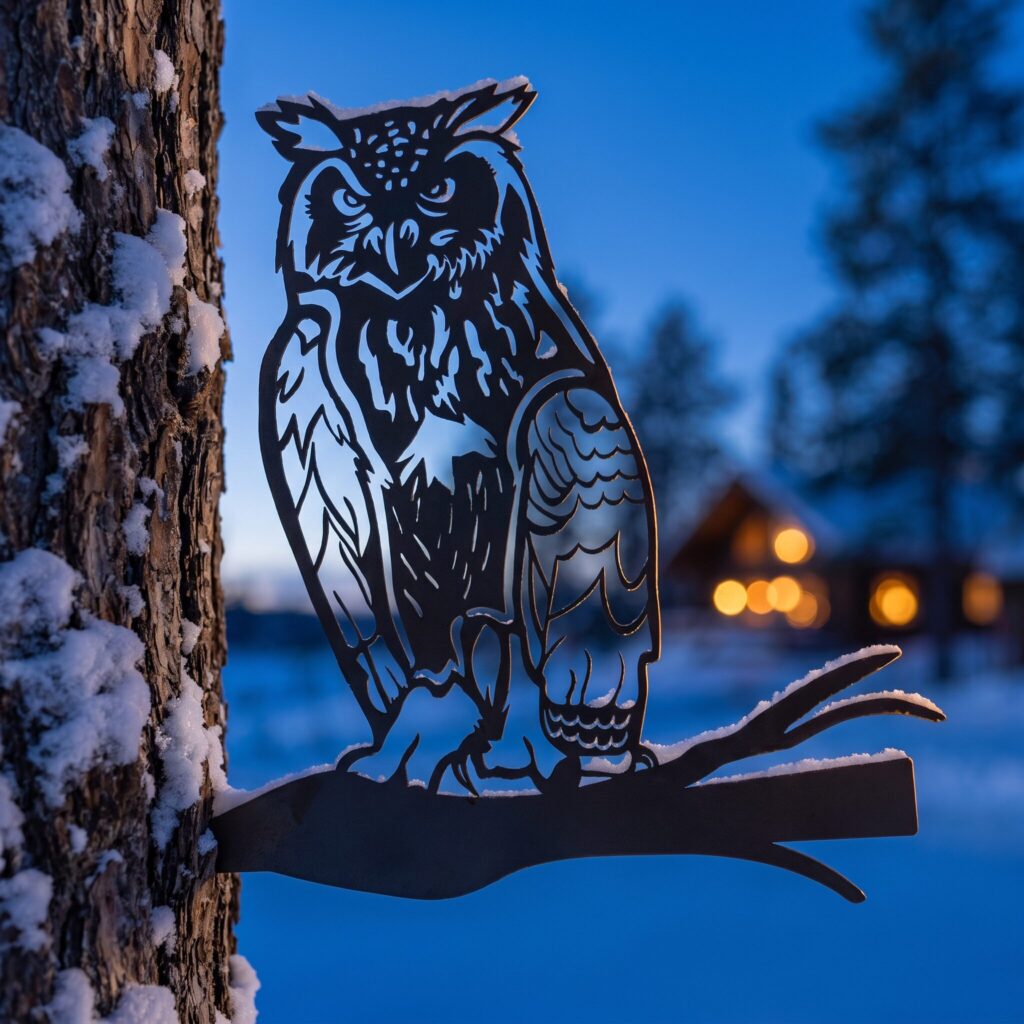
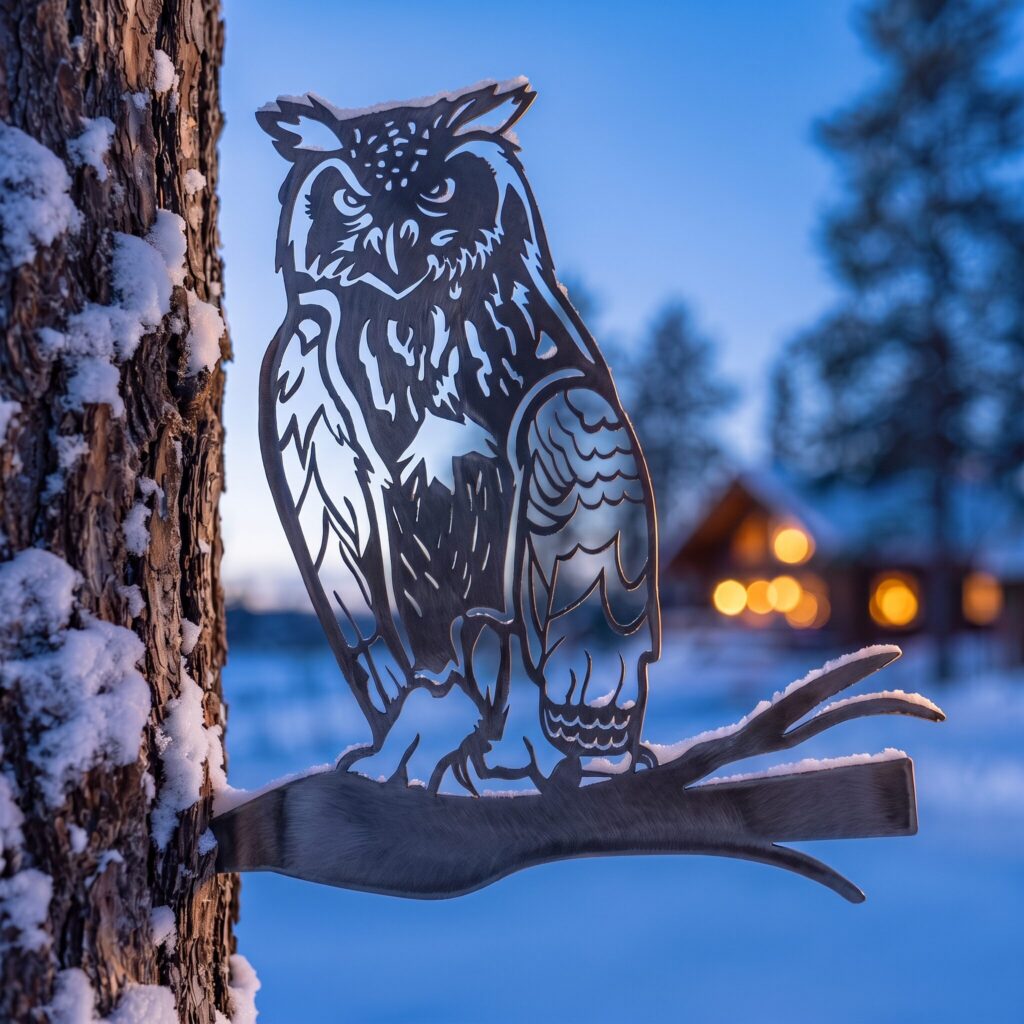
It’s a piece of yard art: a steel owl silhouette that taps into a tree or a wooden post. Shadow Birds makes no claim that it scares woodpeckers, pigeons, sparrows, squirrels or anything else. It doesn’t move, and everything above says a still owl doesn’t keep birds away for long. If your siding or your berries need protecting, put up netting and use the steps in this article. Please don’t buy our owl for that job.
So why have one? Some people simply like an owl. They hear a great horned owl calling from the creek on a January night and want something on the tree that says so. Some just like the shape of it against the bark in the late light.
It’s made of solid steel. It comes in Raw Steel, which weathers outdoors and does most of its changing in the first several months before holding steady, or in Black, which keeps a clean, consistent look. Most pieces run 7 to 17 inches, and the exact size of the Horned Owl Stake is on its product page.
Where an owl silhouette looks right
Since it’s there to be looked at, place it for the view. Our guide to yard art ideas and where to put it goes into this in more detail, but a few things suit an owl in particular:
- A big trunk. Real great horned owls roost by day in a live oak, pecan or cypress, so a broad live oak or pecan suits an owl silhouette. A thin sapling makes it look lost.
- A little above eye level. Chest height or a touch higher, where you can still reach it to set it.
- Light behind it. A silhouette reads cleanly against an open sky or the evening sun. A trunk on the west side of the yard is a good bet for dusk, which is owl hour anyway.
- Seen from the window. Pick the tree you look at from the kitchen or the back porch, especially in winter, when the leaves are down and the owls are calling.
- One per tree. An owl looks right with room around it.
Setting it is quick. Tap the stake in with a hammer, and drill a small pilot hole first if the wood is hard. It works in a tree, a wooden fence post, a porch post or a wall. If you’re wondering what that does to the tree, our pillar guide on whether a metal tree stake will hurt your tree walks through it.
If you’d rather bring birds in than keep them out
Most of this article has been about getting birds to leave. For a lot of yards, the better question is how to invite the right ones. Our guide to native plants for birds in Texas is the place to start: plants that feed cardinals, finches, hummingbirds and the rest through the seasons. It’s the slow, quiet side of the same question.
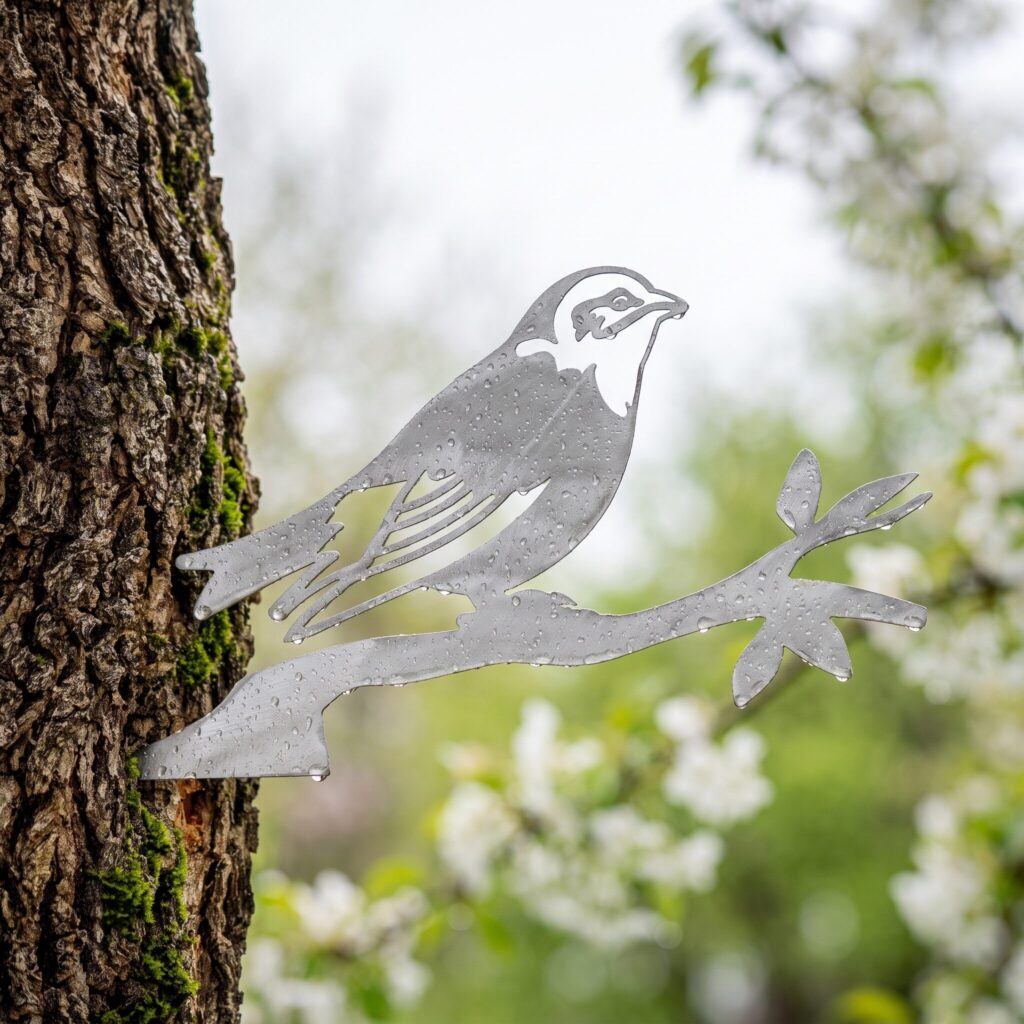
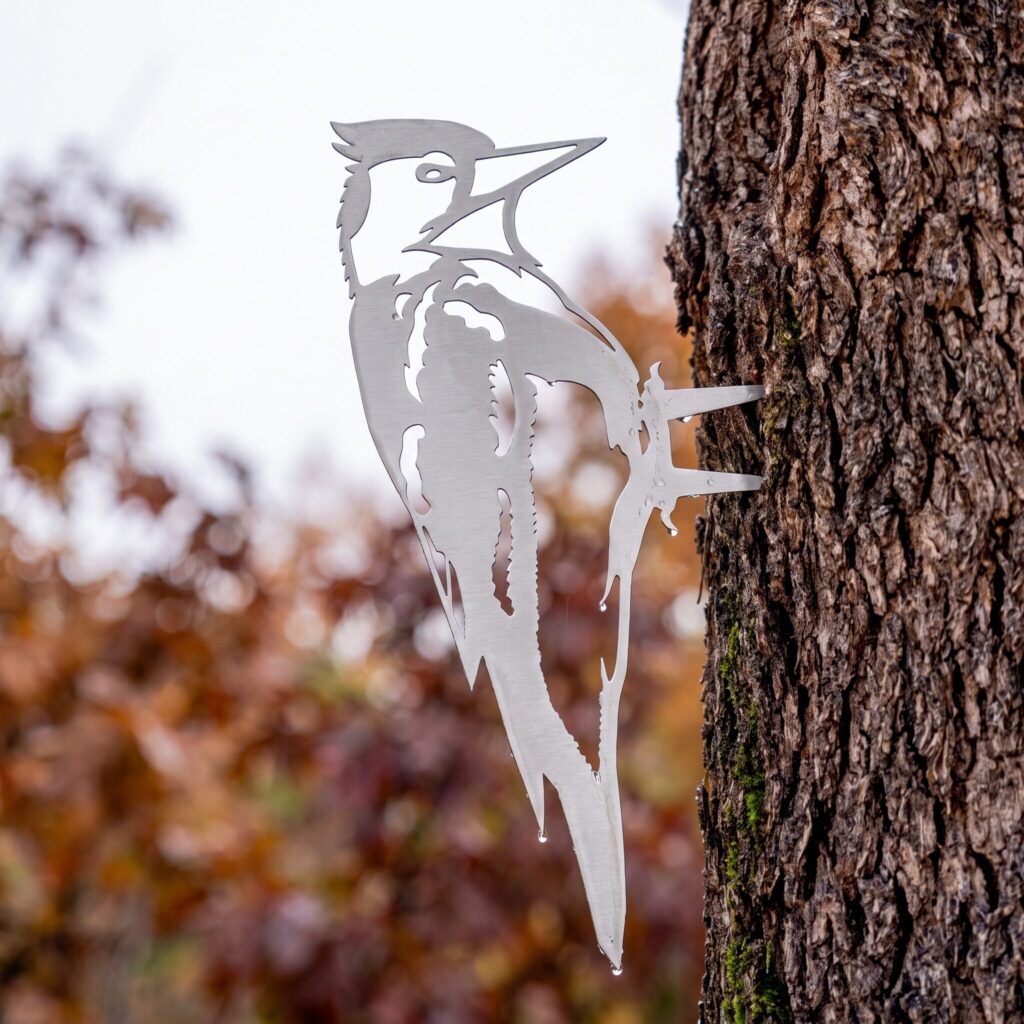
If you want something on the tree while the plants come along, the Woodpecker Stake is cut in the upright, trunk-clinging pose and sits flush against the bark, the way you always find the real bird. The Birds collection has the rest of the tree line: cardinals, a blue jay, finches, a hummingbird and the horned owl.
Questions customers ask
How do I install it?
Find your spot, then tap the stake in with a hammer. If the wood is hard, drill a small pilot hole first. It works in a tree, a wooden fence post, a porch post or a wall.
What are Shadow Birds pieces made of?
Solid steel, in a Raw Steel or Black finish.
Will the Raw Steel finish rust?
Raw Steel weathers outdoors on purpose. Most of the change happens in the first several months, then it holds steady. If you’d rather keep a clean, consistent look, choose Black.
Sources
- Why do woodpeckers like to hammer on houses? And what can I do about it? All About Birds, Cornell Lab of Ornithology, 24 February 2023 (updated 4 April 2024)
- Sorry, but that owl decoy won’t stop critters from destroying your crops, Sam Schipani, Bangor Daily News, originally published March 2021 (republished 22 June 2026)
- Urban Pest Birds: Controlling Damage, NebGuide G2024, University of Nebraska–Lincoln Extension (Vantassel, Hygnstrom and Ferraro, June 2010)
- Woodpeckers, Ask Extension question #728088, 1 October 2020
- Woodpecker Damage Prevention and Control Methods, Internet Center for Wildlife Damage Management
- Pigeon Damage Control and Prevention Methods, Internet Center for Wildlife Damage Management
- Managing House Sparrows and European Starlings, NestWatch, Cornell Lab of Ornithology, updated 27 August 2024
- How do I stop birds from eating my blueberries? Iowa State University Extension and Outreach, Yard and Garden, updated 2 March 2022
- Migratory Bird Treaty Act of 1918, U.S. Fish and Wildlife Service
- Great Horned Owl overview, All About Birds, Cornell Lab of Ornithology
- Great Horned Owl life history, All About Birds, Cornell Lab of Ornithology
- Great Horned Owl sounds, All About Birds, Cornell Lab of Ornithology
- Bird of the Week: Great Horned Owl, Yvonne Karnath, Travis Audubon, 1 July 2026
- January Bird Forecast, Kristen Currie, Travis Audubon, 2 January 2021