
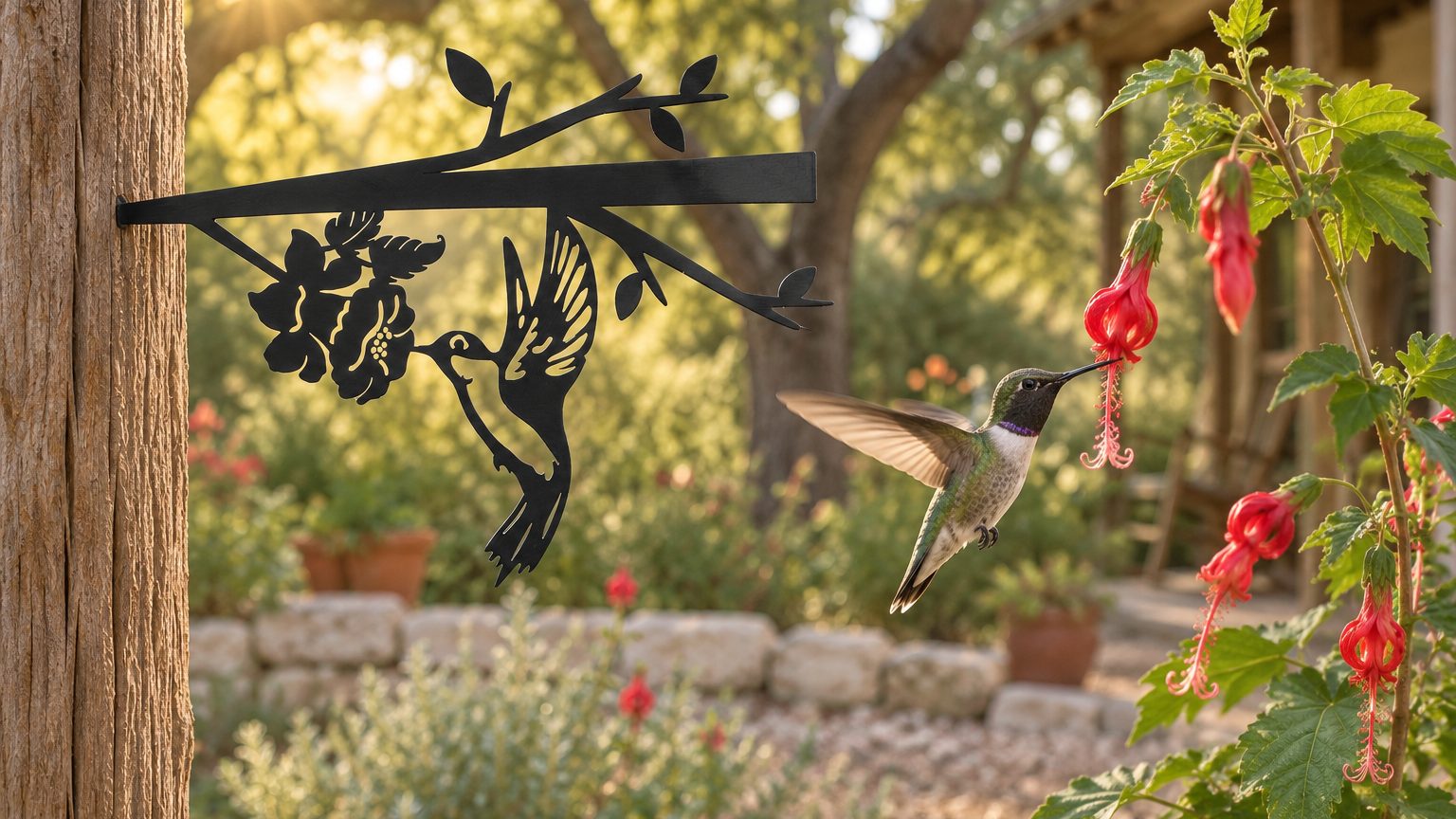
Hummingbirds in Central Texas start arriving in March, black-chinned around the second week and ruby-throated about two weeks later, according to a Travis Audubon forecast. Some stay to nest through summer. Then a second wave passes through on the way south, and Texas Parks and Wildlife says fall migration peaks in mid-September.
That’s the short answer. Below are the nine questions people ask once they’ve seen their first hummingbird of the year: which hummingbirds you’ll see, when to hang a feeder and when to take it down, the nectar recipe, keeping feeders clean in Texas heat, native plants worth putting in the ground, why one bird bullies the rest, and where they nest.
When do hummingbirds arrive in Texas each spring?
People search “when do hummingbirds arrive in Texas” as if there’s one date, but it’s more of a slow tide moving north. Texas A&M AgriLife puts it generally around the beginning of March for the state as a whole.
Closer to home, the March bird forecast compiled by Travis Audubon volunteer Jane Tillman gets more specific: black-chinned typically turn up during the second week in March, and ruby-throats two weeks later. The same forecast makes a useful point about who sticks around: the early birds will likely stay and breed, while later arrivals are just passing through.
The black-chinned arrival window stretches well past one week. The Texas Breeding Bird Atlas, hosted by Texas A&M, notes that black-chinned hummingbirds arrive in Texas between mid-March and early May. So if hummingbirds haven’t found your feeder by the middle of March, that’s normal. Give it a few weeks.
Which hummingbirds in Central Texas will you actually see?
Texas has a lot of hummingbird species on its list. TPWD’s Hummingbird Roundup survey has recorded 18 species of hummingbird in Texas. In a Central Texas yard, though, three kinds of hummingbirds account for nearly every sighting.
Ruby-throated hummingbird. AgriLife’s Maureen Frank notes that in the eastern half of Texas, the ruby-throated hummingbird is most common. Cornell’s All About Birds describes the adult male’s emerald green back and brilliant red throat, and it’s worth knowing that the same throat can appear black in poor light. Females are golden-green above and whitish below.
Black-chinned hummingbird. The same AgriLife article says black-chinned and rufous hummingbirds are common in the west, and Central Texas is where the two halves meet. The Breeding Bird Atlas says the breeding ranges of these two species overlap only in Texas, between the 96th and 98th meridians. Around Austin, Travis Audubon calls the black-chinned common in our area and easy to attract with fresh nectar and flowers. If you’re west of I-35, out toward the Hill Country, this is likely the bird at your feeder. The male has a deep black throat bordered below by iridescent purple, in good light.
Rufous hummingbird. This one is a cold-weather visitor. TPWD’s Mark Klym says rufous and buff-bellied hummingbirds are more numerous in the colder months. Cornell describes males as bright orange on the back and belly, with a vivid iridescent-red throat. If an orange bird shows up at your feeder in November, you’ve likely met one.
When is the fall hummingbird migration in Central Texas?
Fall is the busy season for hummingbirds in Central Texas. TPWD’s Hummingbird Roundup newsletter puts it plainly: migrants from the north and west flood into our state during August, September and even October. On TPWD’s Passport to Texas program, Klym places the fall migration peak in mid-September.
In practice, that means late August through September is when a feeder that saw one or two regulars all summer suddenly has a crowd. The local nesters are fattening up to leave, and hummingbirds from farther north are stopping to refuel on the way through.
The Breeding Bird Atlas gives the black-chinned schedule: south-bound migrants depart from mid-July to mid-October, with a few lingering until December. Ruby-throats keep a similar clock. Cornell notes that males may begin migration by early August, so if the bright-throated males seem to vanish before the females and young birds do, that’s why.
And then, as the summer hummingbirds thin out, the winter visitors start showing up. The rufous hummingbirds TPWD mentions can stay a long while. One Roundup participant in Fort Bend County reported juvenile rufous hummingbirds staying over winter until late February or early March.
When should you put feeders up, and when should you take them down?
Putting them up. AgriLife’s advice is to have feeders out about a week before hummingbirds arrive, which in Central Texas means the last days of February or the first days of March.
Taking them down. Here’s the part people get wrong. There’s an old worry that a feeder left up will keep hummingbirds from migrating. The Farmers’ Almanac calls that a myth and says migration is driven by day length and instinct, not food. TPWD’s Roundup newsletter says the same thing more bluntly: your feeder did not keep birds from migrating in September, and it is not keeping them from migrating in December.
The common rule of thumb is to leave the feeder up two weeks after you see the last hummingbird, per the Farmers’ Almanac. Late hummingbirds are still coming through after your regulars have gone, and they need the fuel.
In Central Texas, you may decide not to take it down at all. AgriLife notes that feeders can be kept out all year long in Texas if cared for properly, and TPWD’s Klym calls taking feeders down in October really one of the worst things you can do. He also suggests increasing the number of feeders in winter. If a rufous shows up in December, you’ll be glad you kept one going.
What’s the right nectar recipe?
For hummingbirds, it’s one part sugar to four parts water. That’s it.
Audubon’s recipe is 1/4 cup of refined white sugar to 1 cup of boiling water, and Cornell’s All About Birds gives the same ratio, about one-quarter cup of sugar per cup of water. TPWD’s Mark Klym recommends one part sugar to four parts water as well, so the sources agree.
How to make it:
- Bring water to a boil.
- Stir in plain white table sugar until it dissolves, at one part sugar to four parts water.
- Let it cool all the way before you fill the feeder.
- Make small batches, enough for a few days at most.
What to leave out:
- Red dye. Audubon says red food coloring is not necessary and could also prove harmful to birds.
- Honey, brown sugar and sweeteners. AgriLife says to use plain white sugar, not honey or alternative sugars.
Cornell does note one seasonal adjustment: in cold, rainy or foggy weather, a third of a cup of sugar per cup of water. For a Central Texas summer, stick with the quarter cup.
How often should you clean a feeder in Texas heat?
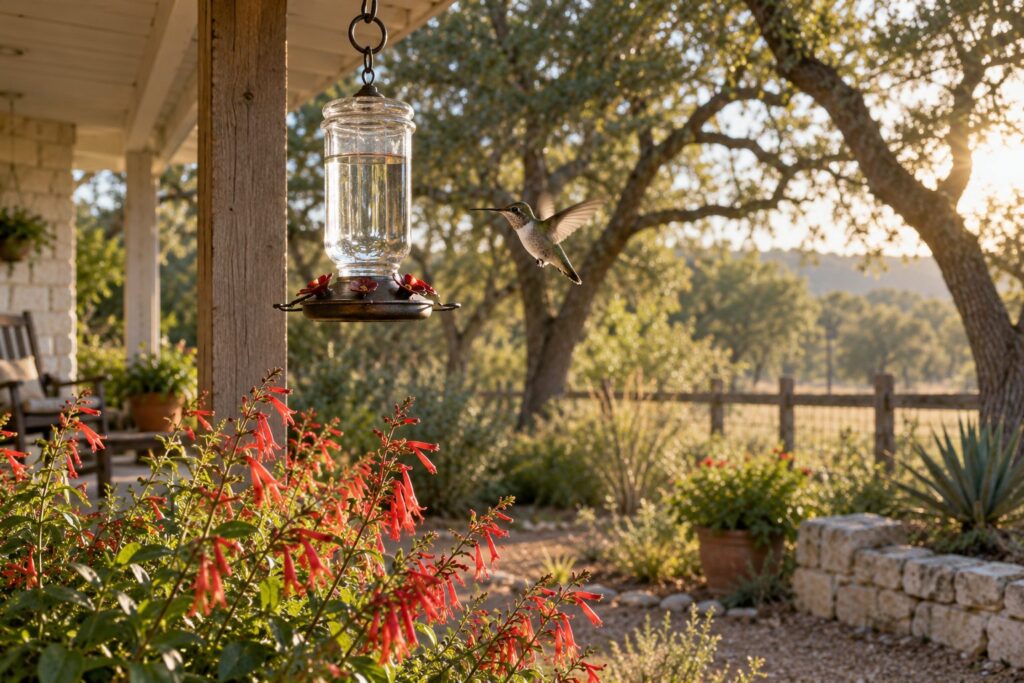
Often, and this is where a Central Texas summer earns its reputation. Sugar water spoils fast in the heat.
Cornell says to change the solution daily in very hot weather, and never to let it sit out for more than two or three days in any weather. AgriLife’s Maureen Frank agrees: during peak season, it is too hot to leave the juice in there for more than a day or two.
The Farmers’ Almanac gives a handy chart:
- Below 70°F, change the nectar every 5 to 6 days.
- Between 70 and 80°F, every 3 days.
- Above 80°F, every 1 to 2 days.
How to clean it:
- Empty the old nectar. Don’t top it up.
- Wash with hot water, or the Almanac’s weak white vinegar solution, and skip dish soap.
- Use a bottle brush inside and a pipe cleaner on the feeding ports.
- Rinse with plain water and refill with fresh, cool nectar.
When you’re buying a feeder, Cornell suggests one with a fill hole wide enough for a bottlebrush, where every crevice is easy to scrub.
Two signs it’s past due, per the Almanac: cloudy nectar or a black-grey haze on the inside walls. If you see either, scrub it before you refill.
One more trick: hang it in shade. The Almanac recommends partial shade to keep the nectar solution from fermenting.
If ants find it, try moving it. One Roundup participant found that moving feeders helped when ants and wasps were a problem.
Which native plants feed hummingbirds in Central Texas?
A feeder is a supplement. Flowers are the real draw, and a bed of natives will keep feeding hummingbirds on days you forget to refill.
TPWD’s Roundup asks participants which plants they see hummingbirds use. In one season’s results, salvias led at 20.7 percent of observations, followed by Turk’s cap at 10.6 percent, with flame acanthus and honeysuckle on the list too. Four natives for hummingbirds that earn a spot in a Central Texas yard:
- Turk’s cap. The Lady Bird Johnson Wildflower Center lists it for part shade or shade, blooming May through November, with red flowers produced in showy profusion during hot weather at the end of summer and early fall, right as fall migration builds.
- Flame acanthus. Also called hummingbird bush. The Wildflower Center says it ranges from south-central Texas and the southern Edwards Plateau, is drought-tolerant, and has flowers that attract hummingbirds and butterflies. It wants full sun.
- Autumn sage (Salvia greggii). The Native Plant Society of Texas notes it blooms March through November in full sun with low water. That long season covers spring arrival and fall migration both.
- Coral honeysuckle. A climbing vine for a fence or trellis, not to be confused with Japanese honeysuckle. The Wildflower Center calls it frequently visited by hummingbirds and lists it blooming March through June, which lines up with the spring arrivals.
Put those four together and you have a relay: honeysuckle and autumn sage for March, flame acanthus through the summer heat, and Turk’s cap carrying the fall rush. Our guide to native plants for birds in Texas goes further, with plants for cardinals, finches and the rest of the yard.
Water matters to hummingbirds too. TPWD’s Klym calls it a critical element of their environment, and a shallow birdbath with a mister or a dripper is easy to add.
Why does one hummingbird chase all the others away?
Because that’s what hummingbirds do. Cornell’s life history notes that male ruby-throated hummingbirds aggressively defend flowers and feeders, with chases and dogfights. The rufous is worse. Cornell calls it extremely territorial at all times of year, attacking any visiting hummingbird, including much larger species. Black-chinned hummingbirds do it too. A Travis Audubon writer describes one bird that sits on the feeder and chases others away, even when they aren’t actively eating.
AgriLife’s Maureen Frank sums it up: they’re a little bit territorial and feisty, so they don’t like to share.
The fix is more than one feeder, spread out. Cornell notes that several small feeders spread around the home can attract and keep more hummingbirds than one large feeder. A few ways to set it up:
- Out of sight of each other. Hang one by the kitchen window and another around the corner of the house, so the bully can’t guard both from one perch.
- Not stacked together. AgriLife advises against placing feeders right on top of each other or too close to a seed feeder.
- Mixed with plants. A Harris County Roundup participant found that after adding habitat, one bird doesn’t dominate all my feeders.
Some people go big. One Medina County participant ran 18 to 20 feeders spread across a property. Two or three is plenty for a town yard.
Where do hummingbirds nest, and how can you tell?
Black-chinned hummingbirds nest across Central Texas. Travis Audubon notes that Central Texas is part of their breeding range, so keep an eye out for small cup shaped nests below the tree canopy. The Breeding Bird Atlas puts their breeding season from late March into mid-August.
What to look for:
- Where. Cornell says black-chinned nests are often on an exposed small horizontal dead branch well below the canopy, and the ones people found were about 6 feet up and at most 12 feet. Ruby-throats tend to build higher, usually 10 to 40 feet above the ground.
- What it looks like. A ruby-throat nest measures about 2 inches across and 1 inch deep, made of thistle or dandelion down, held together with strands of spider silk and dressed with lichen.
- What’s in it. Black-chinned lay two white eggs, about the size of a coffee bean. Incubation runs 12 to 16 days, and the young leave the nest at about 21 days.
The female does the work alone. TPWD’s Roundup notes that females build the nest and care for the young, with males not assisting. The same newsletter has a good tip for finding a nest: females fly to the general area, not straight to it, so look at branch forks nearby.
If you find a nest, admire it from a distance and leave the hummingbirds be. The Roundup asks observers not to disturb nests. Hold off on trimming that tree until late summer, and keep the string trimmer away from the low branches.
A Central Texas hummingbird year at a glance
- Late February: clean the feeder and hang it, about a week before arrival.
- March: black-chinned in the second week, ruby-throats two weeks later.
- April to August: nesting season for the black-chinned, late March into mid-August. Change nectar every day or two once it’s hot.
- Late August to September: the fall rush, with a peak in mid-September. Add a second feeder if you haven’t.
- October: stragglers. Keep feeders up until two weeks after the last one you see, or keep one up all winter.
- November to February: watch for the rufous and buff-bellied, more numerous in the colder months.
If you want to help the people who study them, TPWD’s Hummingbird Roundup is a backyard survey of hummingbirds done every year. Your sightings help show where and when hummingbirds are being seen.
A steel hummingbird by the feeder: what it does, and what it doesn’t
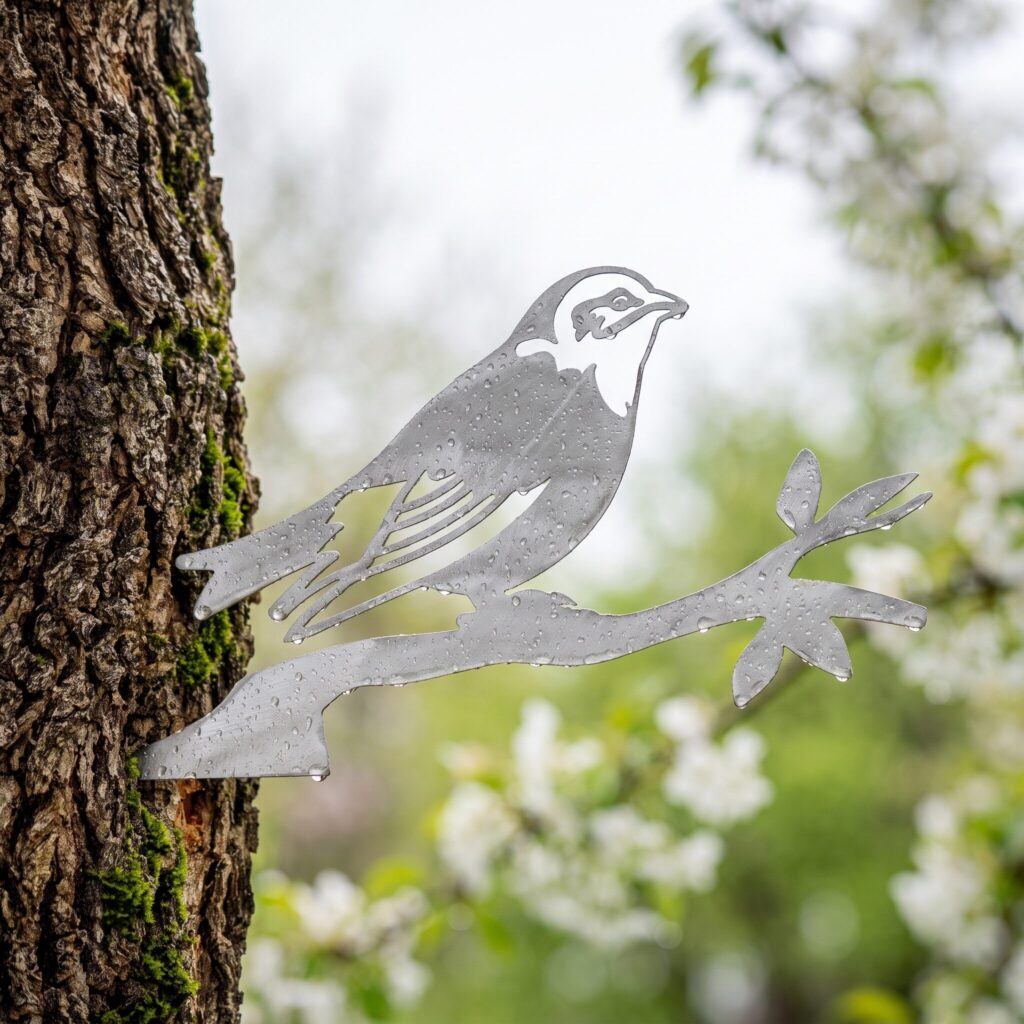
Let’s be straight about this. A steel hummingbird silhouette won’t bring real hummingbirds into your yard. Flowers and fresh nectar do that. Cornell even notes that black-chinned hummingbirds aren’t so much drawn to red as they are to the colors of recent nectar sources.
What a silhouette does is mark the spot. It’s decoration that says “this is the hummingbird corner” all year, including the months the feeder is quiet and the flowers are cut back. In January, when there’s nothing at the feeder but a rufous if you’re lucky, it’s a reminder of what comes back in March.
A few placement ideas:
- On the post or tree beside the feeder, a little above or to the side, so it frames the view from the window without crowding the birds.
- At the edge of the salvia or Turk’s cap bed, on a fence post, where it reads from the patio.
- Facing the window you watch from. That’s the whole point.
Our pieces tap into a tree, a wooden fence post, a porch post or a wall with a hammer, and if the wood is hard you drill a small pilot hole first. If you’re putting one in a tree, our guide on whether a metal tree stake will hurt your tree covers how to do it once and do it right.
Pieces for the hummingbird corner
If you’ve set up a feeder and planted a few natives for hummingbirds, here are the pieces that suit that part of the yard:
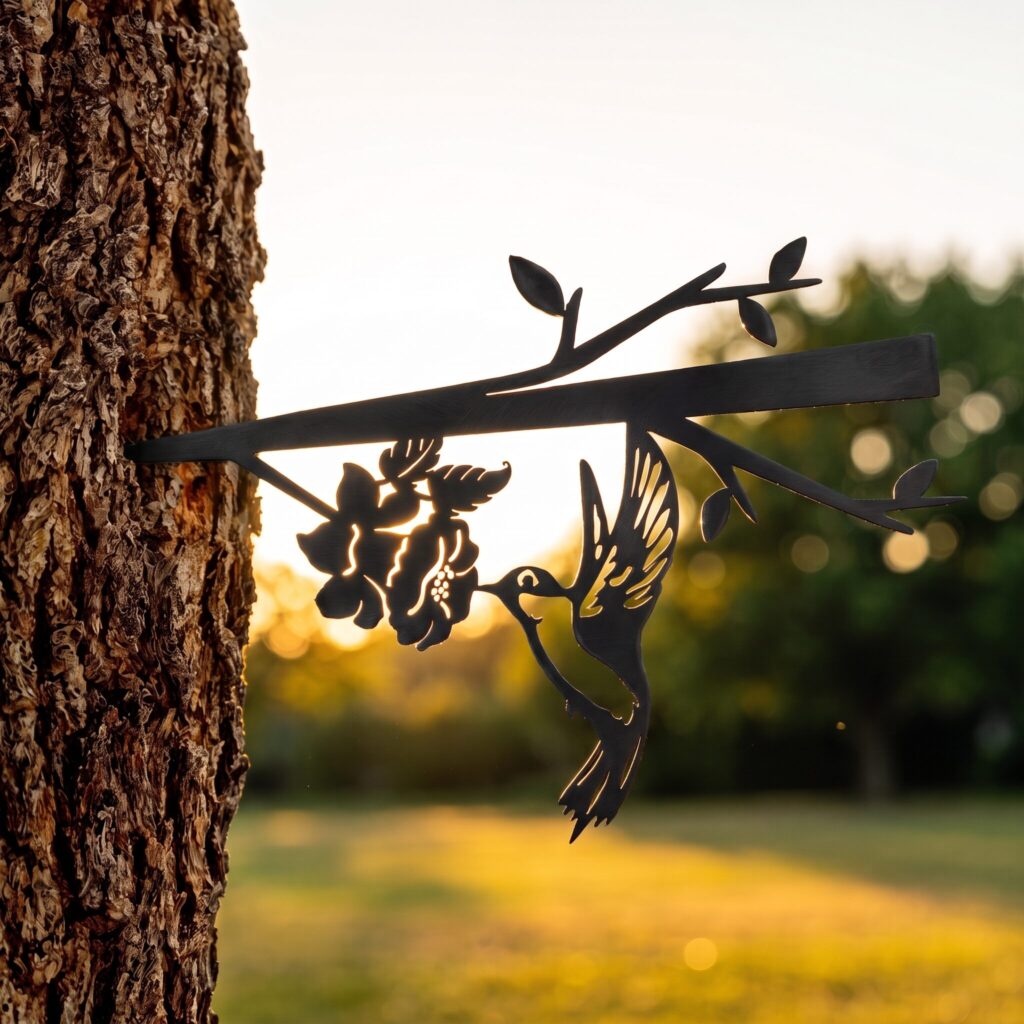
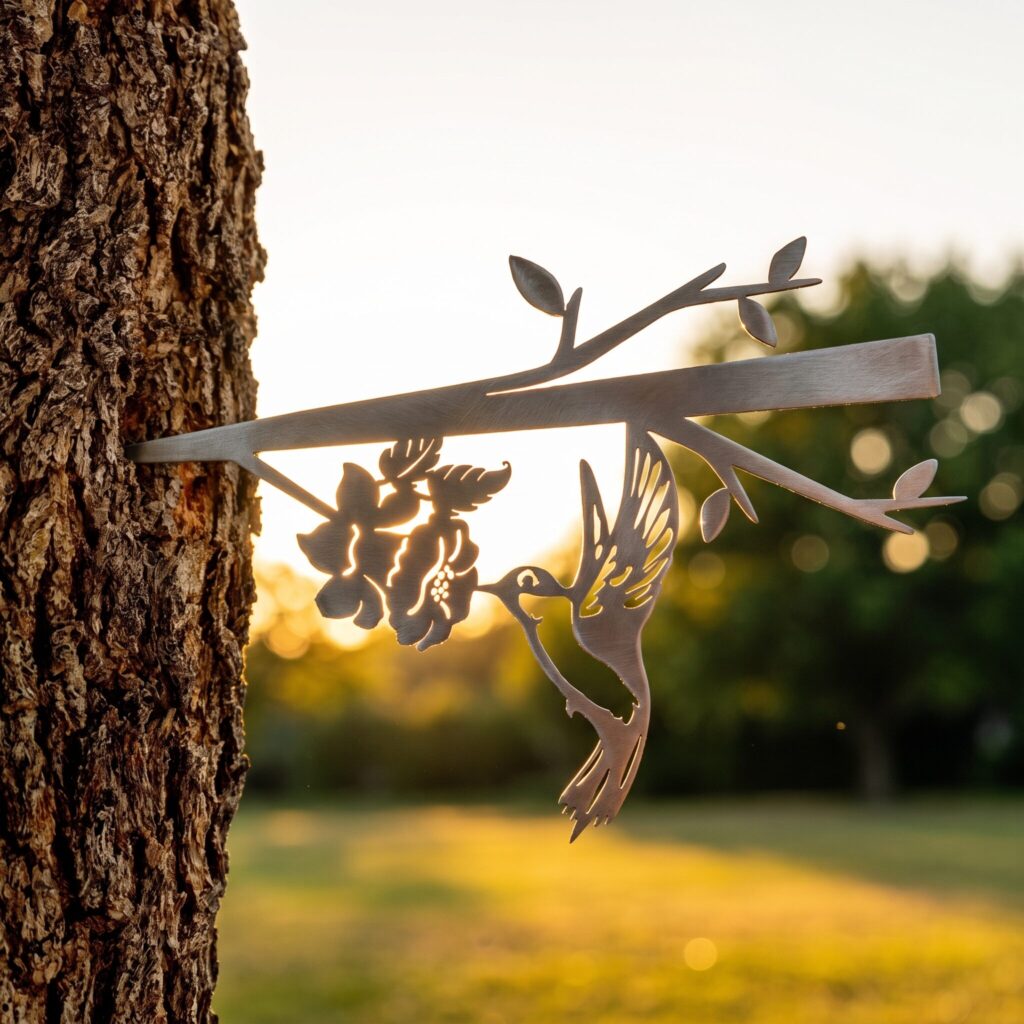
- Hummingbird Stake. The Hummingbird Stake is the obvious one, and a good mark for the feeder post or the tree beside it.
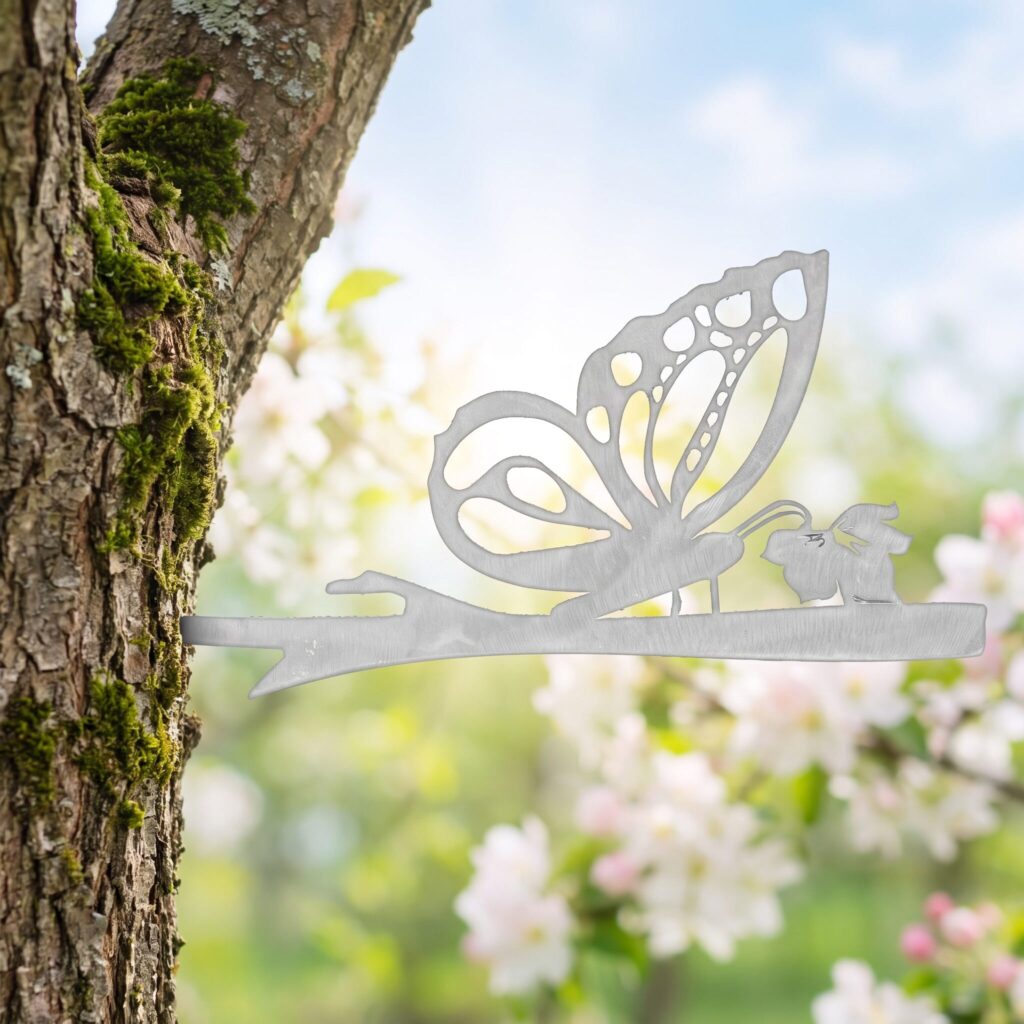
- Butterflies Stake. Flame acanthus attracts hummingbirds and butterflies both, so the Butterflies Stake belongs by the flower bed.
- Finch Stake. The Finch Stake suits the seed-feeder side of the yard, kept a fair distance from the nectar feeder.
- More birds. Browse the rest of the Birds collection if there’s another tree you’d like to mark for the birds that live there year round.
Each piece comes in Raw Steel, which weathers outdoors to a rust-brown, or Black, which keeps a clean, consistent look. Most pieces run 7 to 17 inches, and the exact size is on each product page. If you’re shopping for a gardener or a bird watcher, our list of garden gift ideas that last has more.
Questions customers ask
How do I install it?
Find your spot, then tap the stake in with a hammer. If the wood is hard, drill a small pilot hole first and it will go in easier.
What are Shadow Birds pieces made of?
Solid steel, cut from 1/8-inch American Corten steel. You can choose Raw Steel or Black.
Will the Raw Steel finish rust?
It weathers outdoors on purpose. Most of the change happens in the first several months, then it holds steady. If you’d rather it stay dark and even, choose Black.
Sources
- Central Texas’ March bird forecast, KXAN Austin (Kristen Currie, compiled by Travis Audubon volunteer Jane Tillman), 2 March 2024
- Texas Parks and Wildlife, Passport to Texas: Winter Hummers, Hummingbird Roundup and Hummingbirds Return to Texas
- Hummingbird Roundup newsletter, Vol. 1 Issue 1 (2013 season), Texas Parks and Wildlife Department, 2014
- Texas Hummingbird Roundup 2009 results, Texas Parks and Wildlife Department, Spring 2010
- Spring is the time to put out hummingbird feeders, Texas A&M AgriLife (Dr. Maureen Frank), 18 May 2021
- Black-chinned Hummingbird species account, The Texas Breeding Bird Atlas, Texas A&M AgriLife Research (Robert C. Tweit, 2008)
- How to Make Hummingbird Nectar, National Audubon Society, 15 March 2019
- Feeding Hummingbirds, All About Birds, Cornell Lab of Ornithology, 20 April 2009
- Cornell Lab of Ornithology, All About Birds: Ruby-throated Hummingbird overview, identification and life history
- Cornell Lab of Ornithology, All About Birds: Black-chinned Hummingbird overview, identification and life history
- Cornell Lab of Ornithology, All About Birds: Rufous Hummingbird overview and identification
- Bird of the Week: Black-chinned Hummingbird, Travis Audubon (Lisa S. Graham), 18 July 2023
- When to Take Down Your Hummingbird Feeder, Farmers’ Almanac (Deborah Tukua), updated 27 September 2026
- Hummingbird Nectar Recipe and Feeder Tips, Farmers’ Almanac, updated 7 August 2026
- Lady Bird Johnson Wildflower Center plant database: Turk’s cap, flame acanthus and coral honeysuckle
- Salvia greggii, Native Plant Society of Texas