
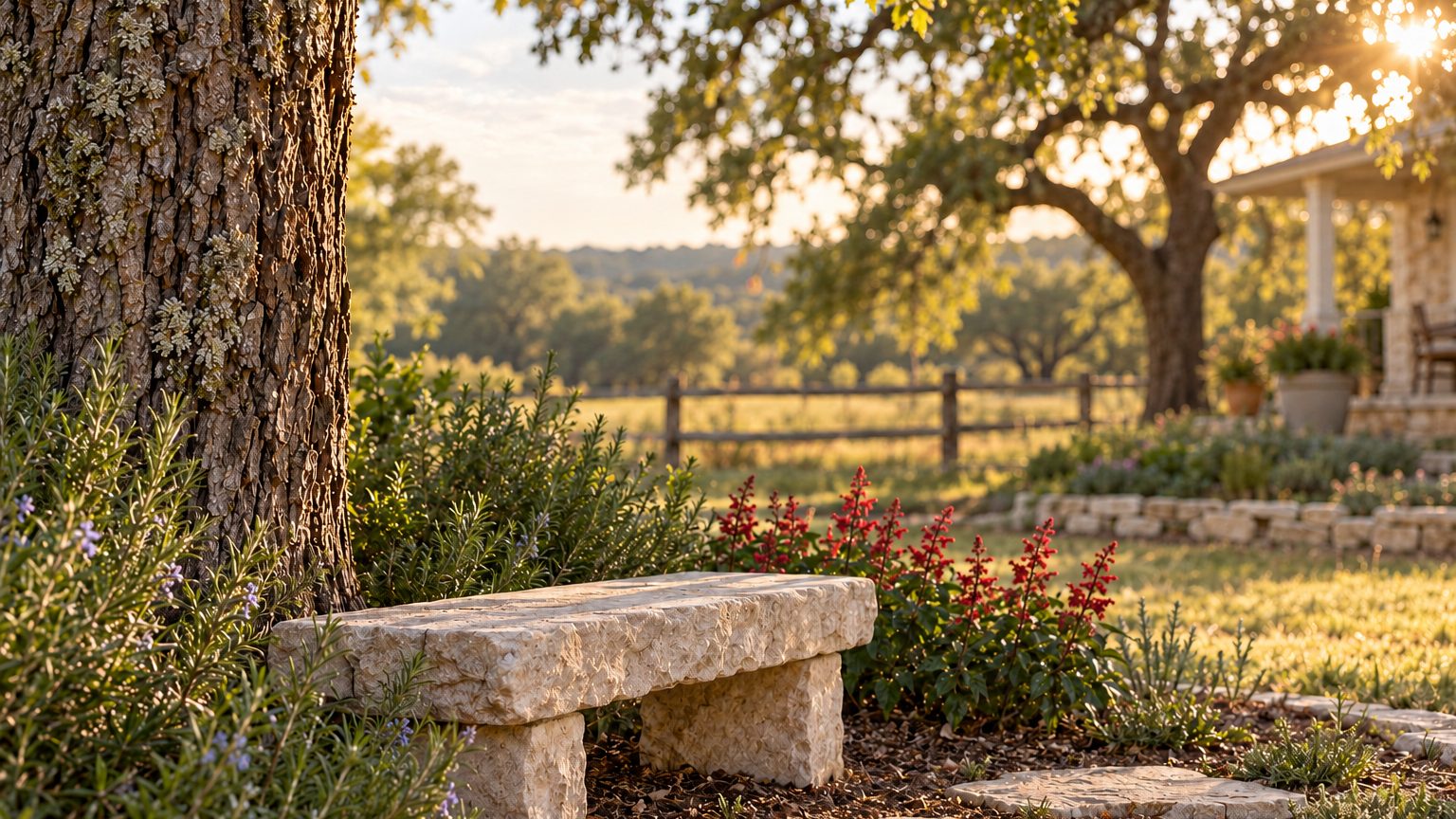
Good memorial garden ideas start small. Pick one spot you see every day, like a tree they loved or the view from a window. Add one focal point, a few plants that carry meaning, something for the birds and a place to sit. A small memorial garden fits in a yard corner or on a porch.
None of it needs a big yard, a landscaper or a deadline. This guide walks through ten parts of a small memorial garden, in order: the spot, a focal point, plants with meaning, plants for birds and butterflies, a path or a seat, personal touches, gardens for pets, doing it as a family, tending it through the year, and when to begin. Near the end there’s a short section on memorial gifts, for anyone helping a friend make one.
Choosing the spot for a small memorial garden
Start with where you’ll actually see it. A small memorial garden is for the people still here as much as for the person you’re remembering, and a spot you pass every day becomes part of your day. A lovely bed at the far end of the lot that you rarely visit won’t.
The master gardeners at Washington State University Extension put it plainly: no space is too small or too large to honor someone. That’s worth holding on to if all you have is a patio.
Places that tend to work for a small memorial garden:
- A tree they loved. The pecan they planted, the oak that held the tire swing. If the tree is already part of the story, the garden has its center.
- The view from a window. Stand at the kitchen sink, or sit in the chair where they used to sit, and look out.
- A corner where two fences meet. The fence lines frame it, and a post gives you somewhere to hang things.
- Beside the porch steps or on the patio. A few pots and a porch post can hold a whole memorial.
- Where they used to work. The edge of the old vegetable patch, or the spot by the shed where the tools lived.
Before you settle, check the two practical things the WSU guide mentions: the amount of sunlight the area receives and the accessibility of the place. Watch the spot through one full day and note where the sun sits morning and afternoon. Then walk to it the way an older relative would, with a cane or in the rain.
A focal point for a small memorial garden: a tree, a bench or a stone
Every small garden needs one thing the eye goes to first. In a small memorial garden, that’s usually the thing that stands for the person.
- A tree. WSU’s master gardeners note that trees add height, longevity and shade, and they advise planning for a plant’s mature size. If there’s already a good tree in the spot, build around its base.
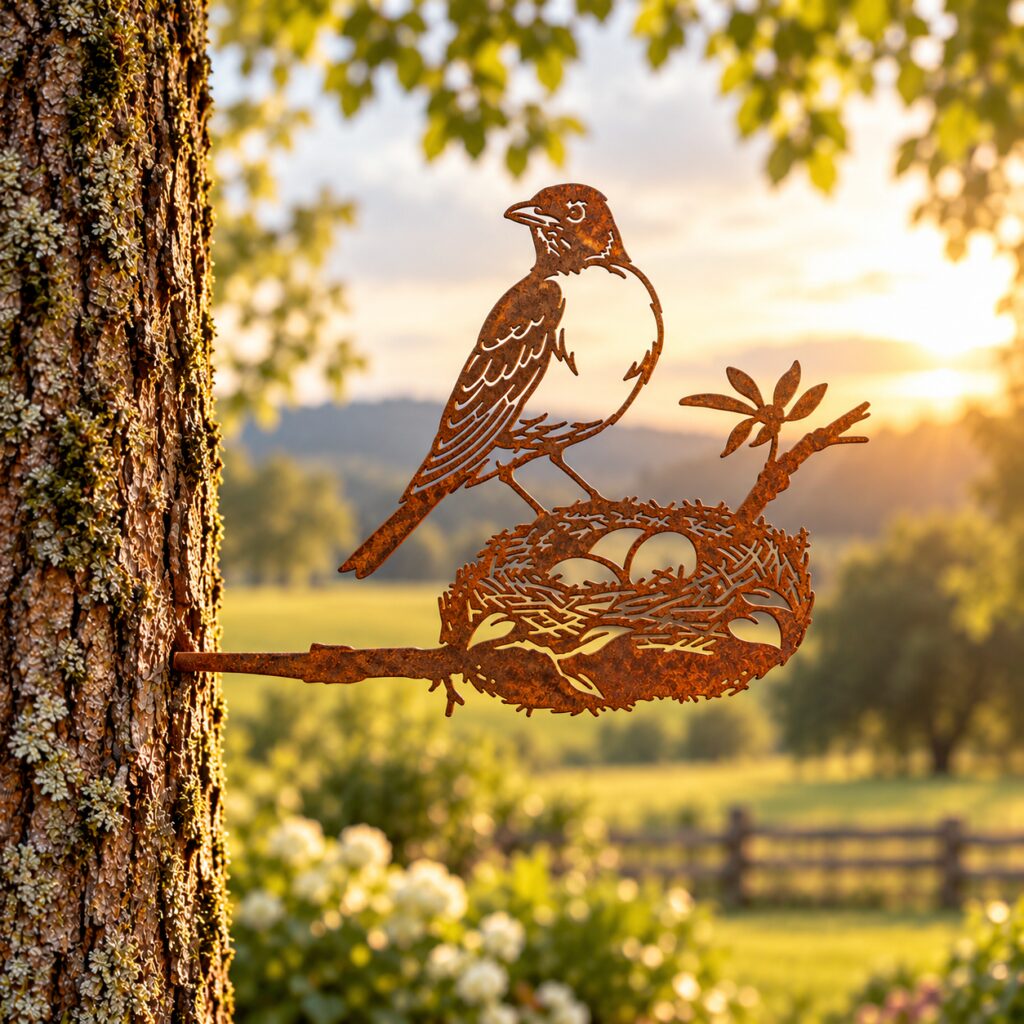
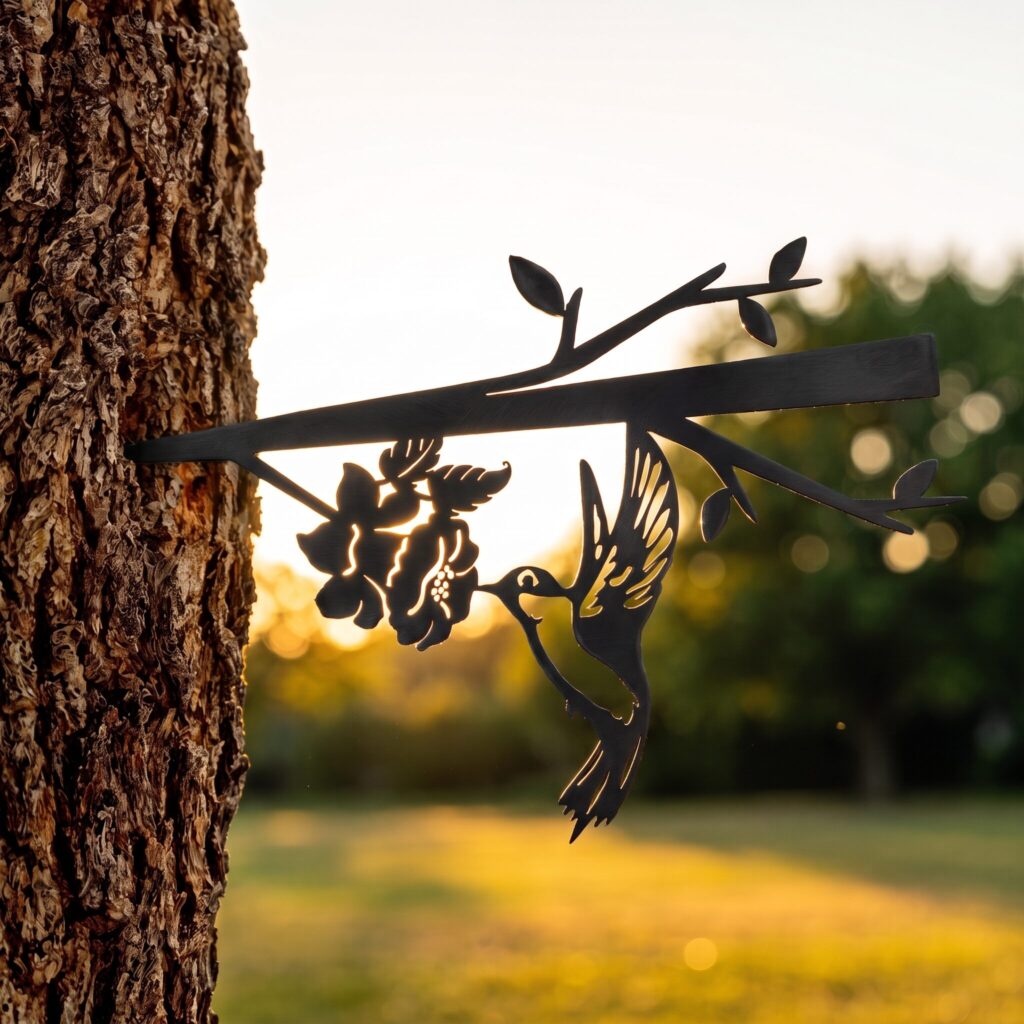
- A silhouette on the tree. A single steel bird on the trunk, about chest height and facing the house, gives the eye a place to land, even in winter when the beds are bare.
- A bench. Sometimes the focal point is simply the place to sit, facing whatever they loved to look at.
- A stone. The WSU guide suggests engraved stones or plaques with chosen wording or poems. A river rock with a name painted on it works too.
Pick one. In a small space, two focal points pull against each other and the garden starts to feel busy. One clear center, with plants around it, reads as settled from across the yard.

Plants that carry meaning
Plants have stood for things for a long time, and borrowing that language is one of the oldest memorial garden ideas there is. You don’t need to know any of it to plant something that matters, but a few plants come with a story attached.
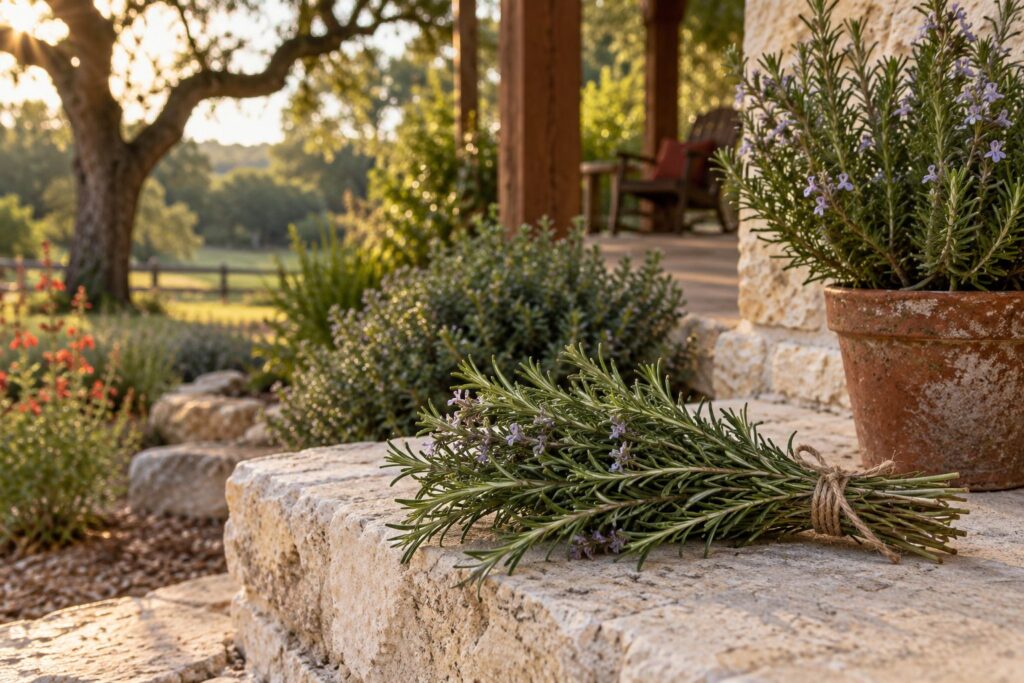
Rosemary, for remembrance. The line comes from Hamlet, where Ophelia says, as UGA Extension’s Keep Bartow Beautiful program quotes it, “There’s Rosemary, that’s for remembrance: pray, love, remember.” It’s also a practical choice for a sunny Texas bed. Texas A&M AgriLife Extension says rosemary should receive at least 6 hours of sun each day and grows best in full sun, and that raised or slightly mounded beds provide the best drainage for it. Plant it beside the path, and the scent comes up every time someone brushes past.
Forget-me-nots, for the name alone. Farmers’ Almanac traces the name to a legend of a German knight who called out “vergiss mein nicht” as a river carried him away, and lists remembrance, faithful love, and lasting connection among its meanings. They enjoy part shade and do better with a bit of shade on sultry afternoons, and the Almanac calls them a cold-loving short-lived perennial that self-seeds. Where summers run hot, treat them as a spring flower in a shady pot.
A few more with old meanings. The WSU guide lists poppies for remembrance and peace, oaks for strength, roses for love and yellow tulips for friendship.
Their plant. Often the plant that means the most is the plain one they grew: her irises, his tomatoes, the rose by the back door. If their garden is still there, ask for a division or a cutting. A clump of irises from Mom’s yard says more than any flower dictionary.
Keep the list short. A small memorial garden needs three or four plants you’ll look after, not twenty you won’t.
Plants that bring birds and butterflies to a small memorial garden
A small memorial garden feels different when something is moving in it. A hummingbird working the flowers, a butterfly on the path, a wren in the shrub by the bench: of all the memorial garden ideas here, this is the one that keeps the place alive.
Native plants do the heavy lifting. Audubon notes that native plants provide nectar for pollinators including hummingbirds, native bees, butterflies, moths, and bats. They also feed the insects birds raise their young on: Audubon points out that native oak trees support over 500 species of caterpillars, and that it takes over 6,000 caterpillars to raise one brood of chickadees.
Three Texas natives that suit a small memorial garden, from the Lady Bird Johnson Wildflower Center’s plant database:
- Turk’s cap, for the shady corner. It prefers partially shady sites, and the Wildflower Center lists it as attracting birds, butterflies and hummingbirds.
- Flame acanthus, for the sunny side. Its flowers attract hummingbirds and butterflies, and it blooms best in full sun but will tolerate light shade.
- Gregg’s mistflower, for butterflies. The Wildflower Center’s 2025 Wildflower of the Year has fuzzy flowers that bloom spring through fall and are especially beloved by queen and monarch butterflies.
Add water if you can. The WSU guide suggests a water source for butterflies and birds, and in a small bed that can be a shallow dish on a stone, rinsed and refilled every few days. Our guide to native plants for birds in Texas goes further into what to plant for the birds you want to see.
Butterflies carry their own meaning for many families. A lot of people take a butterfly that lingers close as a sign that someone they’ve lost is near. That’s a belief, held in the heart, and nobody can tell you whether it’s so. But planting for butterflies means you’ll see more of them, whatever you make of it.
A path or a seat
A small memorial garden is a place to be, not only to look at. WSU’s master gardeners call a place to sit important, whether that’s a bench or other seating, and suggest adding a small table.
In a small memorial garden, keep it simple:
- A seat you already own. Their old lawn chair, the porch rocker, a stump. It doesn’t have to match.
- Face it toward the focal point. Sit down before you commit and see what you’re looking at.
- Think about afternoon sun. In a Texas summer, a seat in full western sun won’t get used until October. Tuck it into the tree’s shade.
- Room for two. Sometimes the visit is a quiet one with someone else.
For a path, the WSU guide mentions stepping-stones and pathways as ways to shape the space. Three or four stones from the back step to the bench are enough. Lay them where your feet actually fall, wide enough to walk with a watering can.
Personal touches
This is where a small memorial garden stops looking like a flower bed and starts looking like them. A few memorial garden ideas people come back to:
- Their words. Their name, a date, or a phrase they always said, on a stone or a small plaque.
- Something from their life. An old watering can, a boot planted with succulents, the wind chime from their porch.
- Their color. If she always wore blue, plant blue salvia. If he never went anywhere without his burnt-orange cap, you know what to do.
- Light for the evening. WSU suggests solar lights, and one lantern by the bench makes it a place you can visit after dark.
- A bird they loved. Many people think of a cardinal as a visit from someone they’ve lost. Our piece on what it means when you see a cardinal goes into where that belief comes from, and why it settled on this bird.
Choose two or three and stop there. A small space reads better with room around each thing, and you can always add something on a birthday or an anniversary.
Memorial garden ideas for pets
A small memorial garden doesn’t have to be for a person. WSU’s guide describes a remembering space for a dear pet who shared their lives, and a pet’s garden can be the smallest of all.
Some memorial garden ideas for a dog, a cat or any animal who was family:
- Their spot. The patch of sun they slept in, or the gate they watched from.
- A stone with their name, maybe with a paw print pressed in before the concrete set.
- Their collar or tag, hung from a branch or a hook on the fence post.
- A wry one. A steel squirrel on the post for the dog who spent its whole life chasing the real ones.
If a dog or cat still shares the yard, look up anything new before you plant it in the ASPCA’s database of plants that have been reported as having systemic effects on animals. Then set the memorial away from the spots where the current dog likes to dig.
Making a small memorial garden together as a family
Building a small memorial garden is one of the few things after a loss that the whole family can do with their hands. The WSU guide’s advice is to “give them a specific role so they can feel the cathartic, calming pleasure of participation in the project.”
Roles that tend to fit:
- Young children can paint a stepping stone or press their handprints into one. WSU notes that family members can contribute stepping stones, bought or made at home.
- Teenagers can pick the plants or build the seat. Give them the decision, not just the shovel.
- Grandparents can choose the words for the stone.
- Family who live far away can send seeds, a cutting, or a memory to write on a tag.
The WSU guide also suggests a dedication event that shares the person’s favorite foods, songs, and memories. It doesn’t have to be formal. A Saturday, a pot of chili, the radio on their station, and everyone with dirt on their knees is plenty.
Let children be children about it. They may want a gnome. They may want to dig and wander off. Both are fine, and some of the sweetest memorial garden ideas come from them.
Tending it through the seasons
A small memorial garden changes through the year, and visiting it to tend it is part of the point. Be honest about how much upkeep you want. The WSU guide suggests a low maintenance ground cover, such as creeping thyme, in place of grass that needs mowing. A garden that turns into a chore stops being a comfort.
A simple rhythm for a small memorial garden in Texas:
- Spring. Forget-me-nots in the shady pot, fresh mulch, and a look at the focal point. If a piece on the tree has loosened, a light tap sets it again in the same hole.
- Summer. Water early. Go easy on the rosemary: AgriLife warns that too much water can cause root rot. Turk’s cap and flame acanthus carry the color through the heat.
- Fall. The mistflower is still going and the light turns low and gold. A good season to sit out there again.
- Winter. Rosemary stays green, and a steel bird on the trunk keeps the spot marked. The Compassionate Friends hold a Worldwide Candle Lighting, with candles lit at 7:00 pm local time on December 13 this year, for families remembering children who have died. A candle in a lantern by the bench is a quiet way to join in.
Birthdays and anniversaries make good tending days too. Pull a few weeds, add one plant, sit a while.
When to start: there’s no right time
Some people start the week of the funeral, planting the potted flowers that came to the house. Others wait until the second spring, or longer. Both are right.
The Compassionate Friends, who support families after the death of a child, put it this way to newly bereaved parents: “we invite you to walk with us for as long as the journey takes.” Grief keeps its own time, and so can a garden.
If you take one of these memorial garden ideas away, make it this: start with one thing. A pot of rosemary by the back door, or one bird on the tree you see from the kitchen. A single plant you water while you think of them is already a small memorial garden.
Small memorial garden ideas for a porch or patio
No yard at all? A porch or patio can hold everything above in a few square feet.
- One large pot of rosemary in the sunniest spot, with drainage holes, since rosemary wants the well-drained soil AgriLife describes.
- A shady pot for forget-me-nots in spring, swapped for something heat-tough in summer.
- A chair and a small table, facing out.
- A piece on the porch post. Our pieces tap into a porch post or a wall as easily as a tree.
- A wind chime or a solar lantern, for sound and evening light.
Containers dry out fast on a hot porch, so check them daily in summer. A patio garden also moves with you if you rent.
Memorial gifts for someone making a garden
If you’re helping someone else, a piece for their small memorial garden is one of the memorial gifts that keeps meaning something after the casseroles stop coming. Flowers fade in a week. A rosemary plant, a stone or a bird on the tree gets seen every day.
Memorial gifts that suit a garden:
- A rosemary plant with a card that carries Ophelia’s line.
- A stepping stone with the person’s name, or a kit so the family can make one together.
- A bench cushion or a lantern for the seat they’ll sit on.
- Your time. Offer a Saturday with a shovel. It may be the gift they remember.
- A steel bird for the tree, so the spot is marked even before anything is planted.
Good memorial gifts leave the placement to them, so don’t be surprised if it sits in its box for a while first. Our guide to sympathy gift ideas instead of flowers has more, and if the loss is a dad, see our piece on choosing a memorial gift for the loss of a father.

Pieces that suit a small memorial garden
If you’d like something on the tree or the post that stays through every season, these pieces suit a small memorial garden well, and they make quiet memorial gifts too. Each one is solid steel and comes in a Raw Steel or Black finish.
- Cardinal Stake: A single cardinal on a branch, for the window you look out of in winter.
- Kissing Cardinals: A pair on one branch. For a long marriage, or for the parent who’s still here.
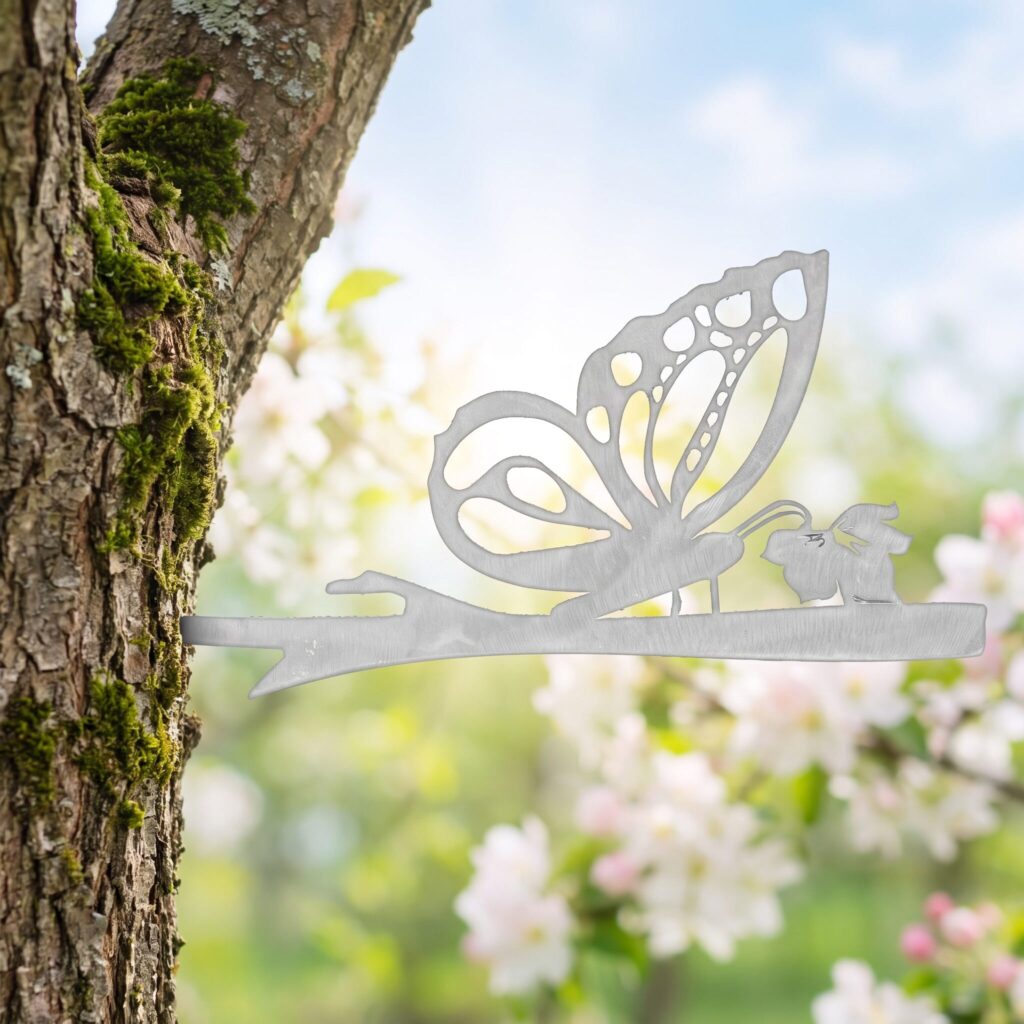
- Butterflies Stake: For the family that sees a butterfly and thinks of someone.
- Hummingbird Stake: For the person who was small, quick and never still, and for a bed of flame acanthus and Turk’s cap.
- Mama Bird Stake: A bird on a nest with one, two or three eggs. Some families choose the number to match the children.
The whole Birds collection is worth a look if the person had a bird of their own: a woodpecker, a blue jay, an owl.
These pieces don’t go into the ground. They tap into a tree, a wooden fence post, a porch post or a wall with a hammer, so in a bed, set the piece on the nearest tree or post. Most pieces run 7 to 17 inches, and each product page lists the exact size. Raw Steel weathers to a warm rust-brown that settles into a garden, and Black keeps a clean, consistent silhouette.
If you’re making a garden for someone in particular, a few of our other guides may help: patriotic garden decor for a veteran, what many people feel when seeing a butterfly after someone dies, and getting through Mother’s Day without mom.
Questions customers ask
How do I install it?
Find your spot, then tap the stake in with a hammer. If the wood is hard, drill a small pilot hole first and it will go in easier.
Will the Raw Steel finish rust?
It weathers outdoors on purpose. Most of the change happens in the first several months, then it holds steady. If you’d rather keep a clean, consistent look, choose Black.
What are Shadow Birds pieces made of?
Solid steel, in a Raw Steel or Black finish.
Sources
- Planning a Memorial Garden, WSU Skagit County Extension Master Gardeners (Kathy Wolfe), 16 May 2024
- Rosemary, Keep Bartow Beautiful, UGA Extension
- Rosemary (E-623), Texas A&M AgriLife Extension Service
- Forget-Me-Nots: Symbolism, Folklore, and How to Grow Them, Farmers’ Almanac, updated 20 September 2026
- Why Native Plants Matter, National Audubon Society
- Turk’s cap, Native Plant Database, Lady Bird Johnson Wildflower Center
- Flame acanthus, Native Plant Database, Lady Bird Johnson Wildflower Center
- Wildflower of the Year 2025: Gregg’s Mistflower, Lady Bird Johnson Wildflower Center
- Toxic and Non-Toxic Plants, ASPCA Animal Poison Control
- Worldwide Candle Lighting, The Compassionate Friends
- To The Newly Bereaved, The Compassionate Friends