
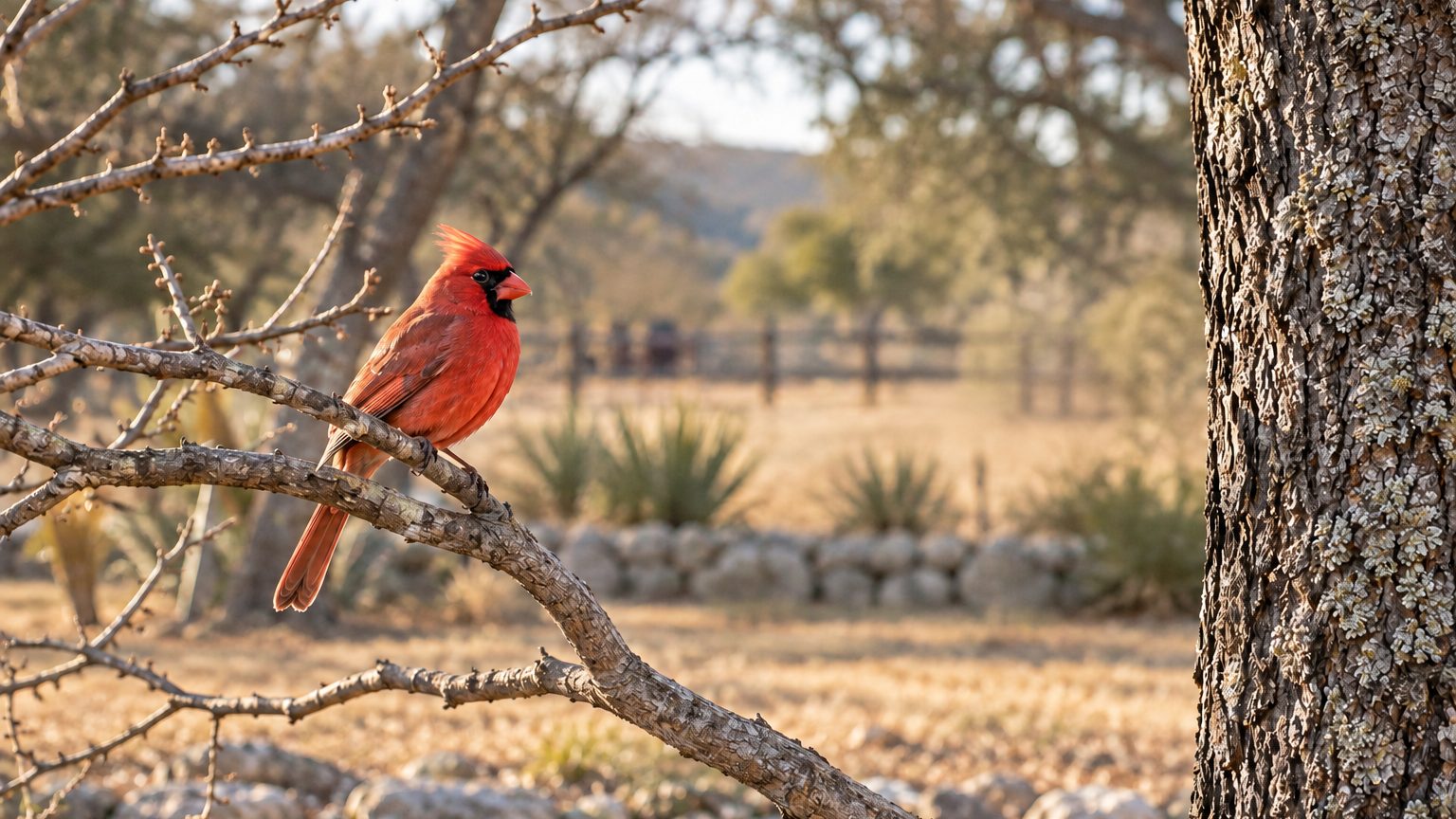
For a lot of people, seeing a cardinal means someone they’ve lost is close by. It’s a folk belief, passed person to person, not a tradition with a written origin. But it makes sense. Cardinals don’t migrate, so they’re still in the yard in January, when people miss someone most.
You’ll hear it said a few ways. When cardinals appear, angels are near. A cardinal is a visit. Someone is checking in. However it’s put, the feeling is the same: a flash of red at the feeder on a gray morning, and the sense that you aren’t quite alone.
This guide goes through where that feeling comes from, the four honest reasons it attaches to this bird and not another, what the real birds are doing when they turn up, and how people keep a cardinal close.
Where the cardinal meaning comes from
There’s no single source for it. No scripture, no famous poem, no founding story. The cardinal meaning most people know has been handed along the way recipes are: by a grandmother, at a funeral, in a sympathy card, in a conversation over the fence.
That’s part of why it holds. It isn’t a rule anyone has to believe. It’s something people offer each other when there isn’t much else to say.
We won’t tell you what to make of it. We’ll tell you what’s true about the bird, which turns out to explain a great deal about why the belief settled on cardinals in particular.
Reason one: cardinals stay all winter
A lot of backyard birds head south for the winter. Cardinals stay.
Cornell Lab of Ornithology notes that cardinals don’t migrate and don’t molt into a duller winter plumage. The bird you see in July is the bird you see in January, in the same red.
Winter is also when grief can sit heavy. The holidays, the first cold mornings, the anniversaries that seem to cluster at the dark end of the year. Seeing a cardinal then isn’t a coincidence of the calendar so much as a fact of the bird: it’s one of the few still there to see.
Reason two: that red in a gray season
Picture a yard in February. Bare branches, brown grass, a gray sky, maybe a skin of old snow. There’s very little color anywhere.
Then a male cardinal lands on the hedge. Because cardinals don’t molt into a duller winter plumage, he’s the same vivid red in the coldest month as he is in June, and against a gray yard he looks almost lit from inside.
Cornell describes cardinals as still breathtaking in winter’s snowy backyards. It’s hard to see that and not stop what you’re doing. That moment of stopping is where a lot of people first feel the cardinal meaning for themselves.
Reason three: cardinals come close
Some birds you only glimpse at a distance. Cardinals come to the window.
Cornell says nearly any bird feeder in their range will draw them, especially with sunflower seed. They also live in the kind of places people do: the lifehistory page lists backyards and ornamental landscaping alongside hedgerows and forest edges.
A bird that shows up at the kitchen window every morning, close enough to see the black mask around the beak, is easy to start talking to. Plenty of people do. Seeing a cardinal that close, that often, is part of why it feels personal.
Reason four: cardinals stay in pairs
Part of the cardinal meaning is about staying together.
Cornell notes that cardinal pairs may stay together through the winter, and that the female sings too, often from the nest, which isn’t common among North American songbirds. A pair calling back and forth across a yard sounds a lot like two people checking on each other.
To be honest about it, not every pair lasts. The same Cornell page says up to 20 percent of pairs split before the next breeding season. But most of what people see in a winter yard is a pair, or a bright male and a quieter brown female, keeping close. People who’ve lost a husband or wife tend to notice that.
What cardinals are doing through the year
Seeing a cardinal in a different season can mean you’re watching a different part of its year. Knowing what the bird is up to makes the visits easier to read.
- Spring. This is when pairs settle on a nesting area, and when males get territorial. It’s also when the window tapping generally occurs, because a bird defending its patch mistakes its reflection for a rival.
- Summer. Nesting season. The pair calls back and forth while they choose a site and carry nesting material, as Cornell describes, and their songs are among the first sounds of a summer morning.
- Fall. Families break up and birds start to gather. In fall and winter, cardinals can form flocks of about a dozen to several dozen.
- Winter. The feeder months. The same red, the same yard, and often the same pair, since pairs may stay together through winter.
So the bird at your window in March may be guarding a nest, and the one at your feeder in January may be one of a small winter flock. Either way, it chose your yard.
If you’re grieving right now
If you’re reading this because a cardinal turned up at a hard time, we’re sorry for your loss.
Whatever you make of the bird, the feeling it brought is worth paying attention to. Some people keep a note of when they see one. Some tell the person they’re grieving with, and find that person has been seeing them too. Some put a feeder up in the spot their person loved and leave it there.
And if the days are heavy, it’s worth saying out loud to someone who cares about you. A cardinal at the window is a good reason to call a friend and tell them about it.
Is seeing a cardinal a sign from heaven?
That’s not ours to say, and we don’t think anyone can say it for you.
What we can say is that the feeling is common, it’s sincere, and it doesn’t need anyone’s permission. If seeing a cardinal on the fence makes you think of your father, then the cardinal has done something real for you, whatever else is or isn’t true.
What’s also true is everything above. The bird stays through winter, wears the same red when everything else is gray, comes close to the house, and keeps company in pairs. Those are good reasons for a belief to settle on it, and they hold whether you take the belief as faith, comfort, or simply a way of remembering.
What it means when a cardinal keeps coming to your window
Sometimes a cardinal does more than visit. It taps on the glass, or flies at the window again and again, for days.
People sometimes read meaning into that too. The bird’s reason is simpler. Extension horticulturists answering through Ask Extension explain that territorial birds like cardinals see their own reflection and treat it as an intruder. It generally occurs in spring, when birds are defending a nesting area.
It’s usually not lethal, though it can be exhausting for the bird. The same answer suggests a few ways to help:
- Cover the outside of the glass with netting or fabric to hide the reflection for a while.
- Hang something shiny, like old CDs or reflective tape, in front of the window.
- Use the semi-transparent window stickers made to keep birds from hitting glass.
None of that takes anything away from what it meant to you to see it. It just helps the bird get on with its spring.
Male or female: which cardinal are you seeing?
The bright red bird is the male. The female is a warm brown with the same crest, and Cornell describes brown females with red accents.
People often notice the male first and only later realize the brown bird beside him is his mate. Once you start seeing them as a pair, it’s hard to stop.
Cardinal facts people are surprised by
A few things about the real bird that tend to surprise people:
- Seven states claim it. The northern cardinal is the state bird of Illinois, Indiana, Kentucky, North Carolina, Ohio, Virginia and West Virginia.
- The female sings. In many songbirds only the male does. The female cardinal sings, often from the nest.
- Winter flocks. In fall and winter, cardinals can gather in flocks of about a dozen to several dozen birds, which is why a feeder can suddenly be full of red.
- Early singers. Their songs are among the first sounds of the day on summer mornings.
How to bring real cardinals to your yard
If you want the real bird around more often, give it what it looks for.
Cornell describes cardinals living in dense, shrubby places: forest edges, hedgerows, overgrown fields and backyard plantings. A thick hedge or a stand of shrubs near the house gives them cover, and cover is what makes a bird comfortable coming close.
Then feed them. Cornell notes they eat many kinds of birdseed and especially black oil sunflower seed. A few practical tips:
- Put the feeder near cover. A few feet from a shrub gives cardinals somewhere to wait and somewhere to retreat.
- Put it where you’ll see it. Pick the window you sit by most.
- Keep it full through the winter, when there’s the least for them to find.
- Be patient. It can take a little while for birds to find a new feeder. Once cardinals do, they tend to come back.
Where to put a cardinal in the yard
If it’s for you, or you’re helping someone set theirs, a few places tend to work:
- The tree outside the window you sit by most. The whole point is seeing it, and a winter view matters most.
- Near the feeder. Real cardinals and a steel one, side by side, is a nice thing to look at on a cold morning.
- By a bench or a favorite chair outside. Somewhere a person used to sit.
- In a small memorial bed, with a few plants they loved.
Set it around chest height, facing the house, with light behind it if you can. Our guide on whether a metal tree stake hurts the tree covers how to choose the tree and set it once. If you’re deciding between the two finishes, our guide to Corten steel yard art explains how the Raw Steel finish weathers.
Other birds people connect with someone they’ve lost
The feeling isn’t reserved for cardinals. People talk about other visitors this way too, and the experience is much the same: a creature turns up at the right moment, and it seems like more than chance.
- Butterflies come up often, especially when one lands close or lingers. Our Butterflies Stake is often given for that reason.
- Hummingbirds come up for people who remember someone small, quick and fearless. The Hummingbird Stake catches one mid-hover.
- Robins and sparrows come up for people who think of the everyday birds on the lawn. The Sparrow and House Stake gives one a little home.
None of these replace the cardinal. They’re just reminders that the feeling isn’t really about one species. It’s about noticing, and letting what you notice mean something.
Keeping one in the yard
Some people hang a feeder. Some keep a cardinal where they’ll see it every day, whether or not the real one comes by.
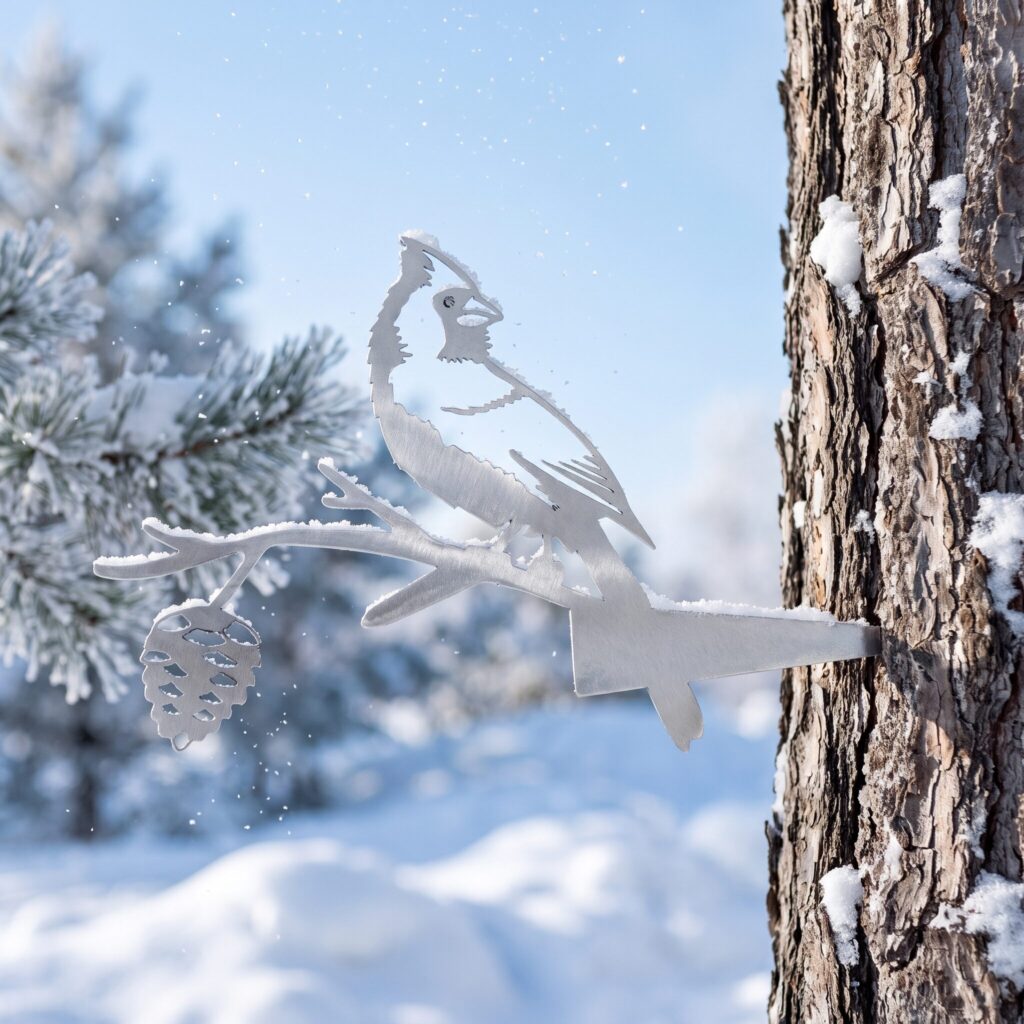
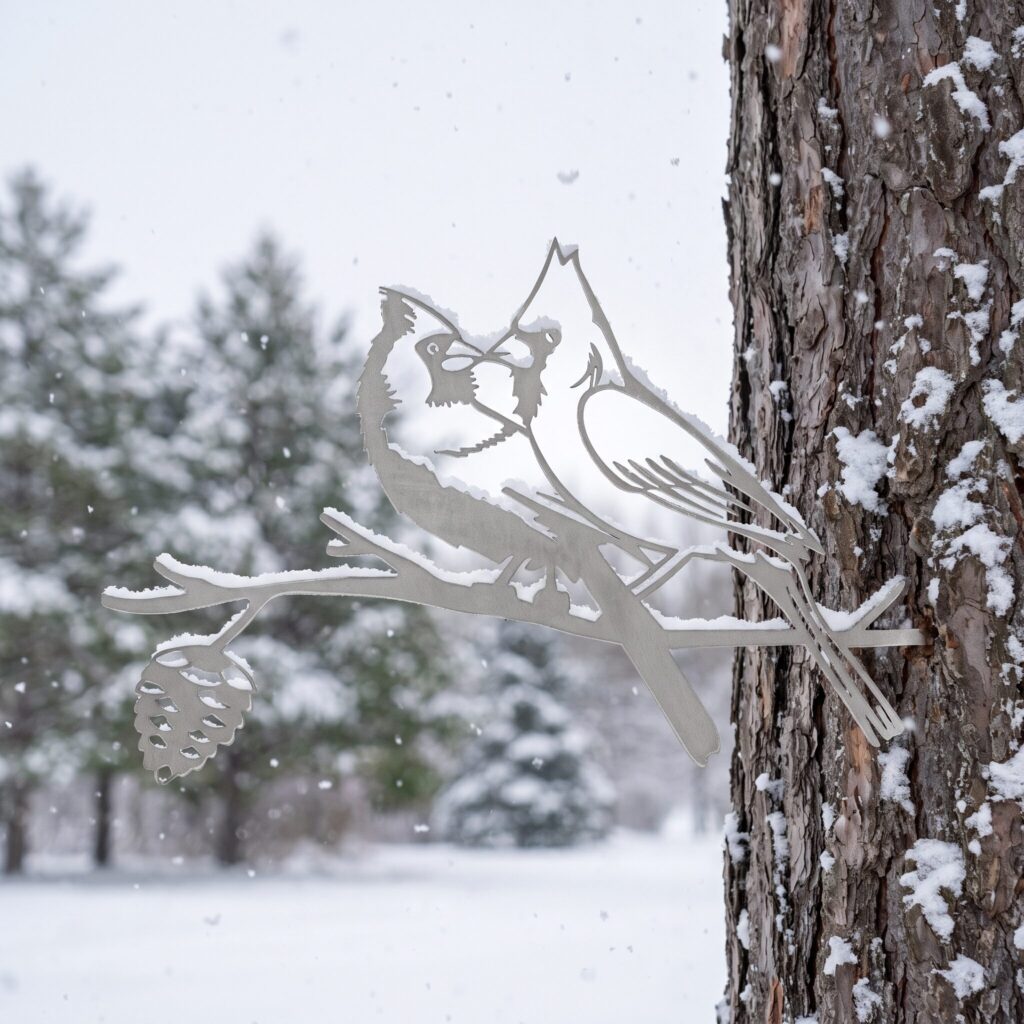
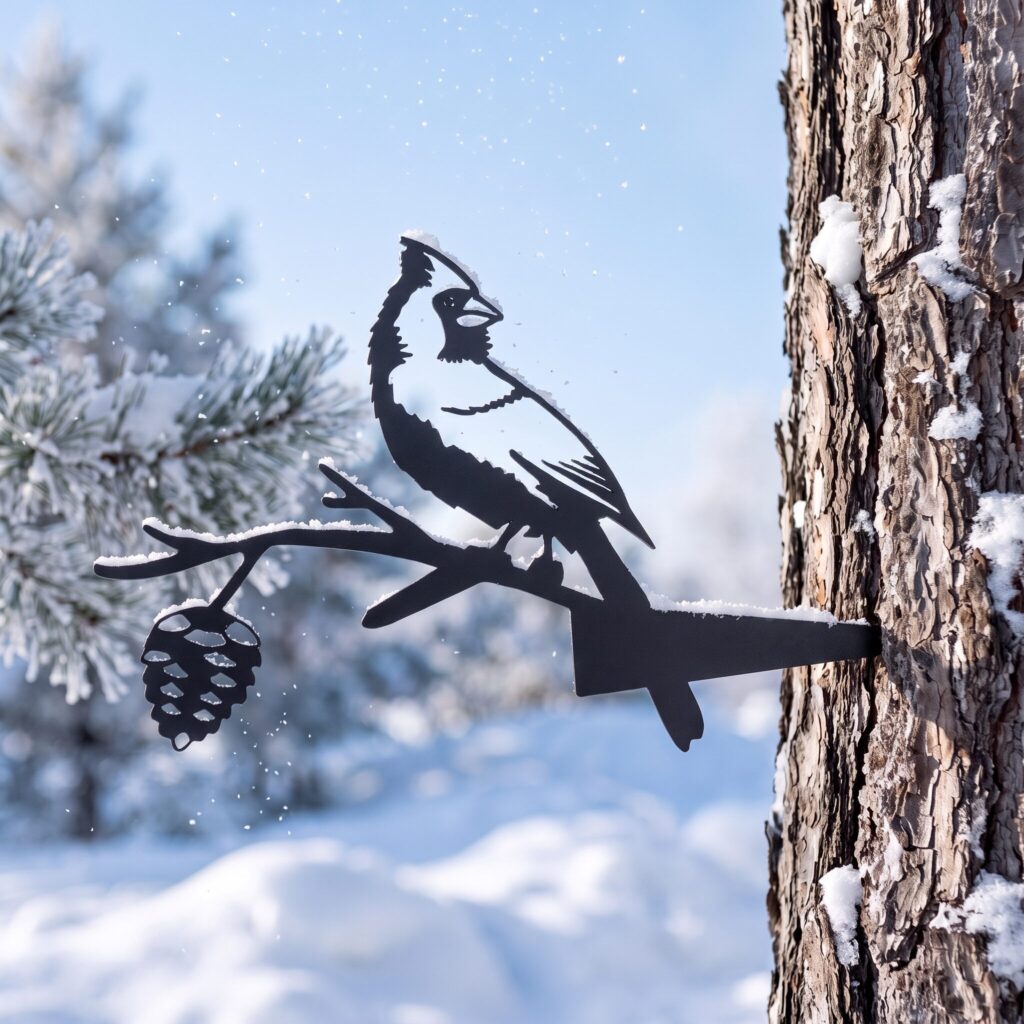
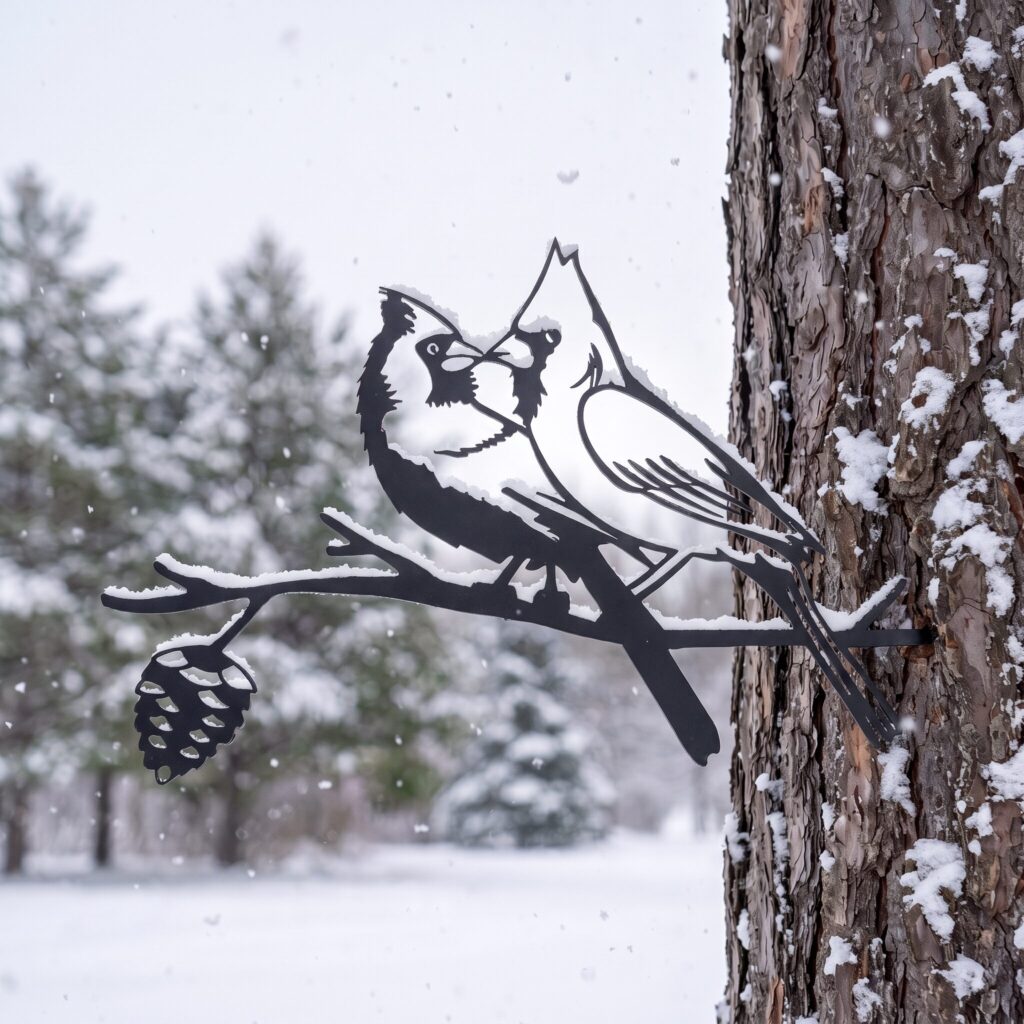
We make two. The Cardinal Stake is a single bird in full silhouette. Kissing Cardinals is a pair, beak to beak, cut as one piece. People give them in memory of someone, and for anniversaries. Both are solid steel, in a Raw Steel or Black finish.
People tend to set them where they’ll be seen from a window in winter. That’s when you’ll want it.
On the finish: the Raw Steel version weathers to a warm brown that sits naturally in a tree, and the Black version stays a crisp, dark silhouette that reads clearly against snow or a pale winter sky. Neither is red, and that’s on purpose. The real red belongs to the bird at the feeder; the steel one is the outline that’s always there, even on the mornings the real one doesn’t come.
Most of our pieces run between 7 and 17 inches, and each product page lists the exact size, so you can picture it on the trunk before you order.
If you’d like to make a small place for remembering, these memorial garden ideas walk through it step by step, and whether cardinals mate for life covers how real pairs behave.
Giving a cardinal as a memorial or sympathy gift
A cardinal is one of the few sympathy gifts that keeps working after the flowers are gone. A card gets put away. A cardinal on the tree out front gets seen every morning.
A few things that help:
- There’s no wrong time. Right after a loss is fine. So is the first winter, a birthday, or the anniversary of the day itself. Sometimes the later gift lands more gently.
- Say why, briefly. A line is enough: “So you have one in the yard all winter.” You don’t need to explain the folklore. Most people already know it.
- Leave the placement to them. They’ll know which window they look out of, and which tree their person loved. Don’t be surprised if it stays in its box a while first.
- Choose the finish for the setting. Raw Steel weathers and settles into the yard. Black keeps a clean, consistent look.
If the person you’re thinking of was half of a long marriage, Kissing Cardinals says a lot without any words at all.
Cardinals and the holidays
Cardinals turn up on a lot of Christmas cards, wreaths and ornaments, and it isn’t hard to see why. They’re red, they’re out in the snow, and they’re at the feeder in December when most other birds have gone.
That overlap matters for the cardinal meaning too. The first Christmas after a loss can be a hard stretch, and it’s exactly when the bird is everywhere you look: on the cards, on the tree, and out the window. For a lot of people, seeing a cardinal in December carries extra weight.
If you’re giving one as a gift around the holidays, that timing is worth knowing. It can land as comfort, and it can also land as a lot. A short, plain note helps either way.
What to write in a card with a cardinal
You don’t need to explain the folklore. Most people already know it, and the ones who don’t will understand the gesture. Keep it short and specific. A few lines people have used, to borrow or change:
- “So there’s one in the yard all winter.”
- “For the tree you can see from the kitchen. Thinking of you.”
- “She loved the cardinals at the feeder. Now you’ll always have one.”
- “For the two of you, still together.” (With Kissing Cardinals, for an anniversary.)
- “No need to put it up yet. It’ll keep until you’re ready.”
If you knew the person who died, one sentence about them is worth more than anything about birds. “He used to fill that feeder every morning” will mean more than a paragraph.
Questions customers ask
Will it arrive in time for a holiday gift?
A lot of these are bought as gifts. Order early during Christmas, Valentine’s Day and other peak weeks to make sure it arrives on time.
What are Shadow Birds pieces made of?
Solid steel. Most pieces come in a Raw Steel or Black finish.
Sources
- Northern Cardinal life history, All About Birds, Cornell Lab of Ornithology
- Northern Cardinal overview, All About Birds, Cornell Lab of Ornithology
- Why a bird pecks at windows, Ask Extension (Home & Garden Information Center, University of Maryland Extension)
- Why Indiana shares a state bird with six other states, FOX59, 29 November 2023