
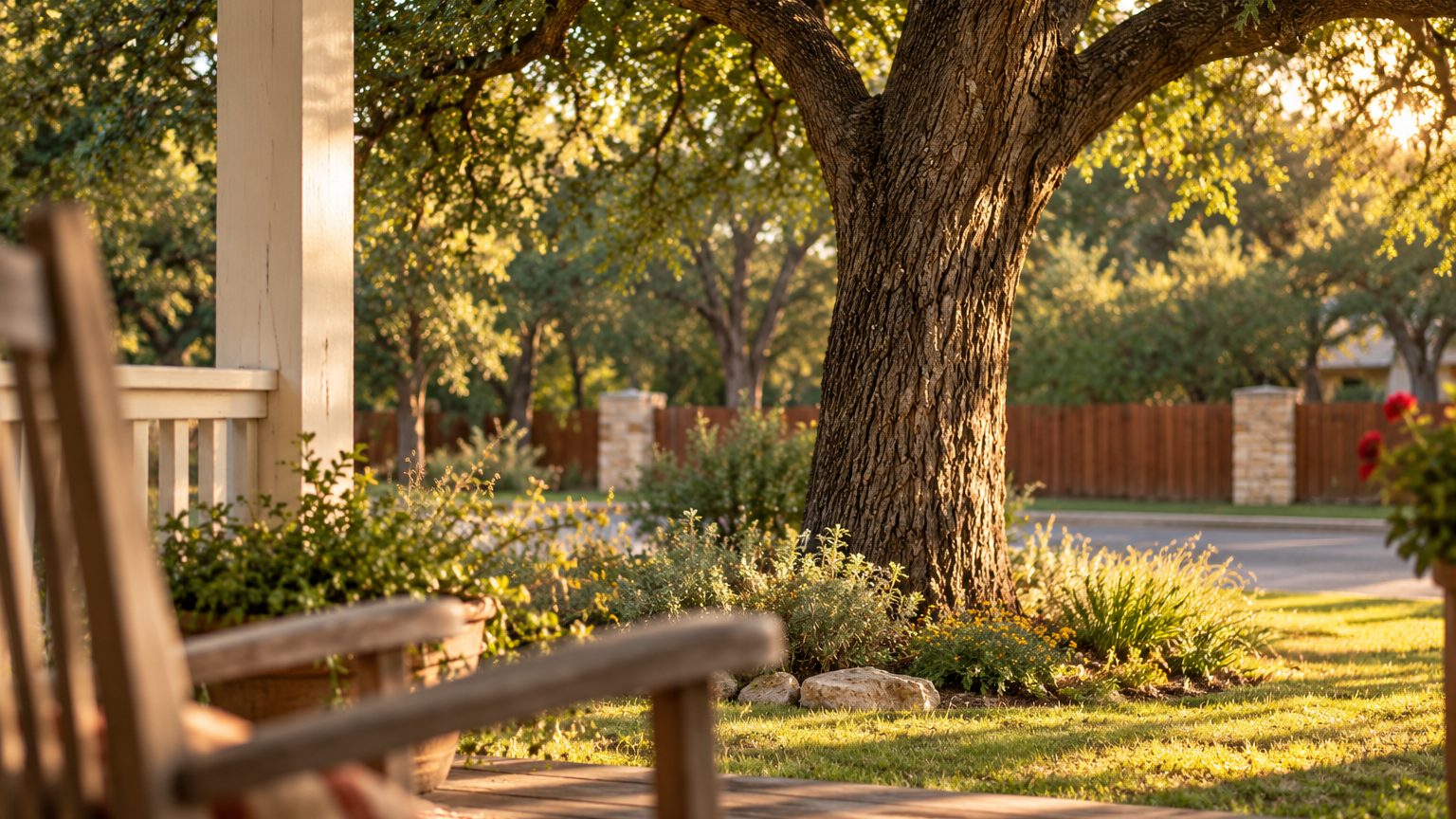
Put yard art where you already look: the tree outside the kitchen window, the porch post by the door, the fence post at the end of the drive. Hang it around eye level or a little above, with open sky or a plain trunk behind it. Good yard art ideas start with the view, not the piece.
That’s the short answer. The rest of this guide covers nine spots around a house that suit a steel silhouette, and what decides whether yard art looks like it belongs or looks dropped in: sight lines, height, background, grouping, scale, light, finish, the seasons, HOA and rental rules, and common mistakes. None of our pieces go into the ground. Every one taps into a tree, a wooden post or a wall.
Start with the view from where you already sit
NC State’s Extension Gardener Handbook describes focal points as carefully placed objects that direct a person’s line of sight. Yard art is exactly that kind of object, and it only earns its place if somebody’s line of sight actually lands on it.
The same handbook suggests thinking about where a yard is seen from, with examples like views through a kitchen or sitting room window or from an existing porch or the street. Those three views are a handy way to sort yard art ideas before you buy anything:
- The kitchen window. You look out of it every day, often at the same hour. This is the view for yard art that means something to you.
- The porch. It’s where you sit at the end of the day. Pick the trunk or post you face from your chair, not the one behind you.
- The street. This is what neighbors and guests see. NC State calls the front of the house the public use area, most often seen by passersby and guests. A welcome piece or a seasonal scene belongs here.
A garden writer at The Middle-Sized Garden gives the same advice in plain words: look out of your windows when deciding where to place your garden sculpture or ornaments.
Try it before you shop. Stand at the sink, sit on the porch, then walk out to the curb, and note the first trunk or post your eye lands on each time. That’s your shortlist for yard art.
How high should yard art hang?
Around eye level, or a hand’s width above it. That height does three useful things:
- It clears the clutter. Just above eye level, yard art sits over the shrubs, the lawn chairs and the car in the drive, so nothing stands in front of it.
- It stays out of harm’s way. Down low, yard art gets lost in tall grass and clipped by the string trimmer.
- It keeps the detail. Set metal yard art up in the branches and you’ll crane your neck to see it, and the cut-out details turn into a dark blob against the leaves.
Then check it from the window you’ll see it from. A window sill can cut off the bottom of yard art that looked right from the lawn, so a porch post you mostly see from the kitchen may want the piece a few inches up.
What’s behind it matters as much as the piece
A silhouette is a shape. It reads when there’s contrast behind it, and it disappears when there isn’t. Before you pick a spot, look at what will sit behind the yard art from your viewing spot.
- Open sky. A clean, simple background. Yard art set on the side of a trunk or post where you see sky behind it reads from across the yard.
- A plain trunk. Bark below the first branches, without a tangle of vines or suckers, is a quiet backdrop.
- A plain wall or fence. Painted siding, a garage wall or a run of stained fence boards gives an outline a clean edge.
- Busy foliage. This is the one to avoid. Leaves behind yard art break up its outline, especially in summer, and a cardinal set against a holly hedge turns into a puzzle.
A simple test: squint. If you can still make out the outline when you squint from the window, the background is working.

Yard art ideas for nine spots around the house
These are the places we’d look first. Each one taps a piece into wood or a wall, never into the ground.
The big tree in the front yard
This is the street view. A front oak or pecan, seen from the sidewalk, suits yard art with a bold outline: a welcome scene, a big bird, or a seasonal piece you change through the year. Clemson’s Home and Garden Information Center notes that a focal point near the entrance will attract attention, so if the tree is close to the front walk, so much the better. Face it toward the street. If you haven’t put anything in a tree before, our guide on whether a metal tree stake will hurt your tree covers which trees are sound enough and how to set it once.
The tree outside the kitchen window
This is the one you’ll see on a gray February morning with your coffee, so give it the piece that matters to you. A Cardinal Stake is the classic choice here. Line it up with the view from the sink, not from the yard.
The fence post at the end of the drive
It’s the first thing you see when you pull in. A critter suits a fence post. The Squirrel Stake looks like it stopped there on its way somewhere.
The porch post by the front door
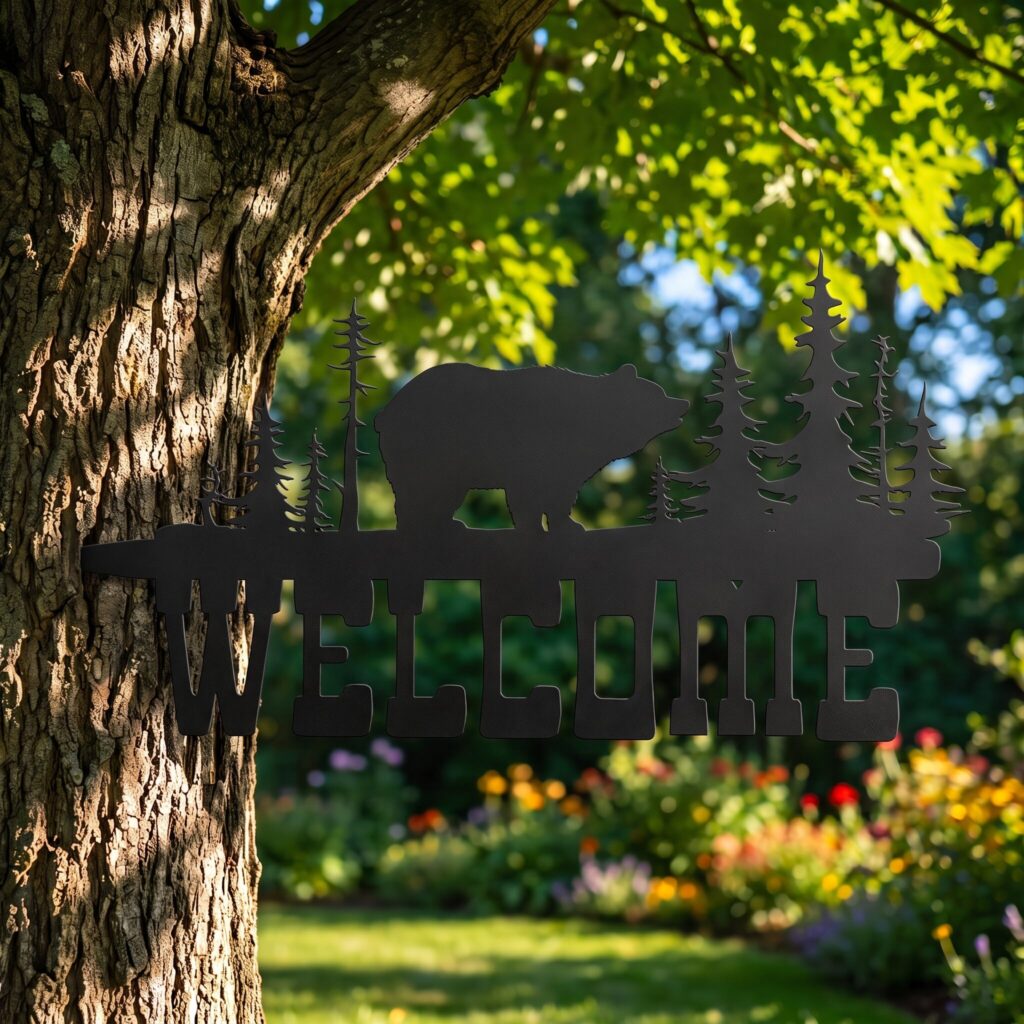
Welcome pieces belong where people arrive. The Welcome Bear Stake, a black bear crossing pines above the word WELCOME, sits well on a porch post at eye level. If the post is above pale concrete or light steps, read the note on finishes further down first.
The garage wall or the side of the house
A garage wall is a big, plain surface, which makes it a good home for metal yard art. It’s also where you get shadows (more on that below). The Horned Owl Stake looks at home up near the eaves, like it’s watching the yard.
By the bird feeder
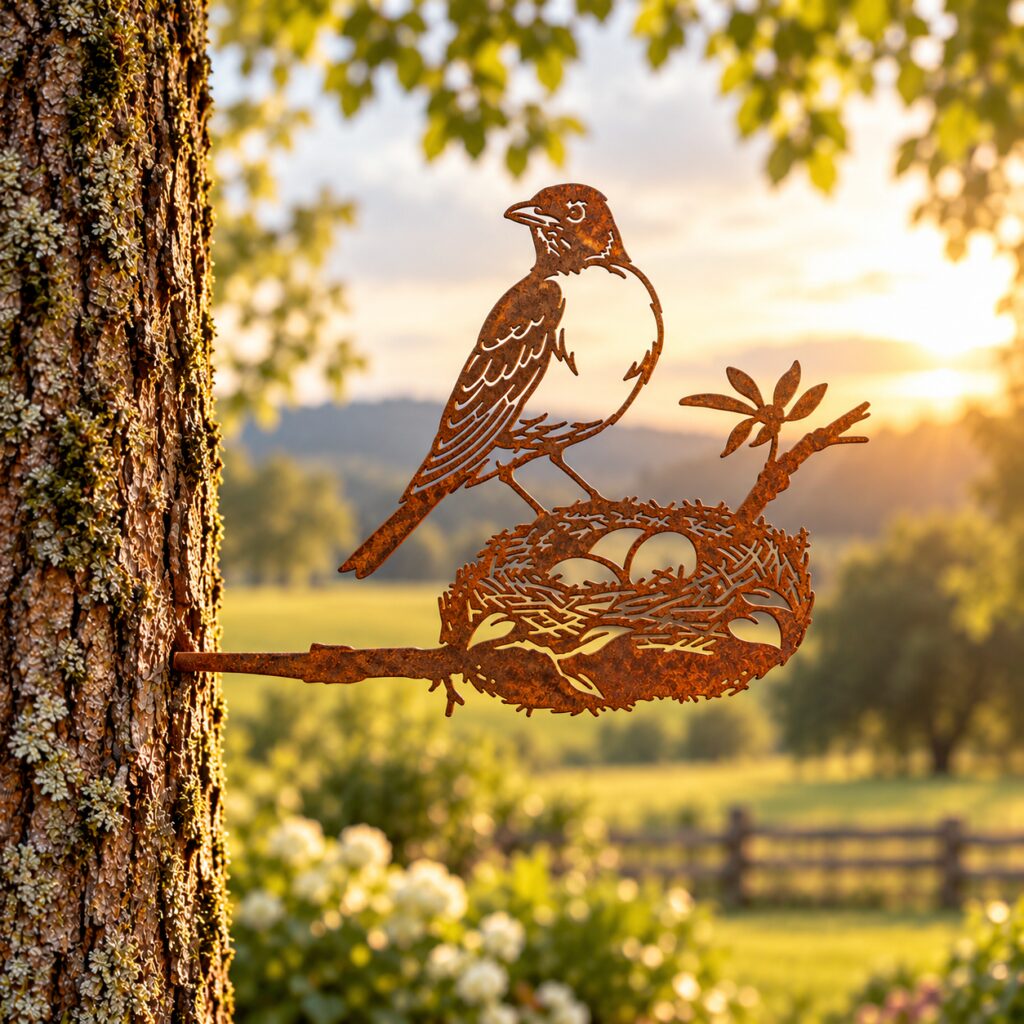
A bird silhouette on the post that holds the feeder, or on the nearest trunk, ties the corner together. The Mama Bird Stake has one, two or three eggs in the nest and a dragonfly at the branch. If that feeder is near a window, the Cornell Lab’s advice is to make the windows bird friendly rather than worry about how far away the feeder is.
The garden gate
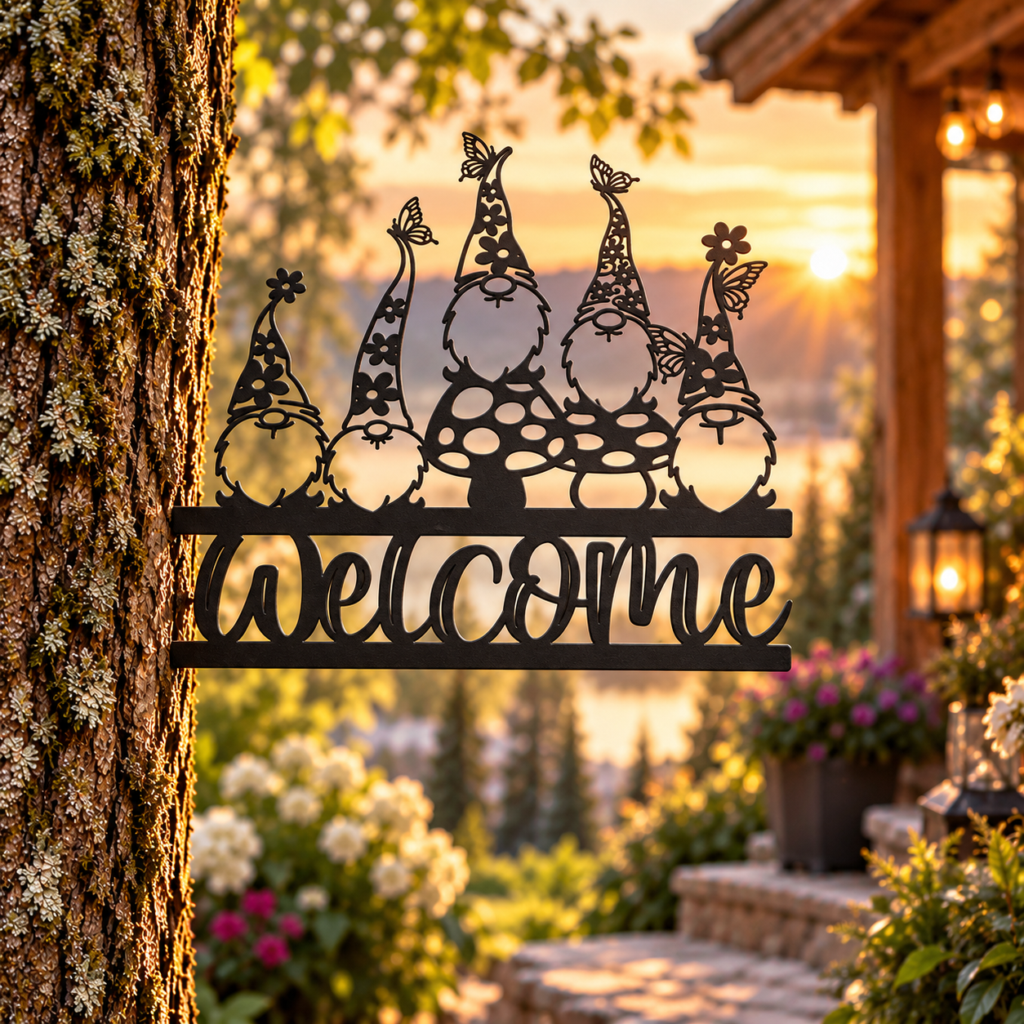
Garden folk look right by the gate. The Gnome Welcome Sign Stake, with five gnomes, a toadstool and the word Welcome, fits a gatepost, as if the gnomes wandered over from the flower bed.
Along a path
NC State’s handbook notes that smaller objects within the garden, such as garden art or plant specimens, also serve to propel us on a journey. The Middle-Sized Garden calls the classic spot for an ornament at the end of a path. Yard art on a post where the path bends, or where it ends, gives people a reason to walk there.
The back fence, seen from the patio
Plenty of backyards have one long fence and nothing on it. A run of fence posts facing the patio is a natural home for a small group of yard art, which brings us to the next question.
One piece or a group?
Start with one. Clemson’s foundation plantings guide says there should only be one striking specimen plant in most foundation plantings, and the same thinking holds for yard art by the front of the house. The same guide puts it simply: more is not necessarily better.
NC State says much the same in another way: simplicity strives to create spaces, not fill them. One silhouette with room around it reads as a choice. Five scattered across the front yard read as a collection that ran out of shelf space.
A group of yard art works when the pieces share a story and a view:
- One theme per group. Birds on the back fence, garden folk by the gate, critters on the woodpile posts.
- One view per group. Every piece in the group should be visible from the same spot, so your eye takes them in together.
- Room between them. Each outline needs its own patch of background. If two pieces overlap from where you stand, move one.
- Different heights. Set them at a few different heights, not in a level row, so they look like they landed there.
A memorial piece usually wants to be on its own. Give it a trunk or a post that doesn’t share the view with anything else.
Why odd numbers tend to look settled
Garden designers group plants in threes and fives for a reason. A Troup County Extension agent at the University of Georgia puts it this way: odd numbers create a better sense of unity and appear more appealing to the eye. A landscape design presentation shared by Cornell Cooperative Extension in Herkimer County adds a second rule: do not place in straight lines, stagger in triangulated form.
For metal yard art, that looks like this:
- Three on a fence. Put one on a post a little higher, and the other two lower on posts either side, so the three make a loose triangle.
- Three on a big trunk. Stagger them around the trunk at slightly different heights, instead of stacking them one above the other.
- A pair that’s meant to be a pair. Two cardinals or a mother and child read as one subject, so they’re fine as two.
Treat odd numbers as a habit, not a law. NC State’s handbook cautions against rules like “always plant shrubs in groups of three or five,” because they don’t account for the site in front of you. If two pieces of yard art look right from the window, two is the right number.
Getting the scale right
Most of our pieces run 7 to 17 inches, and the exact size of each one is on its product page. Where you put yard art changes how big it looks.
- Close views want smaller pieces. A porch post, a gatepost or a path you walk past at arm’s length suits the lower end of that range.
- Far views want larger pieces. NC State points out that the human eye is trained to see what is in the foreground and tends not to notice the things faraway as much. Yard art on a front tree you see from across the street needs size to hold its own.
- Match the trunk or post. A large piece on a slim post looks top-heavy. A small piece on a wide old oak looks lost.
Here’s a trick that saves second-guessing. Cut a piece of cardboard to the size listed on the product page, tape it where you plan to set the yard art, and look at it from the window, the porch and the street. It costs nothing and takes five minutes.
Morning light, evening light and the shadows they throw
Laser-cut steel does something a painted ornament can’t: light comes through the cut-outs. Two times of day show that off.
- Low sun behind the piece. When the sun is low and behind the silhouette from where you stand, the steel goes dark and the outline sharpens. Yard art facing the porch with the sunset behind it turns into a clean black shape every evening.
- Low sun on a wall. Set a piece a little out from an east-facing wall and you get a second silhouette in shadow across the wall in the morning. A west-facing wall does the same in the evening. On a trunk, the shadow falls across the bark.
Before you set anything, notice where the sun sits at the times you’re usually outside. If you drink coffee on the back porch at seven, the morning light is what matters. If you’re out after supper, look west.
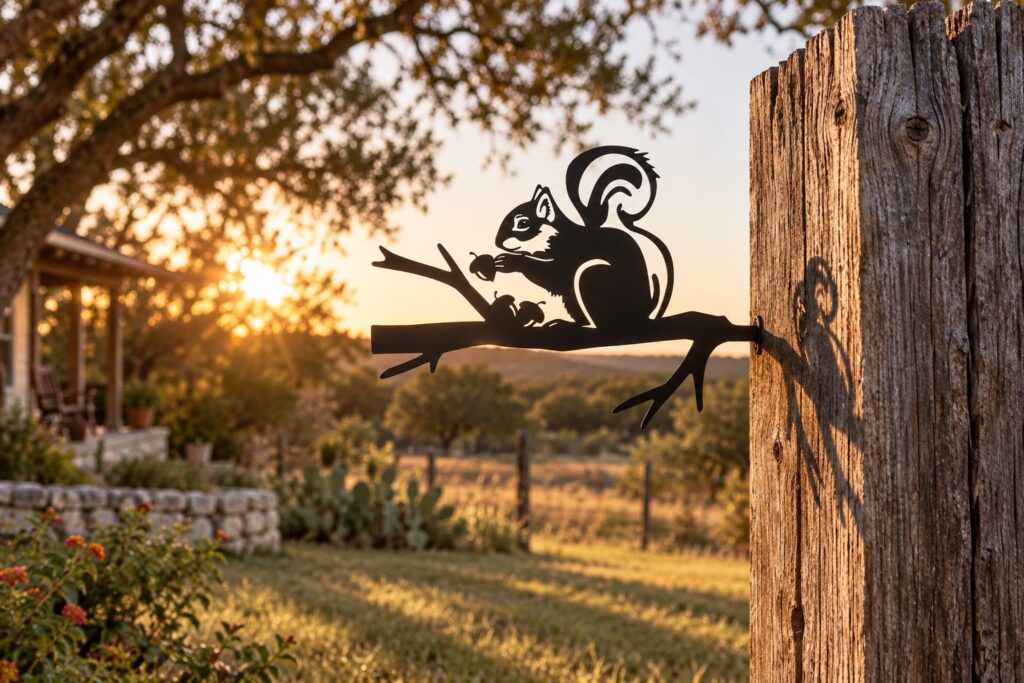
Raw Steel against bark, Black against a light wall
Most pieces come in two finishes. Raw Steel weathers outdoors, with most of the change in the first several months before it holds steady, and Black keeps a clean, consistent look. The right finish depends as much on the spot as on taste.
- Raw Steel against bark. The weathered brown sits in the same color family as a tree trunk, so the yard art looks like it grew there. Choose it if you want the piece to settle in quietly.
- Black against a light wall. A dark silhouette against pale siding, light limestone or a white fence is crisp and easy to read from a distance. Choose it if you want the outline to stand out.
- Brown against brown, dark against dark. These are the pairings to think twice about. Raw Steel on a dark stained fence, or Black in deep shade, can disappear.
There’s a practical side, too. While the Raw Steel patina is forming, rain can carry a little rust onto whatever sits below. Our guide on whether Corten steel yard art rusts explains how to keep that drip line off pale steps and walls.
Changing metal yard art with the seasons
The yard changes around a piece through the year, so check a spot in more than one season.
- Winter opens up sight lines. Bare branches show trunks you couldn’t see in July, and a silhouette stands out against gray bark and sky.
- Spring and summer fill things in. Yard art that stood out in March can vanish behind new leaves by June.
- Autumn brings the weathered finish into its own against turning leaves.
If you like to change things with the calendar, keep one seasonal spot, usually the front tree or the porch post people see from the street. Our holiday pieces hang as pendants or scenes from a cut steel branch, so you change what hangs there, not the hole in the post. The Autumn Stake’s pendants lift off the rings, so the branch stays up year round and only the leaves and acorns change. Our guide to outdoor tree decorations for every holiday goes through the year one holiday at a time.
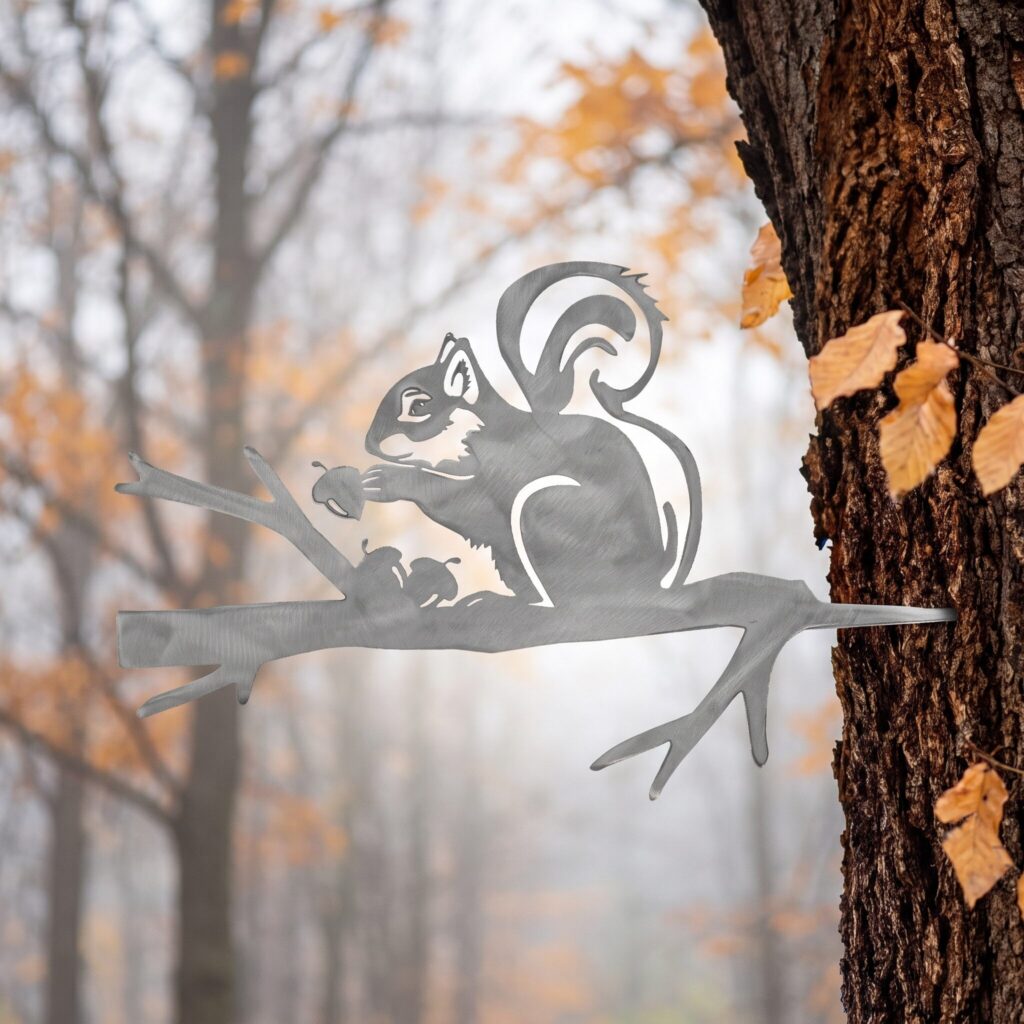
If you have an HOA or you rent
If you have a homeowners association, read the rules before you choose a spot. Look for anything about yard art, decorations or ornaments, and whether it covers the front yard, the backyard or both. If the rules are unclear, a short email to the board now saves taking a piece down later. A spot you can’t see from the street, like a back fence post, sidesteps the question.
If you rent, ask your landlord before you put yard art in a tree, a post or a wall. Every piece taps in with a hammer, so it leaves a small hole when you take it down. A fence post or a porch post is usually an easy ask, and the landlord’s oak may be a harder one. Say exactly where you want it and send a photo. “One small hole in the back fence post” is an easy yes.
Mistakes that make yard art look out of place
Most yard art that looks wrong is in the wrong spot, not the wrong piece. These are the ones we hear about:
- Choosing the spot from the yard. It looks fine while you’re standing next to it, then you can’t see it from the house.
- Going too low. Down by the roots it’s hidden by grass and hit by the trimmer.
- Setting it against busy leaves. A summer hedge or a vine-covered trunk swallows the outline.
- Scattering pieces. One here, one there, one by the mailbox. Group them in one view, or give each its own spot with space around it.
- Testing spots with the hammer. Every trial hole is a real hole. Use the cardboard trick, then tap it in once.
A quick placement test before you pick up the hammer
- You’ve checked the spot from the window, the porch or the street, whichever matters for this piece.
- It sits around eye level or a little above, with sky, plain bark or a plain wall behind it.
- The size suits the view: smaller up close, larger far away.
- The finish suits the background, and Raw Steel isn’t dripping onto pale concrete.
- It’s going into a tree, a wooden post or a wall, never the ground.
Pieces that suit these spots
If you’ve found your spot, here’s where to start looking:
- The kitchen-window tree: the Cardinal Stake or the Mama Bird Stake, with one, two or three eggs in the nest.
- The porch post or the front door: the Welcome Bear Stake.
- The garden gate: the Gnome Welcome Sign Stake.
- The fence post or woodpile: the Squirrel Stake.
- The garage wall or a big trunk: the Horned Owl Stake.
To see all our metal yard art side by side, the Shop All Silhouettes page has the whole line, and every product page lists the exact size so you can make your cardboard template before you order. Every piece is solid steel, in Raw Steel or Black.
Questions customers ask
How do I install it?
Find your spot first, then tap the stake in with a hammer. If the wood is hard, drill a small pilot hole first and it will go in easier. It works in a tree, a wooden fence post, a porch post or a wall.
What are Shadow Birds pieces made of?
Solid steel. Most pieces come in a Raw Steel or Black finish.
Will the Raw Steel finish rust?
Raw Steel is untreated, so yes, it develops a natural weathered color outdoors. Most of that change happens in the first several months, then it holds steady. If you’d rather keep a clean, consistent look, choose Black.
Will it arrive in time for a holiday gift?
A lot of our yard art is bought as gifts. Orders are processed in 1 to 2 business days, and delivery takes 5 to 7 business days after that, within the US. During Christmas, Valentine’s Day and other busy weeks, order early.
Sources
- 19. Landscape Design, North Carolina Extension Gardener Handbook, NC State Extension
- Foundation Plantings, HGIC 1702, Clemson Cooperative Extension Home & Garden Information Center (Karen Russ and Robert F. Polomski, 1999)
- Landscaping for Curb Appeal, Troup County Extension, University of Georgia (Brian Maddy)
- Residential Landscape Design, Part 2: The Design Process, Birgitta Brophy, RLA, shared by Cornell Cooperative Extension Herkimer County (2023)
- Where to place sculpture and garden ornaments, The Middle-Sized Garden (Alexandra Campbell, updated 14 February 2022)
- Why Birds Hit Windows, and How You Can Help Prevent It, All About Birds, Cornell Lab of Ornithology