
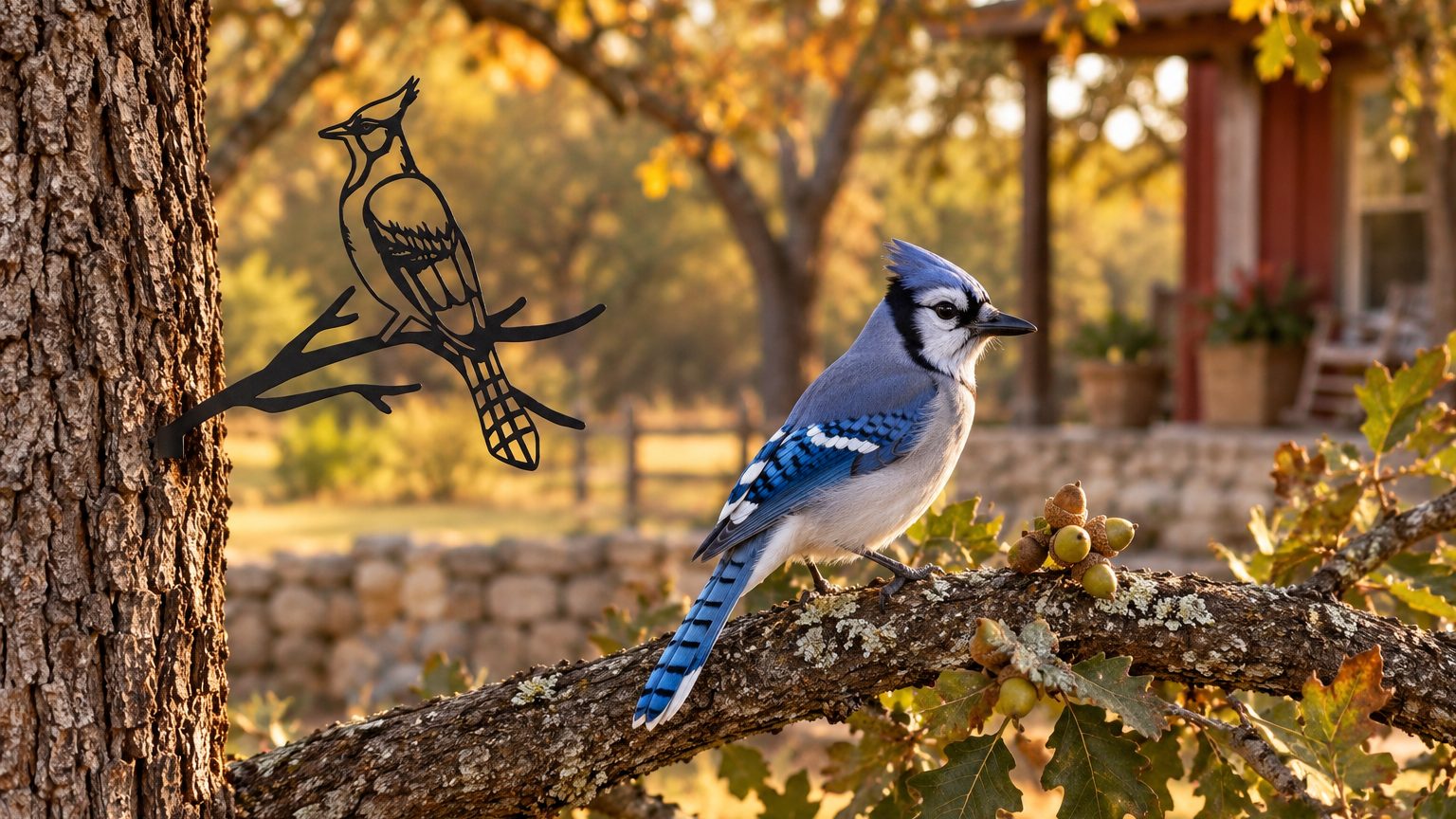
The blue jay meaning people pass along is about boldness, loyalty and speaking your mind. It’s folk belief, not doctrine, and no one can tell you what a bird means for you. It does fit the real bird, though: Cornell Lab says blue jays are known for their intelligence and tight family bonds.
That’s the short answer. Below, we go through what people tend to say a blue jay means, where Native American stories do and don’t come into it, and the six things the real bird does that explain why the beliefs settled on it. Then there’s a section on blue jays in Texas, a few words for anyone who saw one after a loss, and how to bring more of them into the yard.
The blue jay meaning people pass along
There’s no single source for blue jay symbolism. Like the cardinal, the jay picked up its meanings the way a family picks up sayings: from a grandmother at the feeder, from a card, from a neighbor leaning on the fence. What gets passed along tends to sort into a handful of ideas.
- Speaking up. A jay is hard to miss once it starts calling. People read that as a nudge to say the thing you’ve been sitting on.
- Boldness. Blue jays don’t skulk. They land in the open, crest up, and look you over. For a lot of people, that’s the heart of the blue jay meaning: don’t shrink.
- Loyalty. Jays tend to show up in pairs and family groups, and people take that as a reminder to keep faith with the people close to you.
- Protection. A jay will raise the alarm when a hawk or a cat comes through. People who feel watched over sometimes describe the jay as a guardian.
- Planning ahead. Jays bury food for later. That turns up as a quieter thread in blue jay symbolism: put something away now that you’ll be glad of in winter.
None of this is a rule, and you don’t need to sign up for any of it. What we can tell you is that each of these ideas lines up with something the real bird actually does, which goes some way to explaining why they’ve stuck.
Do Native American stories give the blue jay a meaning?
You’ll find a lot of pages online that attach blue jay symbolism to “Native American tradition” as if it were a single thing. It isn’t. There are many nations, each with its own language and stories, and we’d rather not put words in anyone’s mouth.
One well-documented example: the Chinook Texts collected by Franz Boas include several stories about a character called Blue-Jay, described by the Internet Sacred Text Archive as a rather dim but heroic figure who visits the land of the dead in one tale.
There’s a wrinkle worth knowing. The Chinook lived along the salmon-rich lower Columbia River in the Northwest, and the crested jay of that part of the continent is the Steller’s jay, which Cornell describes as a large, dark jay of evergreen forests in the mountainous West. So the Blue-Jay of those stories may not be the same bird that visits a Central Texas feeder at all.
If a particular story matters to you, look for it in a collection that names the nation and the person who told it. That’s a good test for anything you read about blue jay meaning online.
Six things the real bird does
The beliefs are one half of the blue jay meaning. The bird is the other half, and it’s the more surprising one. Here are six facts about blue jays, each from a source you can check.
Blue jays aren’t actually blue
This is the one that gets people. Cornell Lab explains that the pigment in blue jay feathers is melanin, which is brown, and the blue comes from light scattering through modified cells on the feather barbs.
In other words, the blue is built, not dyed. Cornell’s Bird Academy notes that when light passes through a blue feather, it looks brown, because the structure that throws the blue back at you only works when light bounces off it. Scott Sillett of the Smithsonian put it plainly in a Smithsonian story: no bird species can make blue from pigments.
So the bird you admire on a bright morning is, in a sense, a trick of the light. There’s something fitting about that for a bird people associate with seeing things as they are.
They mimic hawks
Blue jays have a wide vocabulary, and some of it is borrowed. Cornell says that in the wild, they often mimic Red-shouldered and Red-tailed hawks, and Audubon calls their version a remarkable imitation of the scream of a Red-shouldered Hawk.
Why they do it isn’t settled. Cornell suggests the call may be used to deceive other species into believing a hawk is present, and Texas Parks and Wildlife says plainly that they use the call of hawks to frighten other birds. If you’ve ever heard a hawk scream from a pine and then watched a blue jay drop onto the feeder, now you know who it was.
That talent for voices is a big part of why “communication” comes up so often in blue jay symbolism.
They plant oaks, more or less by accident
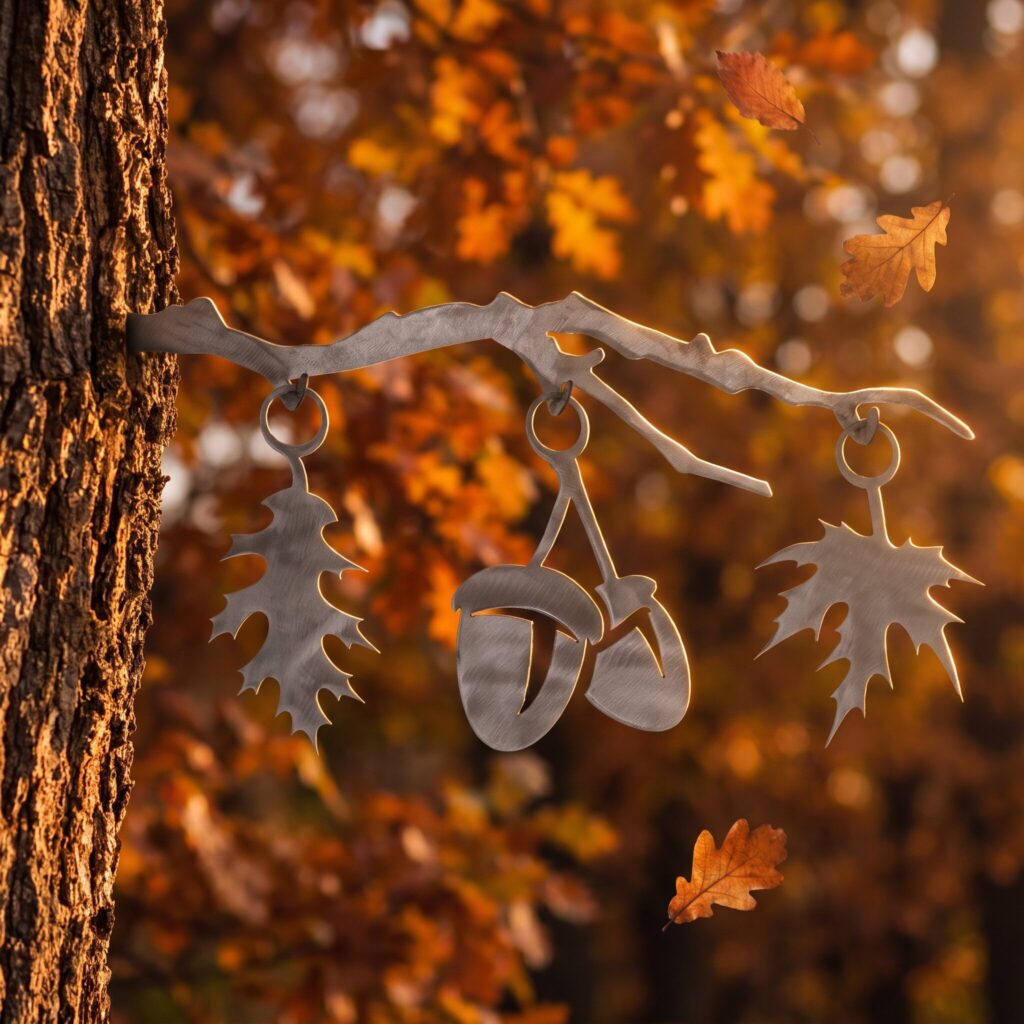
Every fall, blue jays go to work on acorns. Cornell describes a jay carrying two or three acorns in its throat pouch, another in its mouth and one more in the tip of its bill, and notes that six birds fitted with radio transmitters each cached 3,000 to 5,000 acorns in one autumn.
They don’t come back for all of them. Texas Parks and Wildlife notes that jays bury acorns and other nuts for winter, and some of these grow into trees. Over a long enough stretch, that adds up: Cornell says blue jays are credited with spreading oak trees after the last glacial period.
That’s the “planning ahead” thread in blue jay symbolism, and it’s a good one. The jay hides an acorn for itself and, now and then, leaves an oak for someone else.
They keep close family ties
This is where the loyalty belief comes from. According to Cornell, blue jays often mate for life, remaining with their social mate throughout the year.
The young don’t leave home in a hurry either. Cornell notes that young remain with and are fed by their parents for at least a month, and sometimes two, and Texas Parks and Wildlife describes blue jays that often travel in noisy family groups in late summer and fall.
There’s even a small, tender detail in how they behave together. Cornell says blue jays lower their crests when they are feeding peacefully with family and flock members or tending to nestlings. The raised crest you see at the feeder is the public face. The lowered one is for family.
Some migrate and some don’t
Blue jay migration is one of the open questions in backyard birding. Cornell writes that thousands of blue jays migrate in flocks along the Great Lakes and Atlantic coasts, but much about their migration remains a mystery.
The share that goes is small: Cornell says the proportion of jays that migrate is probably less than 20 percent. And the same bird may change its mind, since some individual jays migrate south one year, stay north the next winter, and then migrate south again. Audubon adds that migrating jays do not go south of the United States.
So if your blue jays seem to come and go some years and not others, that’s the bird, not you.
They’re noisy, and they look after their own
Audubon calls the blue jay one of the loudest and most colorful birds of eastern back yards and woodlots, and Cornell notes that blue jays are most often detected by their noisy calls.
They can be pushy at a feeder. Texas Parks and Wildlife says their arrival at a bird feeder tends to clear the area of smaller birds. But the reputation runs ahead of the facts. Cornell says that, despite it, they are far less aggressive than many other species, and that woodpeckers, grackles and squirrels often push jays off feeders. As for the stories about blue jays raiding nests, an extensive study found evidence of eggs or birds in the stomachs of 1% of jays.
Around the nest they change completely. They go quiet, and Texas Parks and Wildlife describes a pair that nest together and both defend the nest, including from people. That mix of loud in public and fiercely protective at home is the root of the “guardian” idea.
Blue jays in Texas: where and when you’ll see them
If you live in the eastern half of the state, you share your yard with blue jays. Texas Parks and Wildlife says blue jays are generally nonmigratory and are found throughout the eastern half of Texas, and another TPWD guide calls the jay one of the most striking species found in the yards, gardens, and parks of East and Central Texas.
They’re also spreading. TPWD notes that they have been expanding their range westward in urban and suburban areas, helped along by the way people have changed the land. If you’re on the western edge of their range, a town with shade trees and feeders is your likeliest place to find one.
Here’s roughly how the year looks in a Texas yard:
- Spring. Pairs settle down to nest, and Audubon notes that blue jays become quiet and inconspicuous around the nest, so it can feel like they’ve left. They haven’t.
- Summer. The young stay close to home, and Cornell says parents often continue to feed them even after they leave the nest. By late summer, a whole family may turn up at the feeder together.
- Fall. This is jay season. TPWD notes that in autumn, when most other birds are quiet, the blue jay usually displays its vocal talents, and that’s when you’ll see them carrying acorns off to bury.
- Winter. TPWD says that in late summer, fall and winter they travel in large aggressive flocks, so a quiet feeder can suddenly fill with blue.
Our own corner of the state, around Salado, sits in the Central Texas country that TPWD describes.
Seeing a blue jay after a loss
People do describe this. Someone dies, and in the weeks after, a blue jay turns up on the porch rail and looks straight at them. Or a jay keeps calling from the tree their mother planted. For some, it feels like a visit. For others, it’s simply the first thing in days that made them stop and look up.
We won’t tell you what it means. That’s yours to decide, and it’s fine to hold it loosely. What we can say is that the feeling is common and sincere, and it doesn’t need anyone’s permission.
If the blue jay meaning that speaks to you here is boldness, some people take it as permission to keep going. If it’s loyalty, they take it as a sign that the bond doesn’t end. If it’s the loud, unmistakable call, they hear someone who always had something to say.
Cardinals carry the same weight for a lot of families. If that’s the bird in your yard, our piece on what it means when you see a cardinal goes into where that belief comes from and why it settled on that bird.
And if the days are heavy, say so to someone who cares about you. A blue jay at the window is as good a reason as any to call a friend.
Blue jay meaning versus cardinal meaning
People often ask how the two compare. As beliefs go, they lean in different directions.
- The cardinal tends to stand for presence and comfort: someone close by, checking in, often in winter.
- The blue jay tends to stand for voice and courage: say it, stand up, look after your people.
They’re not in competition. Plenty of yards have both, and plenty of people take comfort from both. If one of them showed up at a moment that mattered, that’s the one to pay attention to.
How to attract blue jays to your yard
If you’d like to see more blue jays, give them what they look for. There are three things that matter: food, oaks and water.
Peanuts and the right feeder
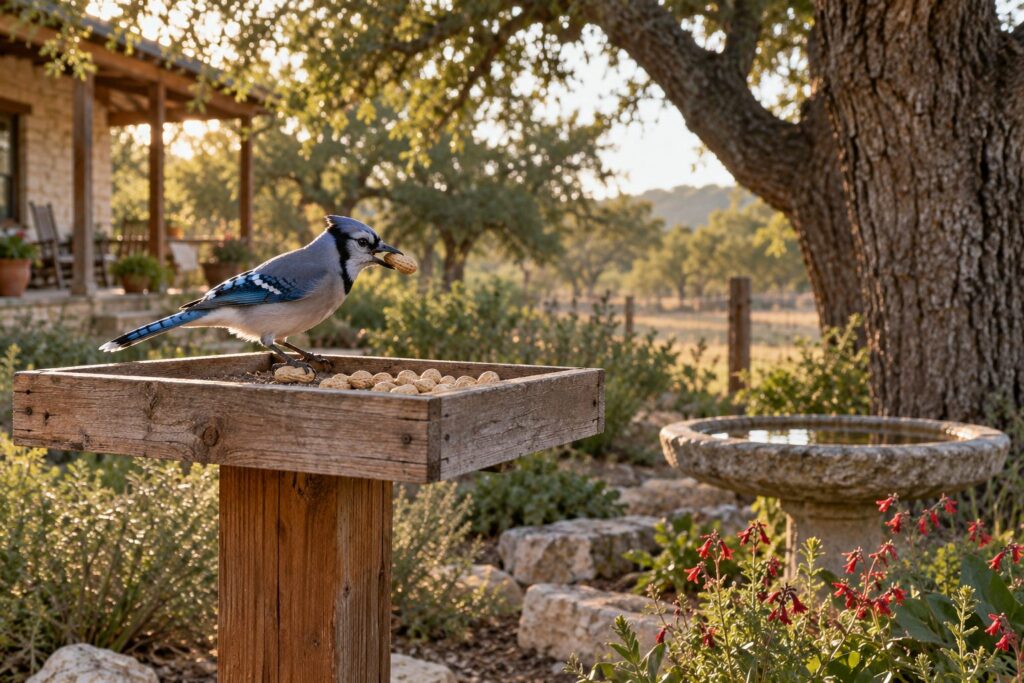
Cornell’s advice is specific. Blue jays prefer tray feeders or hopper feeders on a post rather than hanging feeders, and they prefer peanuts, sunflower seeds, and suet.
A few practical tips:
- Use a platform or tray on a post. That’s the setup Cornell recommends, and it gives a jay room to land and look around.
- Put out peanuts. Watch for a while and you may see a jay load up and fly off with them, the same way it carries acorns.
- Give the little birds their own feeder. Because blue jays can clear a feeder when they arrive, a second feeder a little way off lets the finches and chickadees eat while the jays are busy.
- Keep it where you can see it. Pick the window you sit by, so the visits don’t happen without you.
Plant an oak
This is the long game, and it suits the bird. Cornell notes that blue jays are found in all kinds of forests but especially near oak trees, and that planting oak trees will make acorns available for jays of the future.
An oak you plant this fall won’t feed a jay for years. But the jays you see now may well be burying acorns from someone else’s tree, and that’s how it’s always worked. If you’re in Texas, our guide to native plants for birds in Texas covers what to plant for jays and the rest of the backyard crowd.
Water
Don’t skip this one. Cornell says blue jays often take drinks from birdbaths. A shallow bath near the feeder, kept clean and filled through the Texas summer, gives them another reason to stop.
Keeping a blue jay in the yard
Some people hang a feeder and wait. Some keep a jay where they’ll see it every day, whether or not the real one comes by.
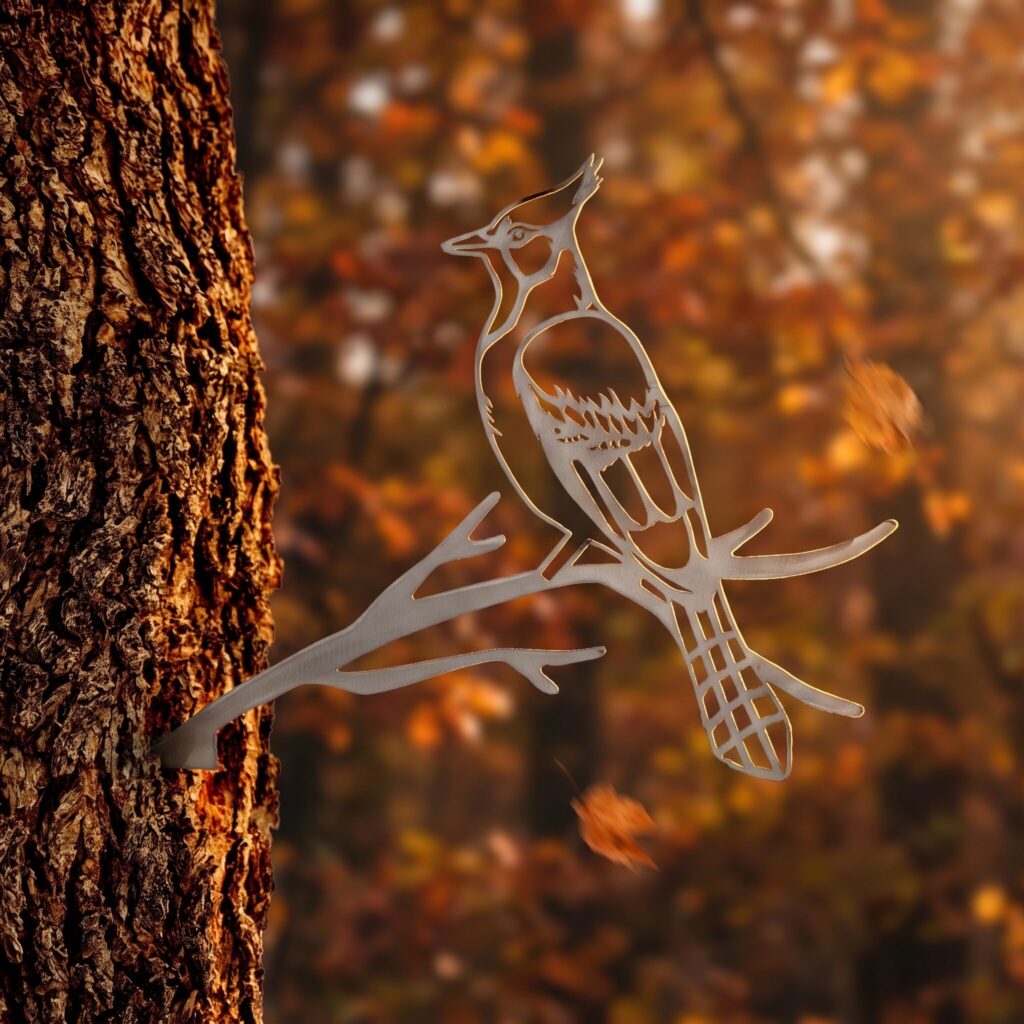
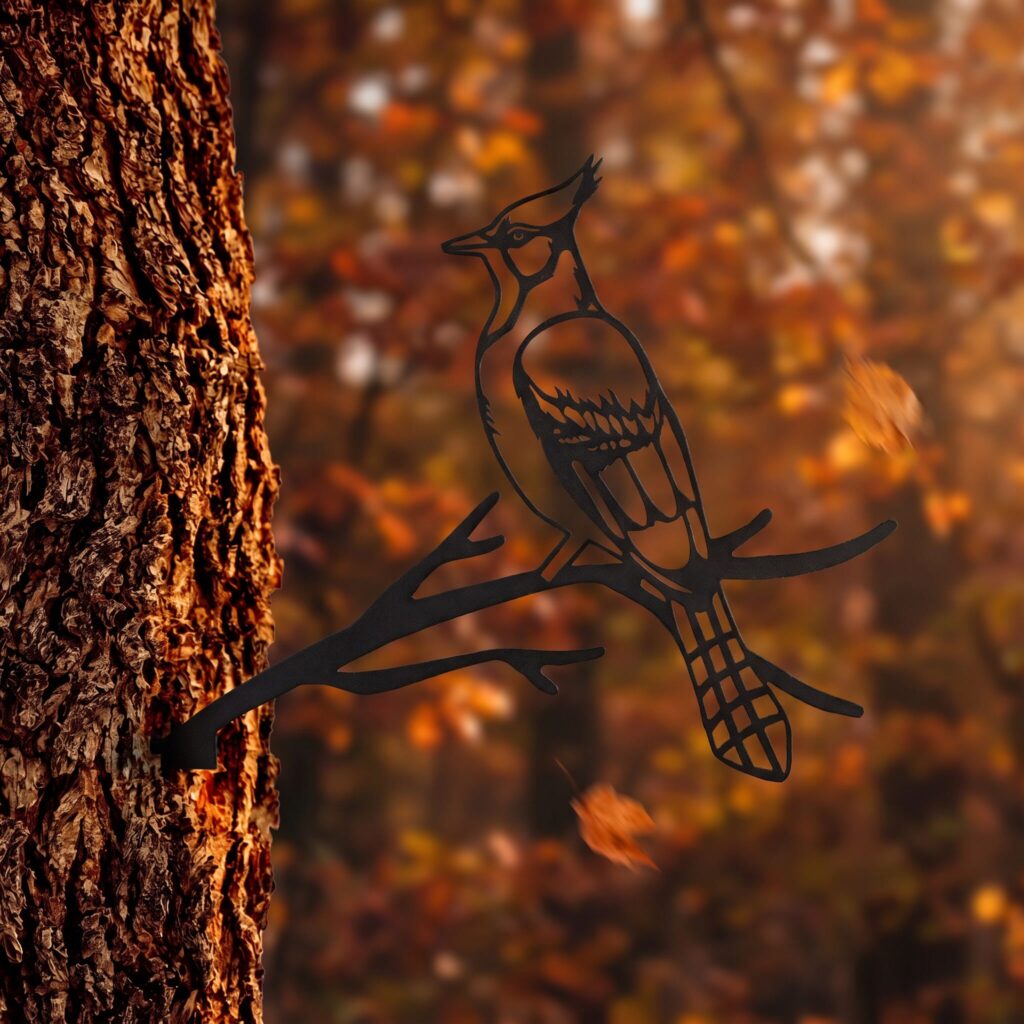
We make a Blue Jay Stake, cut as a jay mid-perch with its crest up, because a jay at rest still looks like it’s about to do something. It’s solid steel, in a Raw Steel or Black finish. Raw Steel weathers outdoors, with most of the change in the first several months before it holds steady, and Black keeps a clean, consistent look.
Neither finish is blue, and that suits a bird whose blue is borrowed from the light. For some people, that’s part of the blue jay meaning too: what you see isn’t always what something is made of. The color belongs to the real bird at the feeder. The steel one is the outline that’s always there.
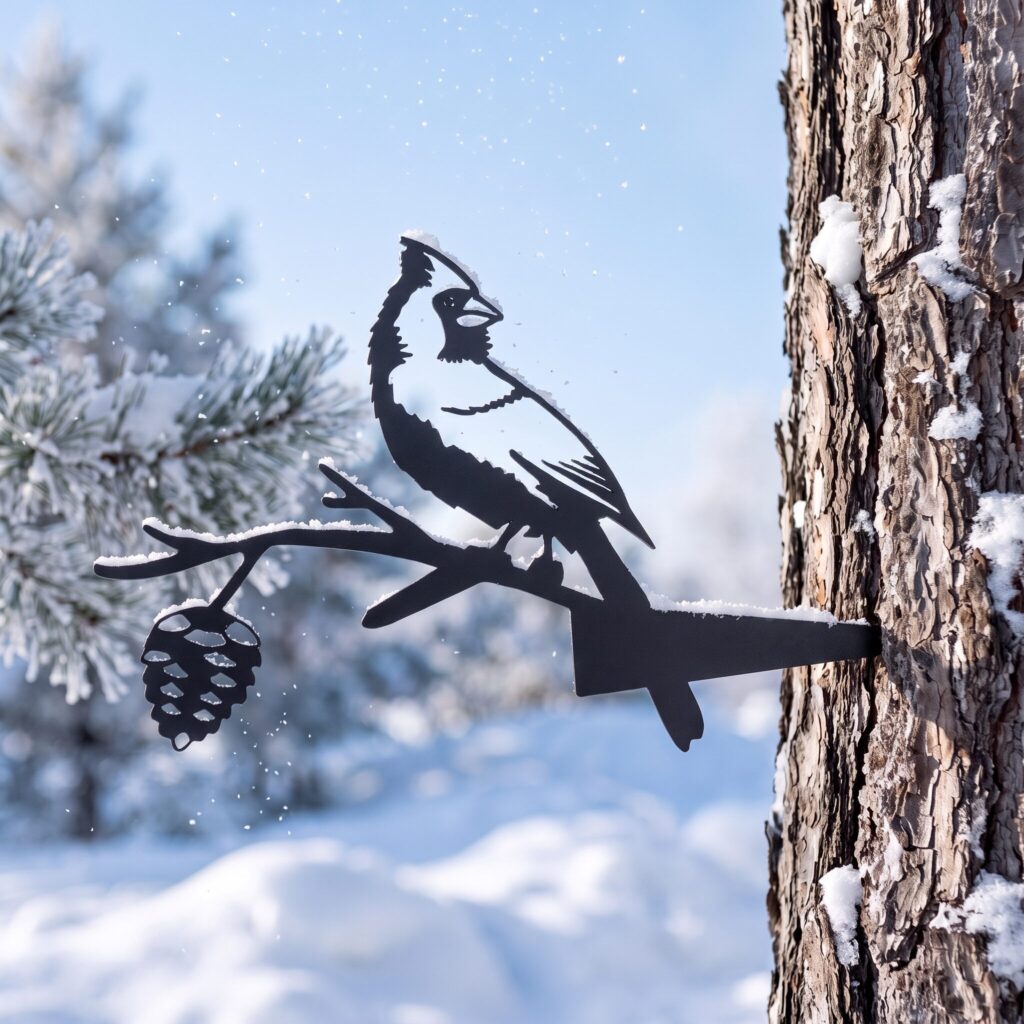
If the jay has company in your yard, the Cardinal Stake is a single cardinal in full silhouette, and the two look good on neighboring trees. For the rest of the tree line, browse the Birds collection.
Where to put a blue jay
A few places tend to work:
- The tree by the feeder. Real jays and a steel one, side by side, is a good thing to look at with your coffee.
- An oak, if you have one. It’s the jay’s own tree, after all.
- The post at the end of the drive. A bold bird for the first thing people see.
- By the back door, for someone who needs the reminder. Speak up, keep going, look after your people.
Pieces tap into a tree, a wooden fence post, a porch post or a wall with a hammer, and a small pilot hole helps in hard wood. Set it around chest height, facing the house, with light behind it if you can. Our guide on whether a metal tree stake hurts the tree covers how to choose the tree and set it once.
Most pieces run between 7 and 17 inches, and each product page lists the exact size.
Giving a blue jay as a gift
A blue jay makes a good gift for the person who’s about to do something hard: a new job, a move, a first year on their own. It also suits the bird lover who already knows the jay isn’t really blue and will be pleased you know it too.
If you’re giving one in memory of someone, a short note is plenty. A few lines to borrow or change:
- “For the loudest voice in the family. We still hear it.”
- “She never missed a chance to speak up. Neither does this bird.”
- “For the oak by the kitchen window.”
You don’t need to explain the blue jay meaning. If they know it, they’ll get it. If they don’t, the bird does the talking.
Questions customers ask
How do I install it?
Find your spot, then tap the stake in with a hammer. If the wood is hard, drill a small pilot hole first and it will go in easier.
What are Shadow Birds pieces made of?
Solid steel. Pieces come in a Raw Steel or Black finish.
Will the Raw Steel finish rust?
Raw Steel weathers outdoors on purpose. Most of the change happens in the first several months, and then it holds steady. If you’d rather skip that, Black keeps a clean, consistent look.
Sources
- Blue Jay overview, All About Birds, Cornell Lab of Ornithology
- Blue Jay life history, All About Birds, Cornell Lab of Ornithology
- Steller’s Jay overview, All About Birds, Cornell Lab of Ornithology
- How Birds Make Colorful Feathers, Bird Academy, Cornell Lab of Ornithology, 11 August 2015
- When Is a Blue Bird Not Blue? Smithsonian (John Gibbons), 28 April 2016
- Blue Jay field guide, National Audubon Society
- Blue Jay (Cyanocitta cristata), Texas Parks and Wildlife Department
- Introducing Birds: Jays, Texas Parks and Wildlife Department
- Chinook Texts, Franz Boas, Internet Sacred Text Archive