
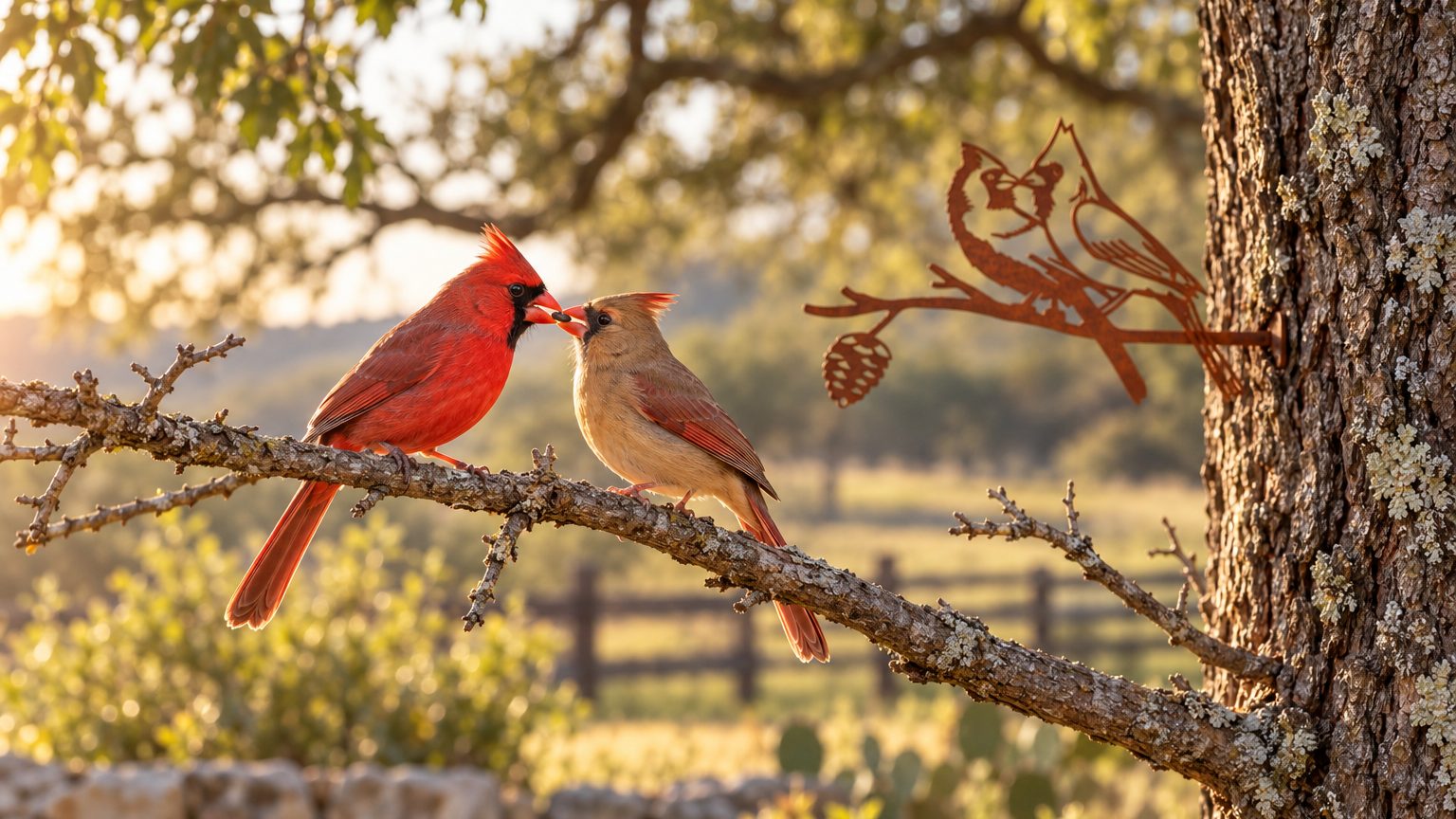
Do cardinals mate for life? Many pairs stay together for several seasons, but not strictly for life. A northern cardinal pair may stay together throughout winter, but up to 20 percent of pairs split up by the next season. When one bird dies or leaves, the survivor pairs again, sometimes with a neighbor that has lost its own mate.
That’s the honest answer, and the real story is worth knowing. Below are nine questions people ask about cardinal pairs: whether they really stay together, how they court (including the seed “kiss”), how they sing to each other, how they hold a territory, how they nest and raise their young, what happens when one dies, why they stay in Texas all year, how to bring a pair to your yard, and why couples have made them a symbol of devotion.
So do cardinals mate for life, or not?
Birds of the World, the Cornell Lab’s reference for ornithologists, describes the northern cardinal as socially monogamous, though polygyny has been observed. In plain terms, one male and one female raise each brood together, and many pairs stay together for several seasons.
“Socially” is doing some work in that sentence. DNA studies have found extra-pair paternity in 9 to 35 percent of young, so not every chick in the nest belongs to the male feeding it. He feeds it anyway.
Pairs also split. Cornell says up to 20 percent of pairs split up by the next season, and a study in Ohio recorded divorce in 2 of 10 banded pairs between seasons and in 2 of 21 within a season.
So the answer sits somewhere between the greeting card and the cynic. Long partnerships are common. A lifelong one is a hope, not a rule, and that’s true of a good many of us too.
The “kiss”: why the male cardinal feeds the female
If you’ve watched a feeder in late winter, you may have seen it. The male picks up a seed, hops over to the female, and passes it to her beak to beak.
Audubon notes that the male often feeds the female early in the breeding season. Texas Parks and Wildlife’s magazine describes a courting male that will alight near his mate, then gently feed her a seed or insect.
UF’s extension service calls it the iconic behavior of a male feeding a seed to a female, and explains that it strengthens the pair bond and may show her how well he forages.
It doesn’t stop once they’ve paired. Birds of the World records that the male feeds his mate during nest-building, and later brings food to the incubating female, at the nest or away from it. One study in southern Indiana counted males feeding incubating females about 3 times an hour.
That’s the practical side of the kiss. The female alone incubates the eggs, so while she sits, he keeps her fed.
If you’d like to see it for yourself:
- Watch early. In Texas, the breeding season can start as early as January, so the first kisses at the feeder may come before spring does.
- Watch low. Cornell notes that cardinals hop through low branches and forage on or near the ground, so look under the feeder and along the edge of the shrubs.
- Give them room for two. A wide platform feeder or a patch of seed on the ground lets a pair feed side by side.
- Keep a little distance. Watch from a window. A pair that feels watched tends to move off to the hedge.
Do male and female cardinals sing to each other?
They do, and it’s one of the less familiar things about them.
Cornell notes that only a few female North American songbirds sing, but the female northern cardinal does, and often while sitting on the nest. Her song from the nest may give the male information about when to bring food.
The two also sing the same material. A mated pair shares song phrases, but the female may sing a longer and slightly more complex song than the male. UF’s extension service notes that the pair sometimes duets, and Texas Parks and Wildlife’s magazine adds that duets between a mated pair peak in the spring and early summer.
Birds of the World adds one tender detail: females in new pairs sing more frequently than females in established pairs. Newer couples, it seems, have more to say.
You’ll also hear them talk as they house-hunt. Cornell describes how the pair call back and forth and hold nesting material in their bills as they assess each site. If you hear one cardinal sing from the top of a shrub and another answer from across the yard in spring, there’s a fair chance you’re listening to a pair, not two rivals.
How a northern cardinal pair holds its territory
Once a pair settles, they claim a patch of ground. UF’s extension service notes that cardinals maintain territories primarily during the breeding season, and a mated pair usually defends its territory together.
The male does the loud part. Audubon notes that males sing to defend territory and will attack rival males, including their own reflections in windows and mirrors. The female isn’t a bystander, though: Birds of the World records male–male, female–female and male–female aggressive interactions along territory lines.
The defense is seasonal. Birds of the World notes that active defense of territory boundaries ceases in late summer or early fall and resumes in late winter to early spring. In between, the yard settles down. In fall and winter, they can form fairly large flocks of a dozen to several dozen birds, so the feeder that hosted one jealous pair in May might host a small crowd in January.
If a cardinal is fighting your window in spring, it’s the same territorial instinct at work. Cornell notes that both males and females do this, most often in spring and early summer, and that a few weeks later these attacks should end.
Nesting, broods and the male’s job with the fledglings
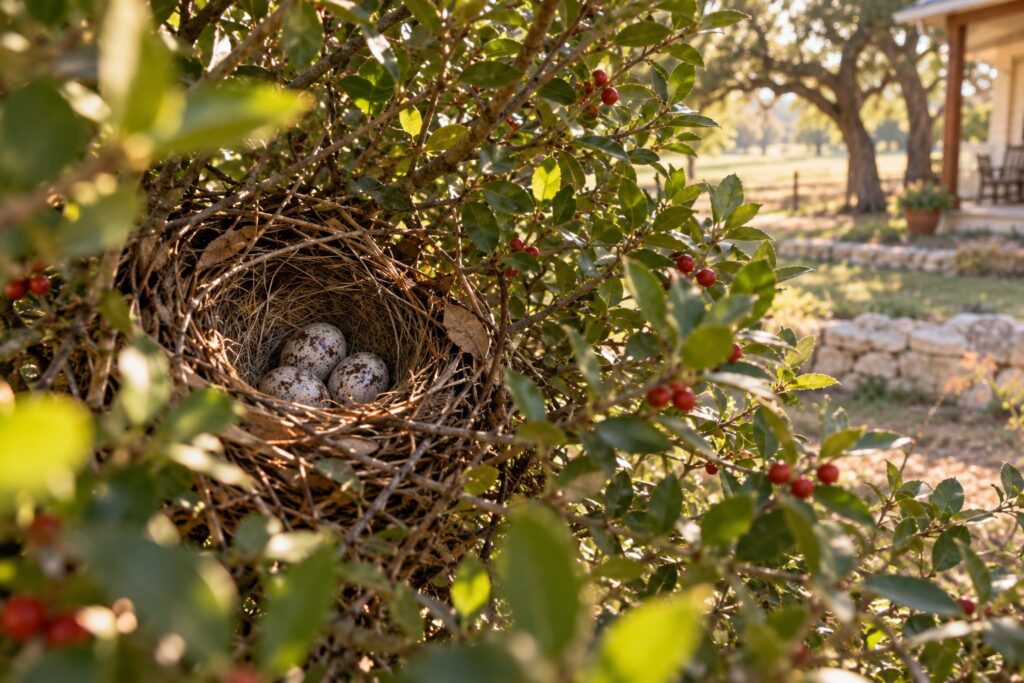
Nest building is mostly her work. Cornell notes that males sometimes bring nest material to the female, who does most of the building. In Texas, the atlas describes nests placed in a small tree, shrub, vine or brier tangle 1–6 m (3–20 ft) above ground.
The numbers, from Cornell’s nesting facts: a clutch of 2 to 5 eggs, 11 to 13 days of incubation, and a nestling period of 7 to 13 days. Cornell also notes that cardinals rarely reuse a nest, so each new brood usually means a new nest.
How many broods a year depends on who you ask and where. Cornell lists 1 to 2 broods, Audubon says pairs typically raise 2 or 3 broods a year, occasionally 4, and the Texas Breeding Bird Atlas notes that cardinal pairs have raised as many as 4 broods per season.
The spread makes sense once you know how many nests fail. Birds of the World notes that up to 8 to 10 clutches may be started in a breeding season, but seldom are more than 2 or 3 successful. A cardinal pair keeps trying, and the long Texas season gives them room to: from as early as January to late August.
Where the male earns his keep
This is the part of the cardinal partnership people rarely hear about. Audubon notes that the male may feed the fledglings while the female starts her next nesting attempt. UF’s extension service puts it the same way: often the male is feeding the recently fledged chicks while the female is incubating the next clutch of eggs.
Birds of the World adds that, after the first young leave the nest, the male feeds all young until the next brood hatches, and that in southern Ontario young are fed for an average of 32 days after fledging.
So if you see a red male in midsummer with a scruffy young bird trailing him around the yard, you’re watching the handoff. She’s on the next nest. He’s on the kids.
What happens when a cardinal’s mate dies?
This is the question underneath a lot of searches for whether cardinals mate for life, and the honest answer is a hopeful one.
The bird that’s left doesn’t usually stay alone. Birds of the World notes that mates are replaced with non-mated individuals or neighboring individuals that have lost a mate themselves. It doesn’t always wait for spring, either: new pairs form during the breeding season, or even in autumn (October), as a result of the death or divorce of a mate.
Birds of the World even records a male who became the mate of the neighboring female after her mate’s summer disappearance, while keeping his own.
For people, that can land two ways. Some find it a little sad that the bird moves on. Others find it a comfort: the yard keeps its pair, the song goes on in spring, and the feeder isn’t left to one bird for long.
For a sense of scale, the oldest recorded northern cardinal was a female, 15 years and 9 months old when she was found in Pennsylvania. A wild bird’s life has hawks, cats and hard winters in it, which is part of why a pair that stays together year after year is worth noticing.
If you’re reading this because you’ve lost someone, and a cardinal at the window has been on your mind, our piece on what it means when you see a cardinal is written for you.
Why cardinals stay in Texas all year
Cardinals don’t migrate. Audubon describes the northern cardinal as a permanent resident throughout its range, and the Texas Breeding Bird Atlas says plainly that the Northern Cardinal is a permanent resident in Texas.
Texas Parks and Wildlife’s magazine places the bird across the eastern two-thirds of Texas, and the atlas found breeding more scattered at the western edge, on the High Plains and in the eastern Trans-Pecos. Salado sits well inside that range, so around our shop they’re year-round neighbors.
Part of what lets them stay is what they eat. Cornell notes that northern cardinals eat mainly seeds and fruit, supplementing these with insects, and feed their nestlings mostly insects. Seeds and dried berries are still on the plants, and on the feeder, in January.
They’ve also done well living near people. Birds of the World notes that this year-round resident has been expanding its range northward since at least the mid-1800s, and Cornell credits the growth of towns and suburbs for part of that spread.
Staying put helps a pair stay a pair. Texas Parks and Wildlife’s magazine notes that northern cardinals don’t travel far, and even sing year-round, too. A bird that never leaves the neighborhood has a much easier time keeping track of its mate.

How to attract a pair of cardinals to your yard
UF’s extension service sums it up: attracting cardinals involves creating habitat conditions that meet their needs for food, cover and water. Here’s what that looks like in a Texas yard.
Cover first
Cardinals want thick, shrubby places. Cornell lists dense shrubby areas such as forest edges, overgrown fields, hedgerows, backyards, and the overview page puts it simply: leave undergrowth in your backyard or around the edges, and you may have cardinals nesting on your property.
- Leave one corner a little untidy. A tangle of vine or a shrub you don’t prune hard gives a cardinal pair somewhere to hide that a neat lawn can’t.
- Plant in layers. A few dense shrubs with something taller behind them gives a pair a place to perch, a place to hide and a place to nest.
- Go native where you can. UF names wax myrtle and American holly as native shrubs that give cover and possible nest sites. Our guide to native plants for birds in Texas has a fuller list for Texas yards.
Food they’ll come back for
Cornell says nearly any bird feeder you put out ought to attract Northern Cardinals, and that they particularly seem to use sunflower seeds. UF adds that cardinals are strong consumers of black oil sunflower and safflower seeds.
- Feed low and wide. A platform feeder, or seed scattered near the shrubs, suits a bird that feeds near the ground, and it gives a pair room to feed together.
- Put the feeder a short hop from cover. A few feet from a shrub gives them somewhere to wait and somewhere to retreat.
- Leave some bugs. Since nestlings are fed mostly insects, go easy on spraying the shrubs in spring.
- Keep it going through winter. That’s when a full feeder matters to them, and when you’ll see the most red.
Water, especially in August
Water is the one people forget, and in a Texas summer it may be the thing that brings a pair in. A few practical notes:
- Keep it shallow, with a rough bottom a bird can stand on.
- Set it near cover, not out in the open middle of the lawn.
- Change it every couple of days in summer, and scrub it when it gets slick.
- Check it on the rare hard freeze. A bowl of fresh water on an icy morning gets visitors.
Then be patient
A new feeder can take a while to be found. Once a pair has claimed your yard, though, they’re residents, not travelers, and you may see the same two from one season into the next.
Why couples see cardinals as a symbol of devotion
None of the biology above makes cardinals saints of fidelity. People have made them a symbol of devotion anyway, and it isn’t hard to see why.
What people notice is real. They’re seen in pairs, the bright male never far from his mate. He feeds her seed beak to beak. They sing back and forth. They don’t fly south and leave each other for the winter. And the male looks after the young while she starts again.
That’s symbolism, not biology, and it doesn’t need to be more than that to mean something. When someone gives a pair of cardinals for a wedding or an anniversary, they aren’t making a scientific claim about monogamy. They’re pointing at the parts that are true: two birds who stay close, look after each other, and keep showing up through a hard winter.
There’s also the color, which needs no explaining on Valentine’s Day.
If you’re shopping for an 11th anniversary, our note on why steel suits an 11th anniversary gift may help. A pair of cardinals cut from steel is one way to say “still here” without saying it.
A year with a cardinal pair in a Texas yard
Knowing what the pair is up to makes them easier to read through the year. Here’s a rough calendar for Central Texas, from the sources above:
- January and February. Courtship begins. In Texas, the breeding season can start as early as January. Watch for the seed kiss under the feeder.
- March and April. Territory and nest-building. Active defense of territory boundaries resumes in late winter to early spring, and this is when the window-fighting starts.
- May. The busy middle. In the Texas atlas, May was the peak month for breeding.
- June and July. Fledglings follow the male around while the female renests, and duets between a mated pair peak in the spring and early summer.
- August. Wrapping up. Texas nesting runs to late August, and water matters as much as seed.
- September to December. Territories loosen and birds can form flocks of a dozen to several dozen. And pairs may stay together throughout winter, at the same feeder, ready to start again.
Things people get wrong about cardinal pairs
A few of the common ideas, set against what the sources say:
- “Cardinals always mate for life.” Not always. Up to 20 percent of pairs split up by the next season.
- “A widowed cardinal stays alone.” Usually not. Mates are replaced with non-mated individuals or neighboring individuals that have lost a mate themselves.
- “Only the red one sings.” The female sings too, often while sitting on the nest.
- “The male just shows off.” He feeds his mate and, later, feeds all young until the next brood hatches.
- “The bird at the window is angry at you.” It’s defending its territory from its own reflection, and Cornell says both males and females do this.
Keeping a pair in the yard
The real pair will come and go with the seasons and the feeder. Some people like to keep one that’s always there.
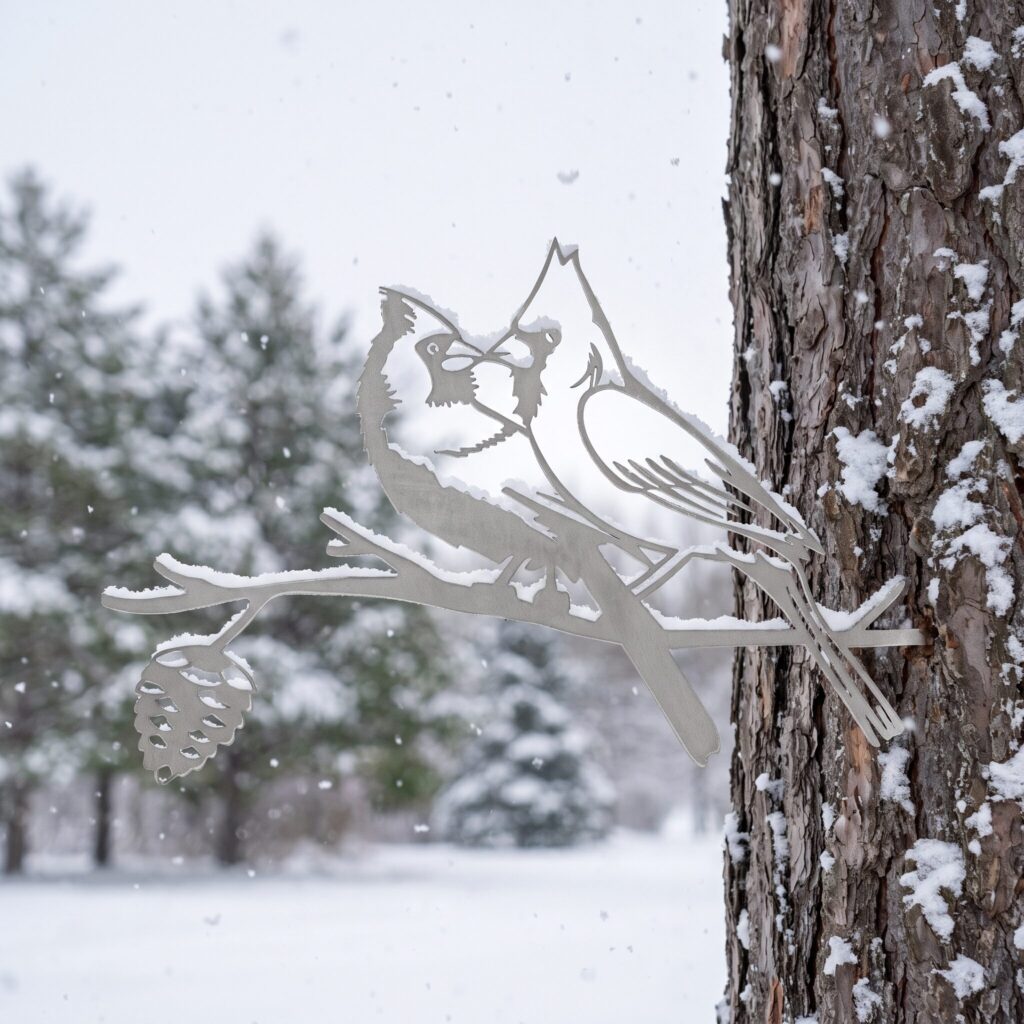
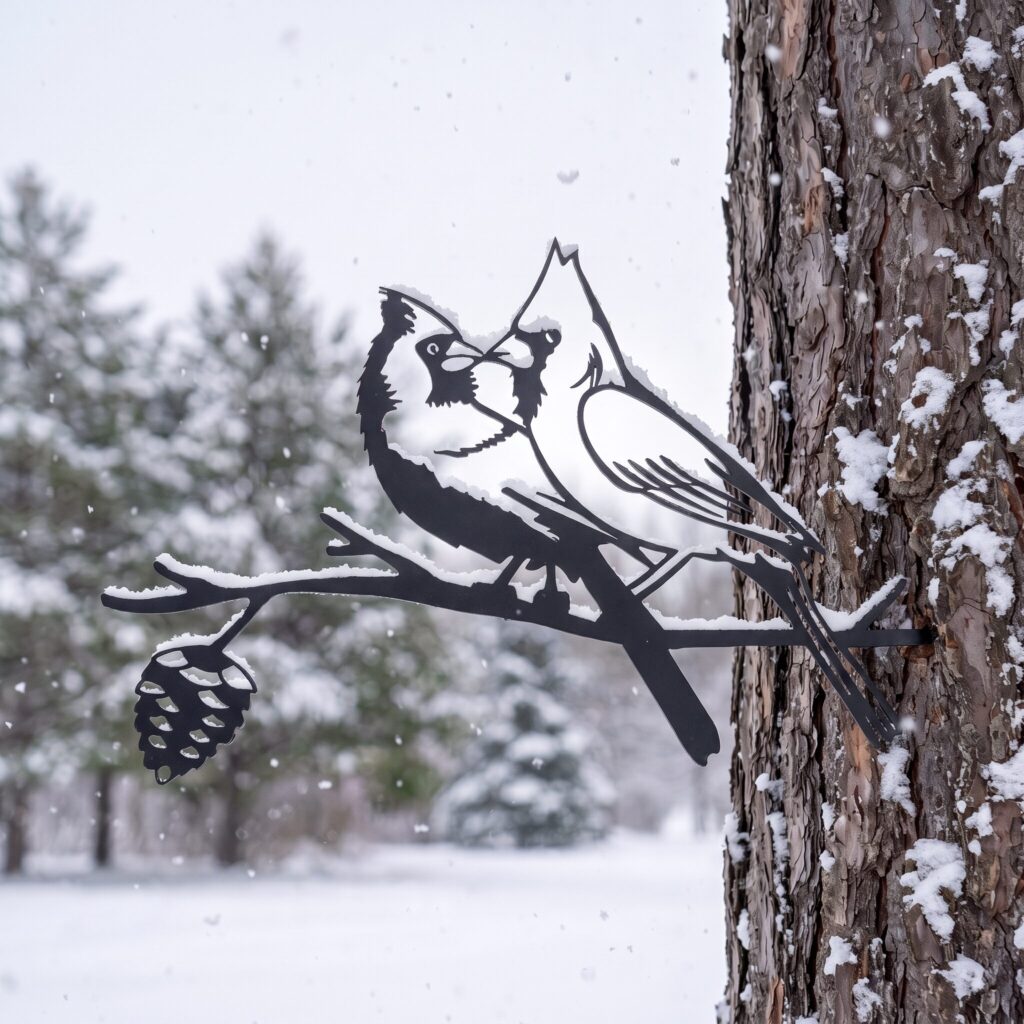
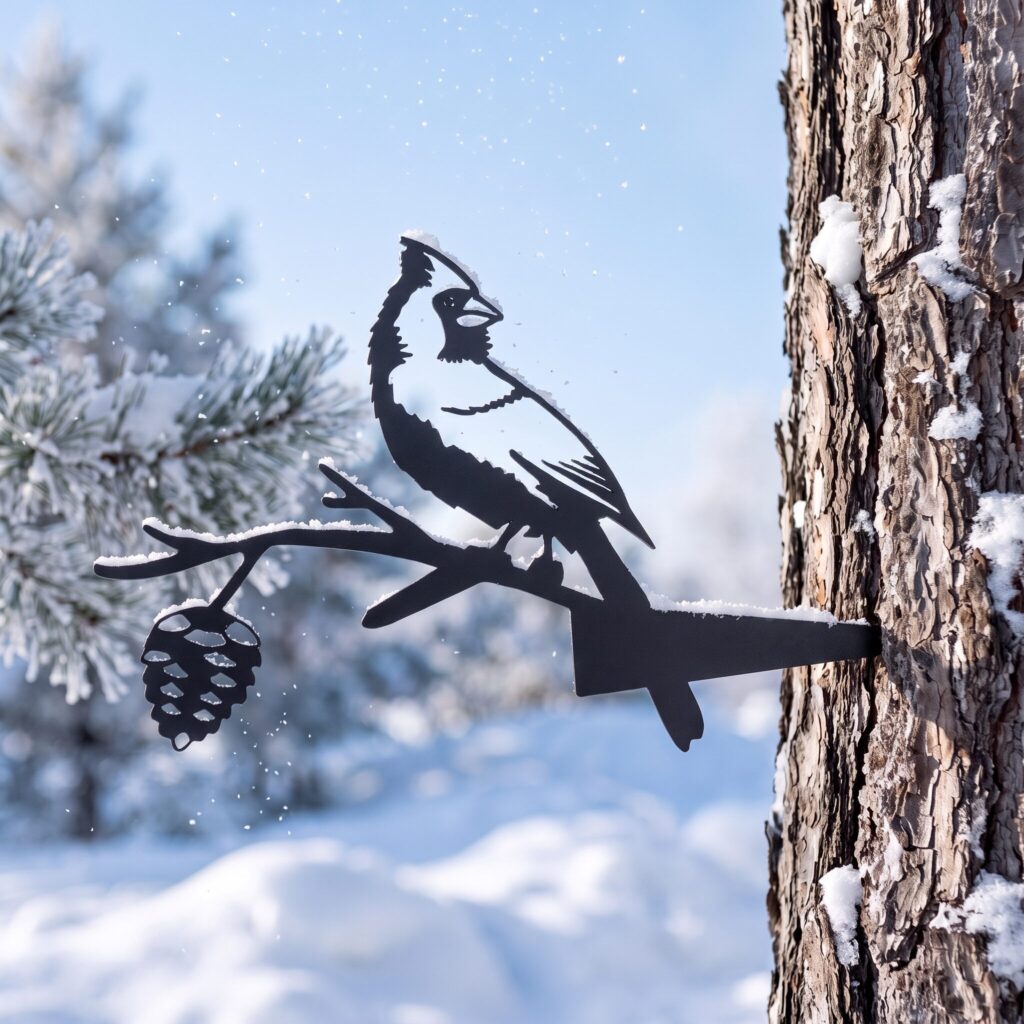
We make two cardinal pieces. Kissing Cardinals is a pair beak to beak, the seed kiss caught in one silhouette. The Cardinal Stake is a single bird, for a tree you see every morning. Both are solid steel, in a Raw Steel or Black finish.
Raw Steel weathers outdoors to a warm brown that settles into the bark, and Black keeps a clean, consistent silhouette against a winter sky. Neither is red, and that’s on purpose: the red belongs to the birds at the feeder.
Most pieces run between 7 and 17 inches, and each product page lists the exact size. Each one taps into a tree, a wooden fence post, a porch post or a wall with a hammer. If you’re putting it in a tree, our guide on whether a metal tree stake hurts a tree covers choosing the trunk and setting it once.
A good spot for a pair is near the real feeder, by the shrubs where the real cardinals wait their turn. The rest of the Birds collection is there too if your yard has other regulars.
Questions customers ask
How do I install it?
Find your spot, then tap the stake in with a hammer. If the wood is hard, drill a small pilot hole first and it will go in easier.
What are Shadow Birds pieces made of?
Solid steel, in a Raw Steel or Black finish.
Will it arrive in time for a holiday gift?
A lot of these are bought as gifts. Order early during Christmas, Valentine’s Day and other peak weeks to make sure it arrives on time.
Sources
- Northern Cardinal life history, All About Birds, Cornell Lab of Ornithology
- Northern Cardinal overview, All About Birds, Cornell Lab of Ornithology
- Northern Cardinal: breeding, Birds of the World, Cornell Lab of Ornithology (Halkin, Shustack, DeVries, Jawor and Linville, version 2.0, 12 February 2021)
- Northern Cardinal: behavior, Birds of the World, Cornell Lab of Ornithology
- Northern Cardinal: introduction, Birds of the World, Cornell Lab of Ornithology (version 2.0)
- Northern Cardinal, Guide to North American Birds, National Audubon Society
- The Northern Cardinal: The Neighborhood Show-off (WEC482), UF/IFAS Extension (Hostetler, Johnson and Main)
- Northern Cardinal species account, The Texas Breeding Bird Atlas, Texas A&M University (Robert C. Tweit)
- Wild Thing: Crimson Crooner, Texas Parks & Wildlife magazine (Sheryl Smith-Rogers, November 2009)