
The simplest way to handle outdoor tree decorations all year is to pick one or two trees you see every day, set a piece once, and change what hangs there with the calendar. Keep wire and string off living limbs, give the pieces you rotate a home that can take a hole, and store each season flat and dry.
That’s the short answer. Below, we go holiday by holiday, from New Year’s to Christmas, with what works on a trunk or limb for each. We also cover hanging tree decorations without girdling a branch, wind and weather, how far yard art reads from the street, Raw Steel versus Black in winter light, and storage between seasons. First, a little history.
A short history of decorating outdoor trees
The Christmas tree, the one most of us picture, started indoors. The University of Florida’s extension office notes that Christmas trees had been a tradition in German homes since the 16th century, and that the first record of one in an American home came from German settlers in the 1830s.
The move outdoors came later. According to Oklahoma State University, the first community Christmas tree in the United States went up in New York City in 1912. In 1923, President Calvin Coolidge lit a 48-foot balsam fir on the Ellipse south of the White House, strung with about 2,500 red, green and white bulbs, the first tree to be called the National Christmas Tree.
Other holidays found their way into the branches too:
- Easter eggs. In the German town of Saalfeld, Volker and Christa Kraft hung 10,000 hand-painted eggs on an apple tree in their garden, a tradition they had kept every year since 1965.
- Yellow ribbons. The editors at history.com trace the habit of tying a ribbon round an oak to a 1973 song and to a Maryland family waiting on news from Tehran, as a symbol of support for absent or missing loved ones.
So the front-yard tree has been a place to say something for a long while. The question is how to say it all year without wearing out the tree, or yourself.
A year-round plan for outdoor tree decorations
Most holiday decorating runs on boxes. One comes down from the attic, goes up for three weeks, goes back, and the next box comes out. Outdoor tree decorations can work differently, because the tree stays put and so can most of what’s on it.
- Pick the tree. One you see from the kitchen window, the porch or the end of the drive. One good tree beats five you never look at.
- Pick the spot. Around chest height, on the side facing the house or the street, with light behind it.
- Set something once. A branch that stays up year round, or one favorite piece of yard art that never comes down.
- Rotate the small things. Let the holiday change what hangs there, not where the hole is.
That last point is for the tree. Davey’s arborists put it plainly: the more holes you create, the more you stress the tree. A tree that gets a new stake every holiday has a lot of holes by December. Our guide on whether a metal tree stake will hurt your tree goes into what that means and how to set yard art once and leave it.
The holiday calendar: tree decorations for a trunk or limb
Here’s the year, holiday by holiday: what the tree looks like then, what tends to work, and which seasonal piece fits. Each of our holiday pieces hangs as pendants or a scene from a cut steel branch, and the branch taps into the trunk with a hammer.
New Year’s Day
The trees are bare in January, which works in your favor. Whatever’s on the trunk can be seen from the street, the walk and the window, with nothing in front of it.
Lettered yard art reads well this time of year. Our Happy New Year Stake is a lettered banner, and it suits the tree by the front walk, where people coming and going will catch it. It can go up the day the Christmas tree decorations come down and stay through the first weeks of January.
Valentine’s Day
February is still gray in a lot of places, and a little shape on a bare trunk goes a long way. The Valentine’s Day Stake shows two cupids and a pierced heart. It’s a good one for the tree you see from the kitchen, rather than the one by the street. Some tree decorations are for the neighbors, and some are for the person doing the dishes.
St. Patrick’s Day
By mid-March, depending on where you live, trees may be starting to leaf out. Before you set anything, stand at the window and look at what’s in front of the trunk now, and what will be in a few weeks.
The St. Patrick’s Day Stake has a leprechaun, a horseshoe and a shamrock. The horseshoe gives it a shape that reads from a distance, so it can go on a tree a little farther out in the yard.
Easter
Easter moves. The Farmers’ Almanac explains that Easter Sunday is the first Sunday after the first full Moon of spring, so it can fall anywhere from March 22 to April 25, and in 2027 it lands on March 28. Check the date before you plan the swap from shamrocks to rabbits.
The Easter Stake has a hare, a basket and a heart egg. It suits a spring tree near the garden bed or the back patio, where the kids are hunting eggs anyway. If you like the idea of an Easter egg tree, it’s a way to have one without a few hundred plastic eggs to collect afterward.
Fourth of July
By July the canopy is full, and anything up in the leaves disappears. Set summer tree decorations low on the trunk, below the first big limb, where the bark is open.
The 4th of July Stake is a USA map lettered Happy Fourth of July. It reads clearly against bark and suits the tree out by the street, or the one by the flagpole if you have one. A trunk that catches morning or evening light shows it off.

Halloween
Halloween is the holiday when people actually walk up to your house after dark, so think about the porch light and the walk.
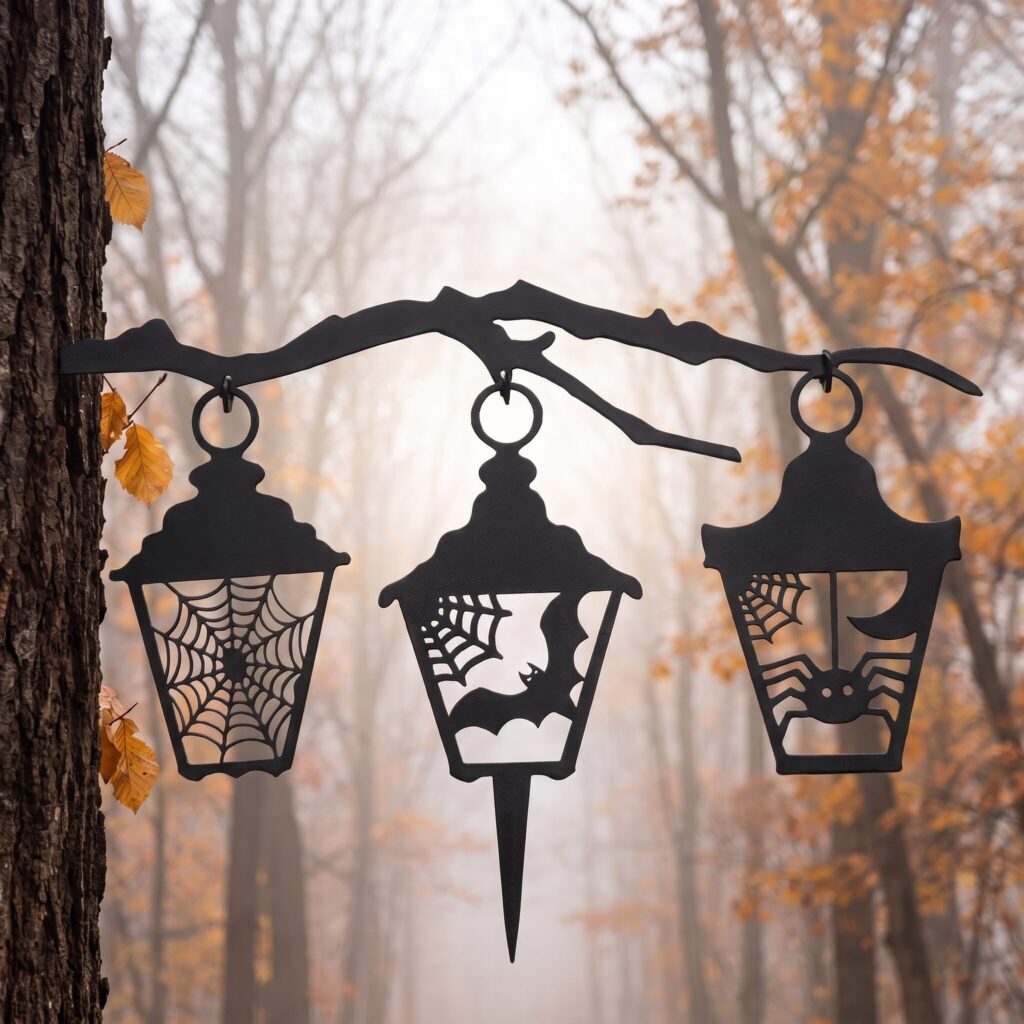
The Halloween Stake has three lanterns with a web, a bat and a spider. Put it on the tree nearest the front walk, at a height kids will see without looking for it. Yard art with a porch light or streetlight behind it reads clearly at dusk, which is exactly when it needs to.
Thanksgiving
Thanksgiving is the in-between holiday. The leaves are coming down, the light is getting lower, and people are coming to the house who don’t come often.
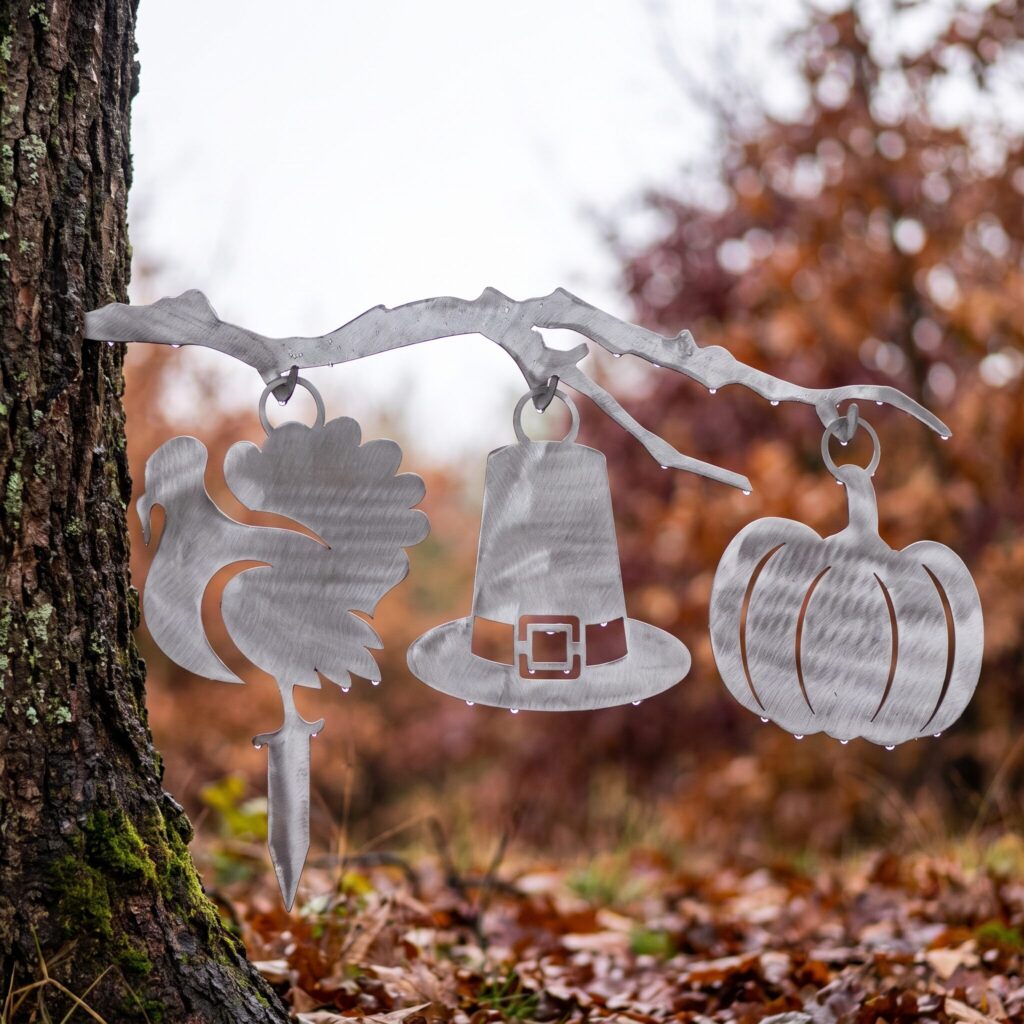
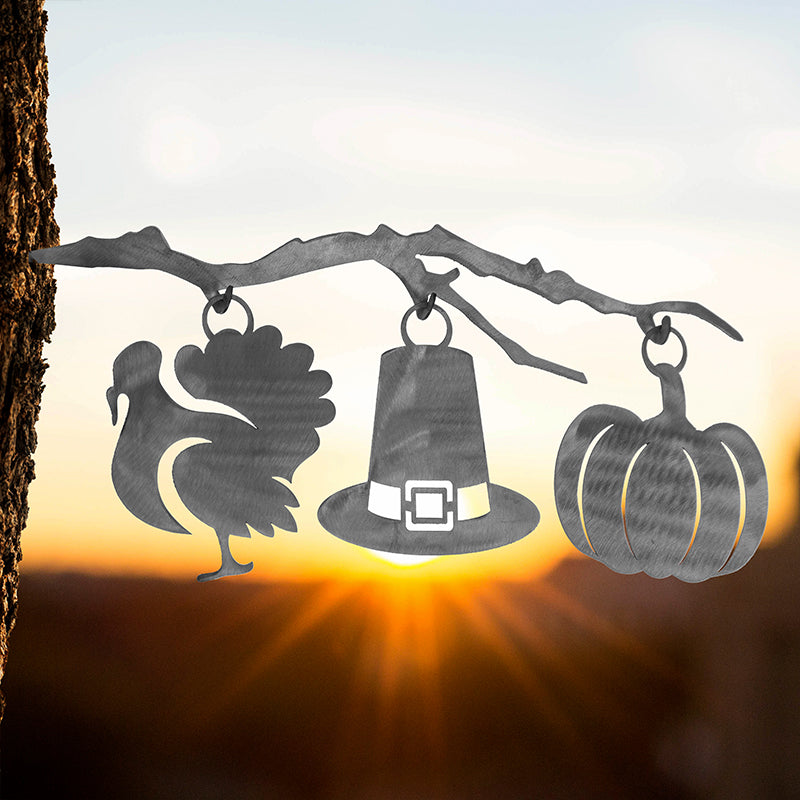
The Thanksgiving Stake has a turkey, a pilgrim hat and a pumpkin. Put it on the tree people pass between the car and the front door. It can go up when the Halloween tree decorations come down and stay until Christmas.
Christmas
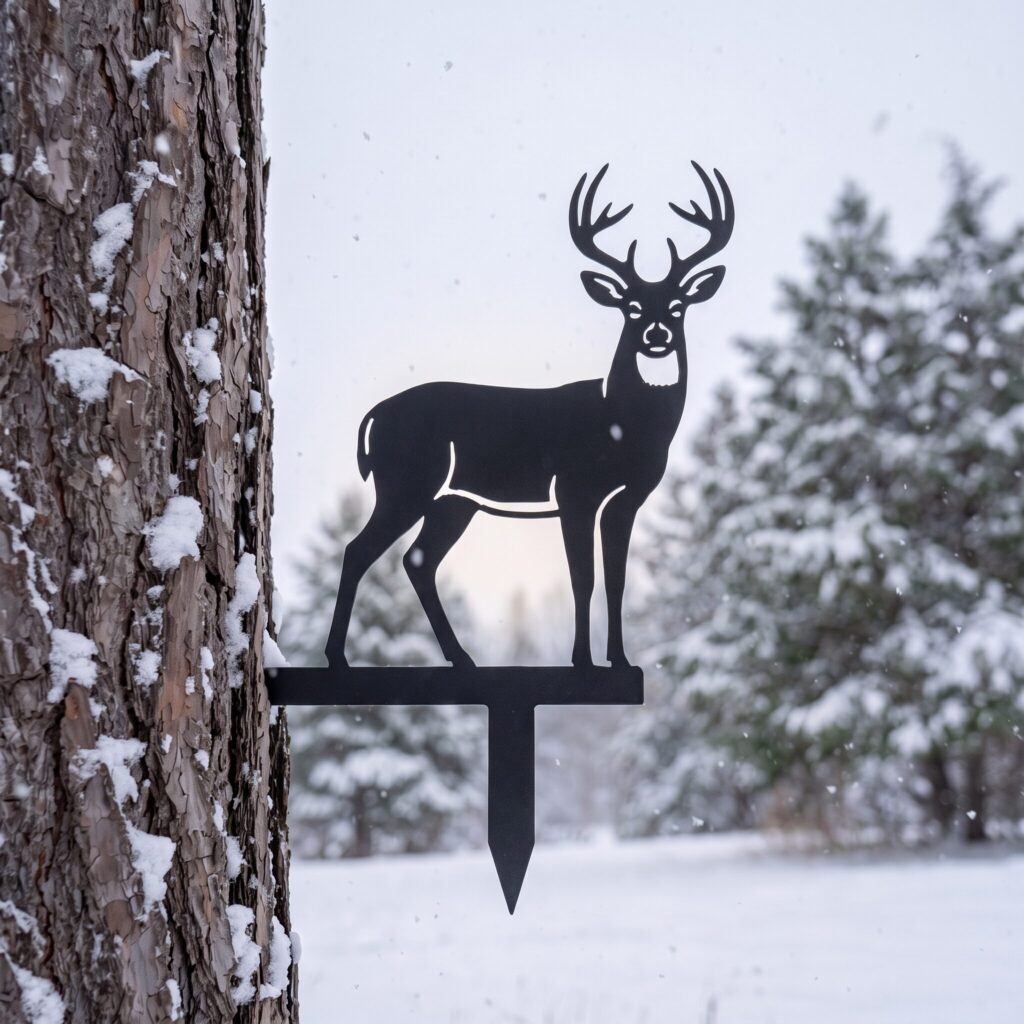
This is the one most people already do, usually with lights and a ladder. The Christmas Stake is a whitetail buck in full rack, cut as one silhouette, and it suits the big tree in the front yard, the one everyone sees from the street.
If you also wrap that tree in lights, read the section on hanging tree decorations below before you start. Lights, and the ties that hold them, deserve a little thought before the ladder comes out.
If gnomes are part of your Christmas, the folklore behind them is in what Christmas gnomes mean.
The Autumn Stake: leave the branch, change what hangs
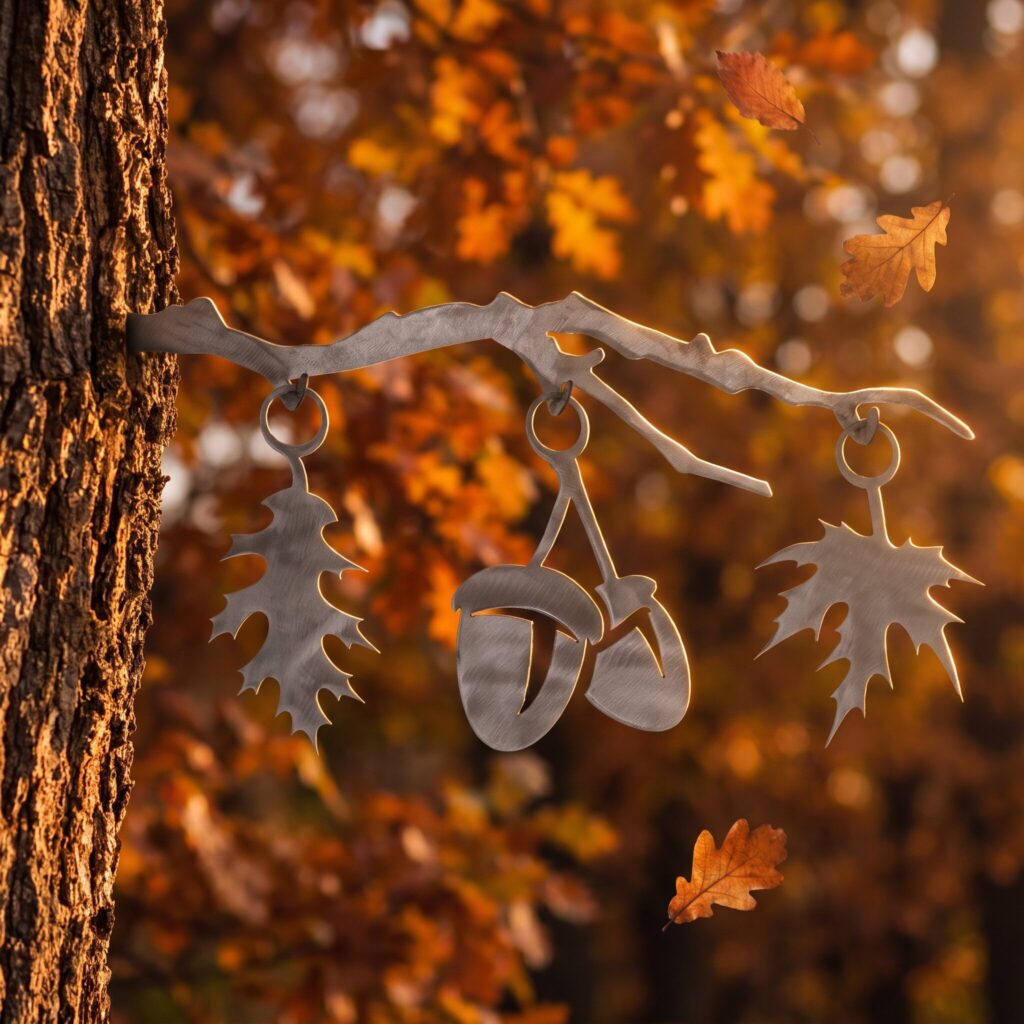
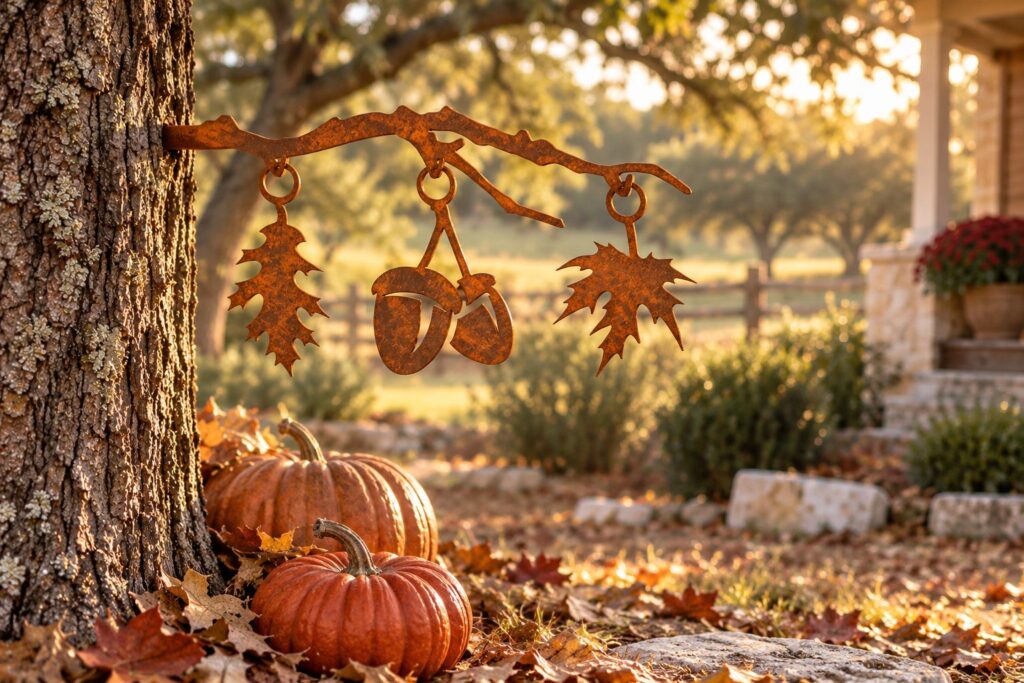
The Autumn Stake is built around the idea behind this whole guide. It has an oak leaf, a maple leaf and acorns, and the pendants lift off the rings, so the branch stays up year round and only what hangs from it changes with the season.
That changes the math for the tree. One hole, set once, and no hammer on the trunk every few weeks. In fall, the leaves and acorns go on. When the season’s over, lift the pendants off, box them, and leave the branch where it is. Swapping takes a minute and needs no ladder or drill.
The same thinking works for the rest of your outdoor tree decorations:
- Keep one branch on the tree. The Autumn Stake’s branch stays up — the pendants come and go.
- Rotate other holiday yard art on wood that isn’t growing. A wooden fence post, a porch post or the side of a shed takes a stake just as well, and a hole there costs a living thing nothing.
- If a holiday piece goes on a tree, give it one spot for good. Mark it, and when it comes back next year, set it in the same hole instead of making a new one.
How to hang tree decorations without hurting the tree
A stake is one small hole. The bigger worry with outdoor tree decorations is everything else: the wire, string, zip ties and twist ties that hold lights and ornaments on.
A branch keeps growing wider. Anything tied tight around it doesn’t. The Morton Arboretum explains that wires left around a trunk or branch too long can cut into the bark as the branch grows, slicing the vessels that carry water and nutrients, and that this injury can kill a branch or a tree. That’s girdling.
It doesn’t happen in one season. Joe Zeleznik of North Dakota State University Extension writes that every wire, strap, zip tie, cable or rope left around a stem or branch will eventually girdle the tree, and that it might take 2 years or 20. It’s slow enough to forget.
A few rules that keep tree decorations from turning into tree damage:
- Don’t tie anything tight. The Morton Arboretum advises skipping plastic cable ties and wire twist ties, which can rub or cut into the bark when the branch sways in the wind, and tying lights loosely.
- Set a date to take it down. The Arboretum takes its own lights down right after the holidays so the trees are free before spring growth begins.
- Check last year’s trees. Walk the yard each spring and look for a forgotten tie, wire or ribbon, especially on trees planted in the last few years.
- Pick a sound, mature tree. Davey’s advice is to leave hardware to healthy, mature trees at least 10 inches in diameter. If the tree is smaller, use a post.
This is where a stake has an edge over a string. One stake goes into the trunk and the decoration hangs from its own steel branch, so nothing circles a limb waiting for the tree to grow into it.
Wind, weather and how far yard art reads
Outdoor tree decorations live outside in all of it: wind, rain, summer sun, the odd ice storm.
- Wind. Tree decorations tied out on a limb swing every time the branch moves. A stake tapped into the trunk holds its place. Set it at a slight downward angle and stop when it’s snug.
- Rain and sprinklers. Our pieces are solid steel, and the Raw Steel finish is meant to weather outdoors. If you don’t want the weathered color, choose Black.
- The string trimmer. Down by the roots, yard art gets hit, hidden by grass and splashed with mud. Chest height keeps it clear.
- Leaves. A bare tree in January can be a wall of green by June. Picture the tree in both seasons.
Then there’s the view. Most of our pieces run 7 to 17 inches, and the exact size of each is on its product page. That reads fine from a kitchen window or across a patio. From the street, set the piece clear of shrubs, on a trunk with sky or a pale wall behind it rather than a dark hedge.
A good test: hold the piece against the trunk, walk to the curb and look back. Then go to the window you use most and look again. Halloween is a front-walk holiday. Valentine’s Day is often a kitchen-window one.
Raw Steel or Black in winter light
Winter light is low. The Farmers’ Almanac notes that on the winter solstice the Sun appears at its lowest in the sky, and its low arc in winter makes objects cast longer shadows. That low, raking light changes how steel yard art looks on a bare trunk.
- Black keeps a clean, consistent look. Against a pale winter sky, frost or snow, it reads as a sharp, dark silhouette, and it holds its shape at dusk with light behind it. It’s a natural fit for Christmas and New Year’s tree decorations on a front-yard tree.
- Raw Steel weathers outdoors to a rust-brown color, with most of the change in the first several months, then holds steady. In winter, that warm brown sits close to the color of bare bark and dry grass, so it reads as part of the tree, and low afternoon sun brings it out.
If the tree is mostly seen from the street at dusk, Black is usually the easy call. If it’s the tree you look at from the breakfast table on a sunny morning, Raw Steel has a warmth worth having. Our guide on whether Corten steel yard art rusts goes deeper into how the Raw Steel finish changes outside.
How to store yard art between seasons
A year-round plan means fewer boxes, but holiday yard art still needs somewhere to go. A few habits make next year easy:
- Dry it first. If a piece comes down wet, let it dry. Wrap it in an old towel or cardboard so a Raw Steel finish doesn’t mark whatever it’s packed against.
- One box per holiday. Write the holiday on the end of the box, not the top, so you can read it on a shelf.
- Store it flat. Lay the branch and pendants flat, with cardboard between pieces, so nothing bends or scratches.
- Keep pendants together. For the Autumn Stake, the branch stays on the tree, so the box holds only the pendants. A small bag keeps them from going missing.
- Note where it went. Tape a slip inside the lid: which tree, which side, how high, and the dates it goes up and comes down.
- Keep it dry. A garage shelf or a closet is fine. A damp shed floor is not.
If you use lights too, store their soft ties with them, and toss any that have gone stiff or cracked.
A simple year of outdoor tree decorations on one tree
Here’s a full year on a single front-yard tree, with a fence post by the porch for the yard art you rotate:
- January: Happy New Year Stake on the post by the walk.
- February: Valentine’s Day Stake, on the post or in its own spot on the kitchen-window tree.
- March: St. Patrick’s Day Stake.
- Late March or April: Easter Stake, timed to that year’s date.
- May and June: a bird or critter that stays put, or a bare trunk for a few weeks.
- July: 4th of July Stake, low on the trunk below the canopy.
- September: the Autumn Stake branch goes up once, leaves and acorns on.
- October: Halloween Stake by the front walk.
- November: Thanksgiving Stake.
- December: Christmas Stake on the big tree out front.
Written out, it looks like a lot. In practice it’s one short trip to the garage a month, and most of the yard art never moves.
Pairing tree decorations with year-round yard art
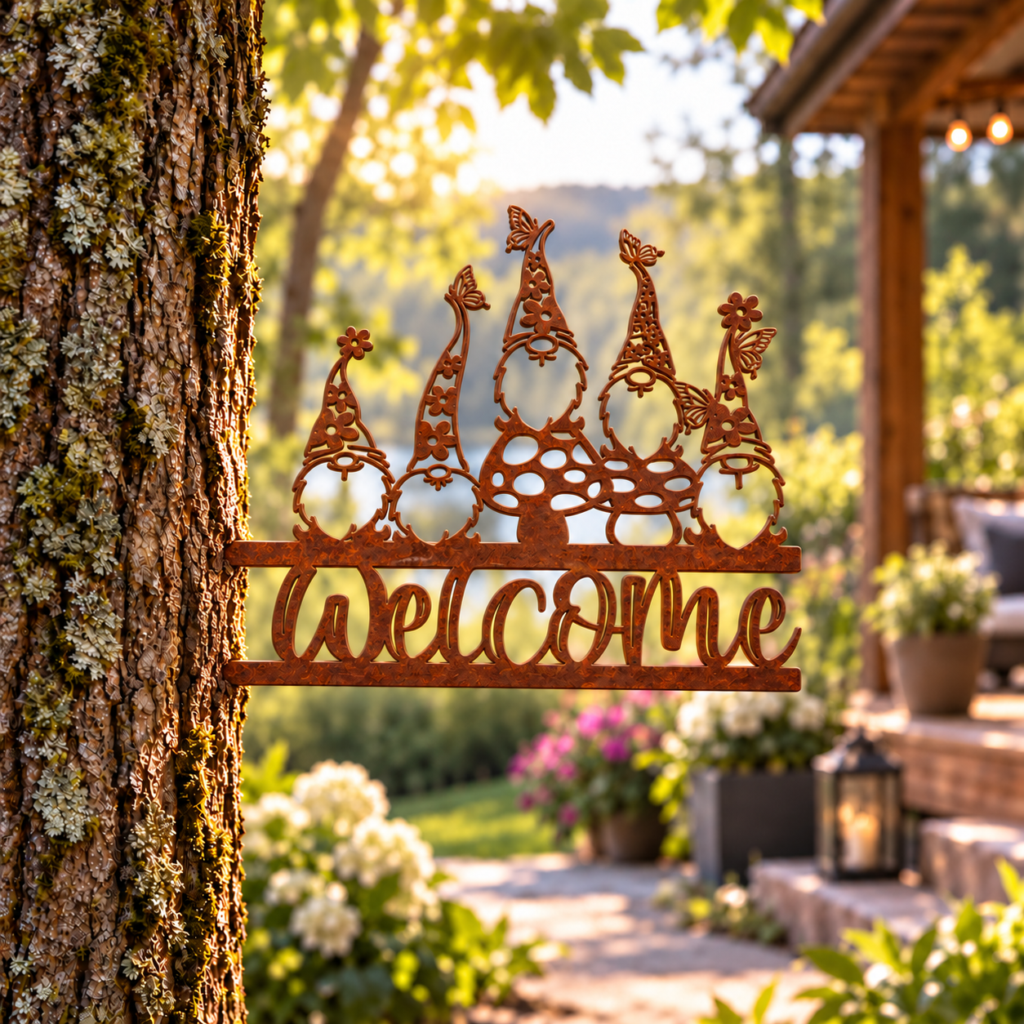
Not everything needs to rotate. One approach that works: keep one piece that stays all year, a cardinal on the kitchen-window tree or a gnome by the garden gate, and let the holiday tree decorations come and go around it.
Gnomes are yard art that’s never really out of season. Our piece on why people put gnomes in the garden goes through where that tradition comes from. A gnome on the gatepost and a Thanksgiving Stake on the tree beside it make a small scene without much effort.
The one rule: don’t crowd a single trunk. One piece per tree reads clearly, and every extra stake is another hole in the same tree.
Finding the right outdoor tree decorations for your yard
The Seasonal & Holiday collection has every holiday in this guide in one place: the Happy New Year, Valentine’s Day, St. Patrick’s Day, Easter, 4th of July, Halloween, Thanksgiving and Christmas Stakes, plus the Autumn Stake for September through Thanksgiving.
You don’t have to buy a whole year of outdoor tree decorations at once:
- Start with the holiday you already decorate for. If something goes up every Christmas or Halloween, begin there.
- Start with the Autumn Stake if you like a branch that stays up and pendants that change.
- Start with the tree you see most, and pick the holiday that suits the view from that window.
Each piece is solid steel, in Raw Steel or Black. It taps into a tree, a wooden fence post, a porch post or a wall with a hammer.
Questions customers ask
How do I install it?
Find your spot, then tap the stake in with a hammer. If the wood is hard, drill a small pilot hole first and it will go in easier.
What are Shadow Birds pieces made of?
Solid steel, in a Raw Steel finish or Black.
Will it arrive in time for a holiday gift?
A lot of these are bought as gifts. Order early during Christmas, Valentine’s Day and other peak weeks to make sure it arrives on time. Orders are processed in 1 to 2 business days and delivered 5 to 7 business days after that, within the US.
What’s your shipping policy?
Shipping is free on orders of $99.99 and up.
Sources
- Brief History of the Christmas Tree in the United States, UF/IFAS Extension Hillsborough County, 15 December 2017
- History of the Christmas tree, Oklahoma State University News, 29 November 2016
- About the Tree, National Christmas Tree Lighting, National Park Foundation
- 50-Year Tradition: Couple Trims Tree With 10,000 Easter Eggs, NBC News
- “Tie a Yellow Ribbon Round the Ole Oak Tree” tops the U.S. pop charts, HISTORY.com Editors, updated 27 May 2025
- Do Nails, Screws or Staples Hurt Trees? Davey Tree Expert Company blog, 7 May 2019
- When Is Easter 2027? Farmers’ Almanac, updated 12 August 2026
- How to Take Care of Trees and Shrubs as You Light Your Landscape, The Morton Arboretum, 8 November 2023
- Springtime spruces 1: girdling Christmas lights, Joe Zeleznik, North Dakota State University Extension
- Winter Solstice 2026: The First Day of Winter, Farmers’ Almanac, updated 27 September 2026